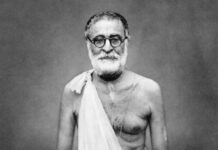



Giridhari dāsa, also known as Girindra, was a descendant of the family line of the famous Makaranda Ghoṣa. He was born in a prosperous high-class kulin kāyastha family in Mahiskhola village on the bank of the river Citra, situated in the Nadail sub-division of Jessore district, present-day Bangladesh. His father was Bārādākānta Ghoṣa, and the younger brother of his father, Rādhārāmana Caraṇa dāsa, had earned great fame for this Ghoṣa family. Giridhari’s mother, Śāśimukhī-devī, gave birth to four sons: Mahendra, Girindra (Giridhari), Nāgendra, and Hemendra.
Girindra was born on the ninth day of the lunar fortnight of Magha-māsa in 1301 B.S. (Jan-Feb 1894 A.D.). At birth, his body was entangled with chains of intestines, and he was sickly from childhood. Nevertheless, he had natural reverence for brāhmaṇas and Vaiṣṇavas. Once his life was in danger from fever and dysentery, but he was cured after eating the remnants of food offered to a brāhmaṇa. He had little interest in scholastic studies, but he loved hearing stories from the Rāmāyaṇa, Mahābhārata, and other histories. He also had a natural talent for dance and music and a deep fondness for tulasī-sevā, through which he obtained great divine treasures. His indifference to worldly affairs was evident throughout his life.
When Girindra was a student in class VI, Vipina Candra Cattopādhyāya was posted as the Munsiff of Nadail. Girindra was greatly attracted by the loud, melodious kīrtana performed by Vipina every morning at daybreak. He gave up his studies and became an ardent follower of Vipina. Despite admonition from his guardians, he attended Vipina’s kīrtana daily. After three years, when Vipina Bābū was transferred to Bankura, Girindra persuaded him to take him along. Leaving all his possessions behind, he carried only a drinking glass and happily enjoyed unrestricted association with his guru.
The great jubilation, roaring, and repeated leaping associated with the performance of nāma-kīrtana at that time intoxicated both participants and the audience with transcendental emotion. Vipina Bābū cared for Girindra as his own son. By example, he taught Girindra vairāgya-dharma and advised him to follow the path of bhajana as prescribed by Haribola Thākura. He trained Girindra in the minute details of devotional service. Under Vipina’s personal care and affection, Girindra quickly matured into a handsome and cheerful devotee, performing his daily tasks with enthusiasm. Some devotees remarked that Vipina Bābū and Girindra had become one and the same. Girindra had free access to all corners of his guru’s house and witnessed many divine manifestations of Vipina Candra. After four years of constant association, Vipina Bābū gave Girindra dīkṣā in the eighteen-lettered mantra.
Wherever Vipina Bābū was posted as Munsiff, Girindra followed him. For the welfare of conditioned souls, he went out every morning chanting “Haribol” with arms uplifted. Under the guru’s instruction, he collected alms, walking more than eight miles daily chanting the holy name, yet never asking any householder. Whatever he received voluntarily, he boiled and ate. Girindra was humorous, demanding, and beloved. His unalloyed devotion to his guru pervaded all his actions.
Due to his restless temperament, Girindra once committed a grave mistake. Vipina Bābū punished him by forcing him to stay away from the house for fifteen days. In self-reproach, Girindra wandered without eating or sleeping until near death. On the fifteenth day, Vipina Bābū brought him back, saving his life. Thereafter, Vipina treated him more sternly, purifying him internally, even striking him with whatever was handy (sticks, shoes, wooden sandals, etc.).
After Vipina Candra’s disappearance in Jan-Feb 1923 A.D., Girindra became viraha-stricken, like a woman separated from her beloved. He wandered aimlessly between Vṛndāvana, Jagannātha Purī, and Navadvīpa, living as an udāsīna. He found no pleasure in food, sports, or conversation. Shelterless and without his guru, he sometimes stayed near the Ganges or in corridors of a ghat, or on the veranda of some householder.
Girindra’s daily routine included walking the streets at 3:00 A.M. chanting “Haribol,” performing his daily kīrtana, bathing in the Ganges, attending the maṅgala-ārati of Lord Caitanya, viewing other deities, completing household deity service, collecting alms, cooking bhoga, offering it to the deity, and taking prasāda.
On one occasion, Girindra went to Jagannātha Purī and stayed at the samādhi of Haridāsa Thākura. There he met Govinda dāsa Bābājī, mahānta of the temple and veka-śiṣya of Raghunātha dāsājī. Attracted by his exalted qualities, Girindra accepted shelter (veśasraya) from him and took the name Giridhari dāsa. Gradually he regained composure, abandoned wandering, and settled in Navadvīpa, constructing a kutir named Śrī Śrī Haribol on land given by Nanilāl Bhakta of Budge Budge with funds raised by devotees.
Giridhari dāsa listened daily to the Caitanya-bhāgavata and used the opportunity to correct devotees, sometimes speaking harshly to admonish lapses.
When his health deteriorated, he followed the advice of well-wishing Vaiṣṇavas and returned to Nilacala on 10 Jaistha B.S. 1351 (May-June 1944 A.D.), living in the samādhi temple of Haridāsa Thākura. He passed away a few months later on 20 Aśvina of the same year (Sept-Oct 1944 A.D.), remembering the holy name of Haridāsa Thākura.
Deepen your Bhakti-yoga practice, harmonize relationships, and receive guided coaching — all at Vedavarsity.com