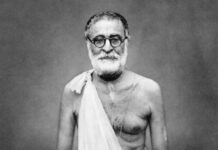
Giridhari dāsa, previously named Annadaprasāda Rāya, was the elder brother of Zamindar Rājārsi Vanamali Rāya Bāhādūr of the Tadasa Estate in the district of Pabna, present-day Bangladesh. His father, Gaṅgaprasāda, brought the entire family to live in Vṛndāvana when Giridhari was still a child. At that time, there were no facilities for the formal education of children of householders in Vṛndāvana; therefore, Giridhari studied under private tutors.
After Giridhari was married, his father passed away, leaving the responsibilities for the service of the deities, care of the family, and administration of the estate upon him. Though Giridhari had religious tendencies from boyhood, he had not received proper training in his own religion. At one point, for unknown reasons, he became antagonistic toward Hinduism and decided to embrace Christianity. His pious mother, however, averted this crisis by placing him under the care of Gaurakiśora Siromani Mahāśaya. Under the guidance of Siromani Mahāśaya, Annadā gradually regained his mental balance and developed into a pure devotee. Siromani Mahāśaya gave him the name Advaita Dāsa.
When Giridhari was thirty-six, his wife passed away after giving birth to a daughter, who also died a few days later. Annadā did not remarry. After the disappearance of Siromani Mahāśaya, Annadā accepted the veka from Kṛṣṇadāsa Bābājī of Govardhana-kunda in Vraja in 1890 A.D. He assumed the name Giridhari Dāsa and began to live exclusively on madhukari, refusing all support from his family. From 1895 A.D. onward, he lived under the shelter of his younger brother, Rājārsi Bāhādūr, who worshiped the deity Rādhāvinode-jīu. The relationship between the two brothers gradually transformed from worldly attachment into divine love.
Giridhari Dāsa was renowned for his wisdom in devotional etiquette. Once, during a discussion among devotees about correcting lapses observed in others, Giridhari remarked: “If a person is aware of his own lapses, he can correct himself. Since we all sometimes commit mistakes over which we have no control, the best remedy is to pray at the feet of Gīrīrāja and Paurnamāsī to shower mercy upon the person concerned.”
Giridhari Dāsa often instructed: “Just as one must take food daily to sustain the mortal body and medicine when required, the essential nourishment for spiritual life is līlā-smaraṇam and bhajana, and the medicine to cleanse the mind of material contamination is tattvajñāna.”
During his stay at Rādhākunda, Giridhari Dāsa became acquainted with a great Vaiṣṇava named Kṛṣṇadāsa. Due to their mutual attachment to devotional discourses, a very deep friendship developed between them. When Kṛṣṇadāsa desired to visit Bengal, Giridhari Dāsa became deeply aggrieved, crying and rolling on the ground. He explained that Kṛṣṇadāsa’s devotional practice in Vraja would suffer if he left, and requested him to postpone his departure for three more days. Realizing the purport of Giridhari’s words, Kṛṣṇadāsa relented, understanding that Rādhārāṇī intended to test his devotion.
During this period, Giridhari Dāsa undertook strict austerities: he abstained from food and water, performed 25,000 nāma-japa, paid 108 sastāṅga-daṇḍavat, and undertook parikramā of Rādhākunda and Syāmākunda four times daily. Kṛṣṇadāsa, meanwhile, meditated on the holy name and virtues of Giridhari Dāsa. On the third night, Kṛṣṇadāsa saw a vision of his guru, who informed him that Giridhari Dāsa had been fasting and praying at the feet of Rādhārāṇī for three consecutive days.
Upon reaching Giridhari Dāsa’s bhajana-kutir, Kṛṣṇadāsa found him lying under the tulasī plant, praying that he not leave Vraja. Overwhelmed with devotion, Kṛṣṇadāsa fell at Giridhari’s feet. Their tearful reunion created an atmosphere of divine jubilation on the banks of Śrīkunda. Kṛṣṇadāsa then abandoned his plan to travel and returned to his daily devotional practice.
On the thirteenth day of the dark fortnight of Pausa-māsa in 1308 B.S. (Dec-Jan 1901 A.D.), devotees learned that Giridhari Dāsa had not left his bhajana-kutir for his routine madhukari. Upon opening the door, they found him lying where he normally slept, with his right hand under his head. A cheerful smile adorned his face, his eyes were half-closed, and drops of froth appeared on his lips. The devotees performing nāma-kīrtana could not comprehend that he had departed from this world. With permission from Rājārsi Bāhādūr, his funeral rites were duly performed.
From the expression of serene contentment on his face, it was evident that Giridhari Dāsa had experienced a vision of the Lord’s līlā so transcendental that his heart could no longer contain the ecstasy of divine love.
Deepen your Bhakti-yoga practice, harmonize relationships, and receive guided coaching — all at Vedavarsity.com