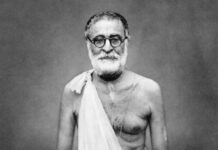
Atula Candra completed his B.A. degree with honors in English, Sanskrit, and Mathematics and was a favorite student of the renowned mathematician, Gaurisankara babu. He lived at No. 1. Madan Mitra Lane in north Calcutta.
Atula married Kshiroda, the only daughter of Digamvari Devi. Digamvari was the sister of Jagadvandhu, thus on the occasion of his marriage Atula met Jagadvandhu for the first time and was very impressed with his beauty, simplicity and sweet disposition. Later, after returning from Brahmanakanda, Jagadvandhu unexpectedly arrived at Atula’s Madan Mitra Lane residence. They did not, however, develop any deeper intimacy on that occasion.
Later, Atula Candra’s daughter, Saraju, passed away when Atula was working as the Headmaster of Arah High School. At that time Jagadvandhu suddenly arrived at Arah to offer solace to him. According to convention, Atula Candra offered Vandhu a pair of loin cloths prepared from matka silk which he gladly accepted. Before his departure for Bengal, Vandhu called Atula Candra aside and told him privately: “The only substantial thing within this unreal universe is Krsna bhajan. Do not get entangled in this maya. You are destined to assist me in my mission.”
After this conversation a distinct change came about in Atula Candra’s nature; he felt agitated inwardly and wanted to ascertain the actual spiritual position of his maternal uncle-in-law, Jagadvandhu.
On one occasion Atula Candra and his assistant teacher had a quarrel, which lasted for a few days, regarding the administration of the school. At that time Atula received a letter from Vandhu, who was staying at Dahapada. The letter advised Atula to give up quarrelling and try to become absorbed in love instead. Atula was stunned to think that Jagadvandhu had the power to understand what was taking place in Arah and could send a letter to reach him just at the appropriate moment.
Atula Candra contemplated the incident for days and became increasingly detached from his daily life. Suddenly an idea came to his mind which would prove beyond any doubt whether Sri Jagadvandhu was actually an incarnation of God; On a dark night Atula Candra went inside a nearby railway tunnel and positioned himself on the rail, thinking that if the incoming Bombay Mail were to stop about five feet away from where he way lying, he would then be convinced that this was an act of God (Jagadvandhu). Thereafter the Bombay mail train came to a halt a few feet away from his body, apparently due to some serious mechanical trouble. Atula Candra jumped up in joy shouting “Jaya Prabhu Jagadvandhu” and ran off in search of Vandhu. That was the end of his career as a teacher. (This miraculous story was narrated by Atula Candra Campati Mahasaya personally to the humble author of this book Sri Haridasa Dasa.)
It is said that Vandhu had once earlier gone to Arah on his way to the west and had given Atula Candra an indirect hint that both of them would meet again in Calcutta. Prabhu gave a leaf packet containing prasada, rice cooked in ghee, to Atula Candra, who after touching the packet to his forehead, happily consumed not only the rice but also the leaf packet. As a result, a wonderful sense of detachment surfaced within Atula Candra and he began to chant “Haribalo” incessantly.
Atula Candra’s manners and behavior after his arrival in Calcutta appeared to be somewhat unbalanced. He discarded his original dress, putting on a saffron colored robe, and began to walk about the streets of Calcutta in search of his beloved Jagadvandhu, all the while chanting Harinama, unmindful of food or rest. Though he became emaciated, he looked cheerful and anxiously awaited the darshan of Jagadvandhu. One day, while strolling near Strand Road he heard a familiar voice coming from a horse-drawn carriage with its shutters down, saying; “Hare Krsna, Come to me”. In ecstacy, Atula Candra jumped on the roof of the carriage, chanting the holy name very loudly and continued until the carriage came to a halt at No. 67, Casadhopa Pada Lane (a locality of farmers and washermen).
Atula Candra was considered a very close devotee of Prabhu Jagadvandhu, so much so that Atula would become mesmerized at the very sight of Jagadvandhu. One day Vandhu gave two rupees to Atula and made him buy one set of loin cloths and a pair of cymbals. Then Vandhu called Atula close to him and instructed him clearly as follows; 1. To go to Jagannatha Ghata very early the following morning, take a dip in the river Ganges, put on the set of loin cloths and discard the saffron robe; 2. To wander continuously throughout the streets playing his cymbals and chanting “Krsna Govinda Gopala Shyama”; 3. To go to Kalighata, take a dip in the river and then return to Jagannatha Ghata for another dip; 4. To continue this program throughout the day and night for as long as possible; 5. Govinda would provide him food at His will; 6. After the task would be satisfactorily completed then Atula would be able to receive darsana of a Mahapurusha.
From the next day, Atula dedicated himself fully to implicitly following Vandhu’s instructions. By the grace of Jagadvandhu he acquired adequate strength and was able to undergo the difficult rituals prescribed by Jagadvandhu for a long period of time. Despite many obstacles he continued, oblivious of his near and dear ones, his pride of birth, education, and status. After completing his vow Atula was filled with ecstacy. Drawn by the love of Jagadvandhu, Atula went to the cottages of the “Domas” (untouchable caste) in the Rambagan area where a maha mahotsava had been organized by the devotees to celebrate the appearance of Sri Jagadvandhu Prabhu. Atula was overjoyed to see the festivities and embraced everyone present. With his own hands, Vandhu offered Atula mahaprasada and later on took Atula with him to Pabna. A mahapurusha called Harana Kshepa (Kshepa means insane) used to live at the outskirts of this town. Harana’s behavior and manners appeared very unusual. Jagadvandhu Prabhu went away after leaving Atula in the charge of Harana Kshepa.
During Atula’s stay there he was ordered one day by Harana to eat the left over food of one Vanku Mondala. Without hesitation Atula consumed the left over food as ordered. Afterwards Harana affectionately embraced Atula and kissed him on the cheek.
Soon thereafter Harana explained to Atula the real identity of Jagadvandhu Prabhu, which left no further doubt in Atula’s mind. Before sending Atula back to Calcutta, Harana blessed Atula and endowed him with mahasakti (great power). (This has been taken from a book entitled Sri Vandhu Lilatarangini)
On his arrival in Calcutta Campati (Atula) devoted himself to the service of Vandhu. It is said that Campati once picked up phlegm, which had been spit by Jagadvandhu into an open drain, and swallowed it as if it were nectar. Seeing this Vandhu at first questioned Campati’s action but afterwards, in appreciation of his total devotion, gave him a `Magna Carta’ saying that from then onward Campati would be at liberty to act as he wished and Vandhu would hold himself responsible for the consequences of his actions.
Thereafter Atula Candra, dressed in the garb of a social outcast and fearlessly went from door to door chanting the holy name at the top of his voice in the neighborhood of wine shops and prostitutes quarters. Keeping in the spirit of his own name, Atula Candra, took it upon himself to reclaim the clan of social outcasts.
Later on Atula Candra supervised the seva at Sriangana, established by Vandhuprabhu at Goalcamata in Faridapura. For two and a half years (from 1910 to 1912 AD.) Kshiroda Devi, Atula’s wife, prepared the bhoga with due reverence; she abstained from speech and kept her nose covered by a piece of cloth while cooking. She used to travel between her nearby maternal uncle’s house and Sriangana daily.
After the demise of Vandhuprabhu on the first day Asvina 1328 B.S. (1921 AD.), Campati Mahasaya stayed mostly at his Madan Mitra Lane house in Calcutta. He followed the teaching of Vandhu and wandered about the streets of Calcutta daily chanting the holy name. He walked about absorbed in trance, oblivious of his garments, food, and rest. His melodious kirtana was appreciated by everyone throughout the city.
Sri Bipin Bihari Cattopadhyaya, a Munsiff by profession and a resident of Makadadaha, happened to be a classmate and childhood friend of Campati Mahasaya. We (the author and his associates) had the good fortune of enjoying the company of Campati Mahasaya in his most intimate mood at Makadadaha by courtesy of Bipin babu. When the two friends met they would invariably become involved in a fake quarrel, but would later sing and dance together. Once Bipin babu took Campati Mahasaya to Kasi with him. One day they got into one of their usual arguments but it turned so serious that Bipin babu suddenly called a barber and instructed him to shave half of Campati’s head, moustache, and beard. Campati Mahasaya did not protest and the barber completed his job. Afterwards Campati calmly went into the street as if nothing had happened and wandered about singing Harinama, unmindful of the peoples’ adverse reactions to his appearance. When Campati Mahasaya returned in the evening Bipin babu called his junior, Giridhari Dasa, and pointing to Campati said, “This is called nirabhimana (modesty). Without this state of mind one cannot expect to reach God.” Then he embraced Campati and they happily chanted the holy name together. Bipin babu eventually died on the lap of his friend Campati Mahasaya.
Campati Mahasaya had respect for all religions. One day I (Haridasa Dasa) reached his place when he was taking prasada. Seeing my pale face he said, “I know today is Ekadasi and you have not taken any food.” At that moment a gentleman passed by and Campati begged him for some money. The person did not have any cash but went out and brought some ravdi (sweetened condensed milk) from a shop outside. Campati affectionately gestured to me to take the milk and I was fully satisfied. Later on he took me out with him but cautioned me to keep silent and listen only to what he said. First he went to a gentleman at Kumartuli and asked for eight annas to buy food for me, a brahmana boy who had nothing to eat that day. After some persuasion the man paid two annas. Thereafter we walked inside the prostitutes quarters of the Sonagaci area. Campati Mahasaya fell prostrate on the door steps and began reciting “Haribola, jaya Prabhu Jagadvandu sundara, jaya sundara baiji (baiji means a professional dancing girl). On hearing Campati’s Harinama the inmates of the quarters began to abuse him with filthy language. This, however, had no effect whatsoever upon Campati. Constantly chanting the holy name, Campti Mahasaya proceeded towards Beadon Park. Without realizing how to attain bhakti I (the author) followed along behind him thinking within myself that I was going around with an insane person. As if reading my thoughts, Campati Mahasaya suddenly stopped and turning towards me and said, “You fool, bhakti is attained through bhiksha.”
He then walked up to Rambagan and after placing a piece of his loin cloth around his neck approached each hut dweller. Addressing them as mothers of Vraja he begged for their bhiksha. These low caste Doma community people were extremely poor yet each one of them gave half a paisa to Campati with great pleasure, which amounted to five annas in all. I thought that his method of collecting alms was a bit queer and questioned him about it. In his typical taunting way he told me that according to Jagadvandhu, Harinama is the only satyam (truth) in this universe, everything else is mithya (falsehood).
Campati Mahasaya’s deep devotion to Jagadvandhu was unparalleled; He saw Prabhu in everything. When we used to meet he always snatched away my money or clothing. Once, while escorting him from the Medical College to his Madan Mitra Lane residence, I asked him to bless me for a good future life. He replied saying that he would do it if I gave him sixteen annas (a full rupee). I told him that I had no possession except my abhiman (pride). He said, in his typical taunting way, “When a man is born out of urination and dies when his breathing stops what then is the value of abhiman?”
Before his demise in 1925 AD. I made several unsuccessful attempts to meet him again. However, Campati Mahasaya appeared in my dream and warned me to be careful of Narijati (women).
Deepen your Bhakti-yoga practice, harmonize relationships, and receive guided coaching — all at Vedavarsity.com