Overview
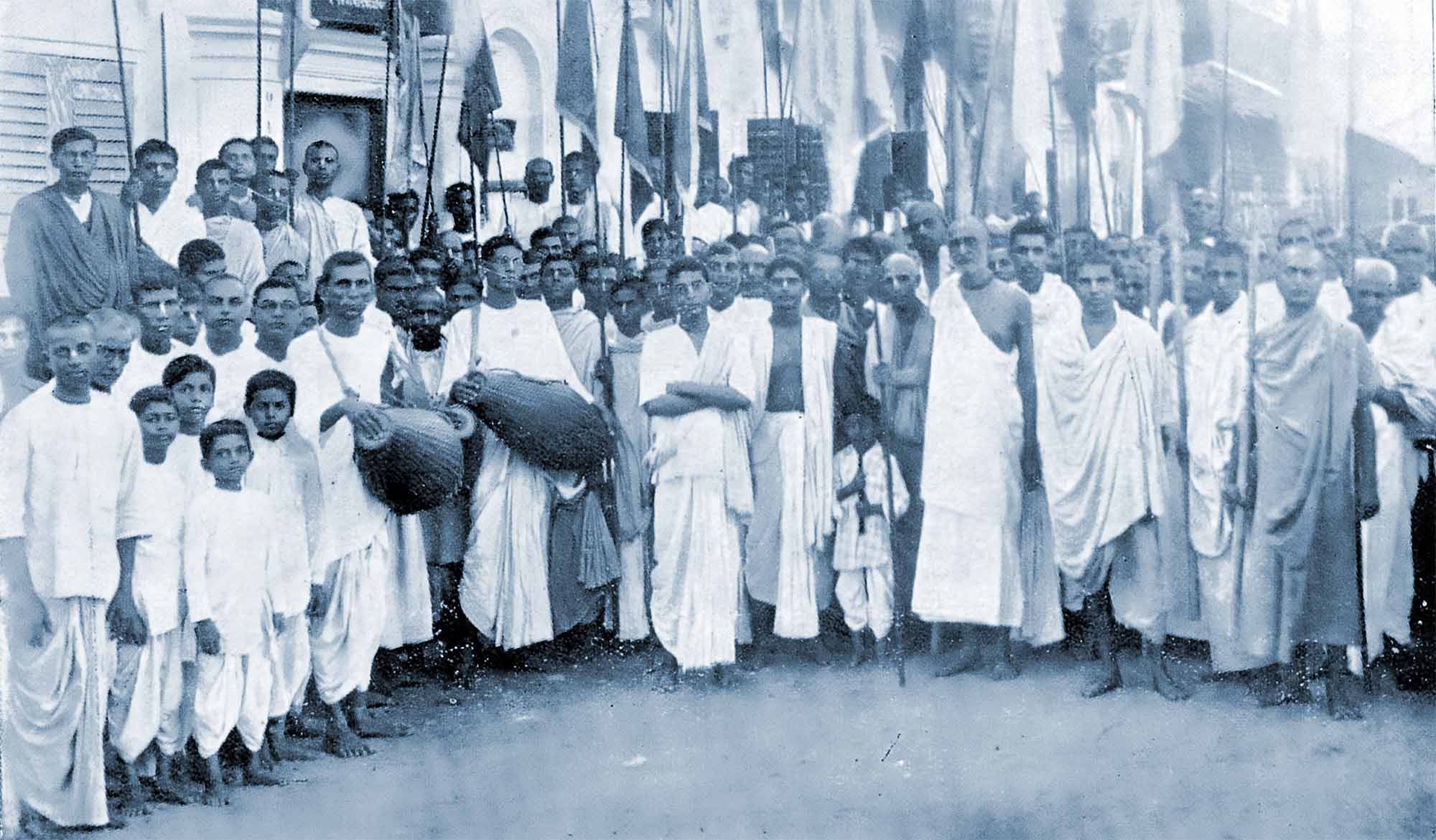
The following talk, ‘Śrī Nāma Saṅkīrtana’, by Prabhupāda Śrīla Bhaktisiddhānta Sarasvatī Ṭhākura was given on the day of Śrī Nityānanda Trayodaśī, at Śrī Yogapīṭha in Māyāpura, in the year 1926. This lecture was originally printed in The Gauḍīya (Vol.5, Issues 34 & 35). Herein, Śrīla Sarasvatī Ṭhākura explains the five primary limbs of devotion in relation to hari-nāma, and gives pertinent advice on the qualification to chant the Holy Name.
We receive the quintessential teachings of Śrīman Mahāprabhu within the Śrī Śikṣāṣṭaka. Mahāprabhu did not teach about Deity worship, but in the Śikṣāṣṭaka, He gave teachings concerning śrī-nāma-saṅkīrtana. Firstly, He says, “It is necessary to perform kīrtana of the Name of Śrī Kṛṣṇa properly.” He also said, “The Name and the Named (nāma and nāmī) are identical.” When the glorification of an object is performed properly, that object is revealed through analysis. The Name of Bhagavān, His form, qualities, pastimes, and associates – Śrī Nāma is comprised of these five things. All these (Name, form, qualities, pastimes, and associates) reside within Bhagavān’s form as Śrī Nāma. Although there may be distinctions and diversity amongst these (such as between the Name and the form, the Name and the qualities, the Name and the pastimes etc.) from the standpoint of the perceiver, the object itself is not separate. (in other words, the form, qualities, pastimes and associates are non-different from the Name – they are not separate objects).
If someone thinks, “I will take darśana of the form of Bhagavān,” then they should know that these eyes cannot take darśana of Bhagavān’s form. The forms perceived by material eyes are objects for sense enjoyment. Bhagavān Kṛṣṇacandra is the Enjoyer (bhokta) – He is not an object of enjoyment. Sense gratification occurs through objects of enjoyment. As it is stated in the Bhāgavata – “Those things in relation to Bhagavān cannot be perceived through these eyes. Those things that are seen with these eyes are not the form of Bhagavān.”
Śrī Kṛṣṇa and śrī-kṛṣṇa-nāma are not two separate entities. Although perceived and accepted in different ways, the form, qualities, pastimes, and associates are all within Śrī Nāma. A distinction is observed between the name and the named within the material world, however this is not the case in relation to śrī-kṛṣṇa-nāma, which is aprākṛta. Thus, Śrī Gaurasundara has said, “Let śrī-kṛṣṇa-saṅkīrtana be our sole abhidheya, or objective!”
‘Śrī Kṛṣṇa’ plus ‘saṅkīrtana’ equals ‘śrī-kṛṣṇa-saṅkīrtana.’ ‘Śrī Kṛṣṇa’ means ‘śrī’ and ‘kṛṣṇa.’ ‘Śrī’ means Lakṣmī. In other words, all Lakṣmīs are expansions of Śrīmatī Gāndharvā (Rādhārāṇī). Thus, when we say ‘śrī-kṛṣṇa’ it means Gāndharvā along with Giridhara Vrajendra-nandana. When everyone comes together for kīrtana, that is called saṅkīrtana, or samyak-kīrtana. Saṅkīrtana means the chanting of the complete glories of Śrī Kṛṣṇa – the Name, form, qualities, pastimes and associates. Such kīrtana is nāma-saṅkīrtana. Such saṅkīrtana should be especially victorious above all!
We know of the nine aspects of bhakti in the stage of sādhana-bhakti – (1) Hearing, (2) Chanting, (3) Remembering, (4) Serving the Lord’s feet, (5) Worship, (6) Offering prayers, (7) Servitorship, (8) Friendship, and (9) Offering one’s very self. The sixty-four limbs of bhakti described in Śrī Bhakti-rasāmṛta-sindhu are all expansions of these devotional activities. Among these sixty-four divisions of bhakti, five are mentioned as the most essential forms of sādhana:
sādhu-saṅga nāma-kīrtana bhāgavata-śravaṇa
mathurā-vāsa śrī-mūrtira śraddhāya sevāna
sakala-sādhana-śreṣṭha ei paṣca aṅga
kṛṣṇa-prema janmāya ei pāṣcera alpa-saṅga
Associating with sādhus, chanting the Holy Name, hearing the Bhāgavata, residing in Mathurā, and serving the Deity with faith – these five limbs are the best kinds of sādhana. Even by a little connection with these five, kṛṣṇa-prema can appear. (Caitanya-caritāmṛta, Madhya 22.128-129)
When analysing these five superior kinds of sādhana, it is obvious that śrī-nāma-bhajana is at the foundation of them and it is victorious above all. The term, sādhu-saṅga is mentioned with the sole purpose that a taste for śrī-nāma-bhajana will arise in one through the association of those who are devoted to Śrī Nāma, or who engage in śrī-nāma-kīrtana. In the Śrīmad Bhāgavata, only śrī-nāma-bhajana has been glorified as the para-dharma (the supreme religious principle):
etāvān eva loke’smin puṁsāṁ dharmaḥ paraḥ smṛtaḥ
bhakti-yogo bhagavati tan-nāma-grahaṇādibhiḥ
Bhakti-yoga to Bhagavān, beginning with the chanting of His Name, is recognised as the supreme dharma for the people in this world. (Śrīmad Bhāgavatam 6.3.22)
kaler doṣa-nidhe rājann asti hy eko mahān guṇaḥ
kīrtanād eva kṛṣṇasya mukta-saṅgaḥ paraṁ vrajet
kṛte yad dhyāyato viṣṇuṁ tretāyāṁ yajato makhaiḥ
dvāpare paricaryāyāṁ kalau tad dhari-kīrtanāt
O king, despite the age of Kali being an ocean of faults, it has one great quality. By performing kīrtana, one immediately becomes free from all bondage and attains the highest attainment. That which was achieved in the Kṛta-yuga by meditation on Viṣṇu, in Treta-yuga by the performance of fire sacrifices, and in Dvapara-yuga by serving the Deity can be achieved in the Kali-yuga by hari-kīrtana. (Śrīmad Bhāgavatam 12.3.51-52)
The beginning, middle, and the end of the Śrīmad Bhāgavata constantly teaches śrī-nāma-saṅkīrtana. The inherent meaning of mathurā-vāsa, i.e. residing in śrī-dhāma, is for the purpose of engaging in nāma-bhajana. Residing where one is immersed in the Name, or in a place where sādhus engage in saṅkīrtana together – that is actual śrī-dhāma-vāsa.
Śrī-mūrti-sevā (worshipping the Deity) is performed through the mantra consisting of the Name of Bhagavān, and primarily by bhagavān-nāma-kīrtana – thus, śrī-nāma-kīrtana is victorious above all. Only through śrī-nāma-saṅkīrtana is all perfection achieved:
bhajanera madhye śreṣṭha nava-vidhā bhakti
kṛṣṇa-prema kṛṣṇa dite dhare mahā-śakti
tāra madhye sarva-śreṣṭha nāma-saṅkīrtana
niraparādhe nāma laile pāya prema-dhana
Within bhajana the nine processes of bhakti are superior. They possess the potency to give Kṛṣṇa and kṛṣṇa–prema. Amongst them, nāma-saṅkīrtana is the best of all. If the Holy Name is chanted without offence, one will achieve the treasure of prema. (Caitanya-caritāmṛta, Antya-līlā 4.71)
Among thousands of devotional practices mentioned in the sātvata-smṛti, or among the sixty-four kinds of bhakti, śrī-nāma-saṅkīrtana is the supreme. All auspiciousness is achieved through the yajṣa of nāma-saṅkīrtana. All the nine processes of bhakti are present within nāma-saṅkīrtana. Śravaṇa, kīrtana, smaraṇa, vandana etc. are all included in śrī-nāma-saṅkīrtana. In consideration of abhidheya, the heartfelt intention of Jagadguru Śrī Gaurasundara, who enacts the pastimes of preaching the siddhānta of acintya-bhedābheda, is that śrī-kṛṣṇa-saṅkīrtana alone is the ultimate abhidheya. One who practices the limb of bhakti known as kīrtana attains all auspiciousness. All kinds of sādhana are included within śrī-kṛṣṇa-saṅkīrtana. One who is firmly convinced of this knows that śrī-kṛṣṇa-saṅkīrtana is the crest-jewel of all sādhanas. Śrī-kṛṣṇa-saṅkīrtana encompasses various processes of sādhana within it.
yadyapi anya-bhaktiḥ kalau kartavyā, tadā kīrtanākhya-bhakti-saṁyogenaiva
Although other processes of bhakti should be performed in the age of Kali, they must be accompanied by kīrtana. (Bhakti Sandarbha 273)
eka aṅga sādhe keha sādhe bahu aṅga
niṣṭhā haile upajaya premera taraṅga
eka aṅge siddhi pāila bahu bhakta-gaṇa
If someone performs either one limb of bhakti or many limbs, if they are determined, then the waves of prema will arise. Many devotees have attained perfection by following only one limb. (Caitanya-caritāmṛta, Madhya-līlā 22.134-135)
Among the many limbs of sādhana, śrī-kṛṣṇa-saṅkīrtana is the best. Even in those śāstras where one limb of sādhana is mentioned, the object of focus is śrī-kṛṣṇa-saṅkīrtana. Without śrī-kṛṣṇa-saṅkīrtana, no other limb such as mathurā-vāsa, sādhu-saṅga etc., can be complete. However, if one simply performs śrī-kṛṣṇa-saṅkīrtana, then through that, one achieves all the results of mathurā-vāsa, sādhu-saṅga, śrī-mūrti-śraddhāya sevāna, and bhagavata-śravaṇa. The jīva attains all perfection through nāma-bhajana. Through the one limb of nāma-saṅkīrtana, all perfection is achieved. Paṣca alpa-saṅga (a little connection with one of these five) – even one of these must include the mention of śrī-nāma-saṅkīrtana. In the holy dhāma where Śrī Kṛṣṇa resides, there is no other activity besides śrī-nāma-saṅkīrtana.
Through hearing and chanting the Śrīmad Bhāgavata, a jīva is delivered from anarthas and becomes qualified to attain the highest necessity. Even amongst the liberated souls, there is no other activity besides śrī-nāma-saṅkīrtana. Through hearing, chanting, and deliberating upon the Śrīmad Bhāgavata, a jīva is liberated. By reciting the Śrīmad Bhāgavata, a jīva learns how to engage in hari-saṅkīrtana. By performing arcana (which includes a system with mantras based upon the Holy Name, and within the mantra, the Holy Name in the fourth nominative case is employed)*, the jīva receives instruction in performing saṅkīrtana. One who recites the mantra offers himself at the lotus feet of Śrī Nāma. The day that one achieves mantra-siddhi (perfection in chanting the mantra), is the day that hari-nāma constantly dances within the mouth.
- Translator’s Note: This refers to the Sanskrit grammatical rule concerning case endings – in this case, the caturthī-vibhakti, or fourth case ending, indicating the recipient of an action. For example, with the fourth case ending, the name kṛṣṇa becomes kṛṣṇāya (‘unto Kṛṣṇa’), indicating surrender. Thus, a typical mantra used in Deity worship would be, śrī-kṛṣṇāya namaḥ – ‘I offer obeisance unto Kṛṣṇa.’
yena janma-śataiḥ pūrvaṁ vāsudevaḥ samārcitaḥ
tan-mukhe hari-nāmāni sadā tiṣṭhanti bhārata
O descendant of Bharata, the Name of Hari will eternally remain on the lips of those who have worshipped Vāsudeva in their previous hundred births. (Padma Purāṇa, cited in Hari-bhakti-vilāsa 11.454)
If we neglect to serve the Vaiṣṇavas, the residents of the maṭha of pure bhakti that are engaged in śrī-kṛṣṇa-saṅkīrtana, and instead become mere practitioners of the path of arcana, then our own welfare will be out of reach. It is the duty of the residents of the maṭha to read the Śrīmad Bhāgavata. A maṭha is not established in the māyika universe – it only descends. In the māyika universe, there is only talk of gratifying one’s senses. Everyone is busy in the maṭha trying to satisfy Kṛṣṇa’s senses. Guided by external consciousness, some persons observe among the residents of the maṭha similar behaviour to their own indulgence in sensual activities and efforts for self-gratification. This is merely the illusion of the perceiver, being inebriated by sensual knowledge.
Everything necessary for serving Hari is available in the maṭha in all respects. By serving the residents of the maṭha, one becomes qualified to chant Śrī Nāma. The residents of the maṭha always serve Hari in every way and with all their senses. They have no other duty except serving the hari-janas (devotees of Hari). The residents of the maṭha perform kīrtana of all these things for the benefit of those who do not understand what is a hari-jana. If those who are gṛhasthas can become free from the gṛha-concept through their hari-bhajana and identify as a resident of Goloka, perceiving the members of their household, not as objects of personal enjoyment, but as instruments for Kṛṣṇa’s service, then they too will achieve auspiciousness. If we keep all of our senses engaged in the external world, we can never become devoted to the Holy Name. It is for the purpose of making us devoted to the Holy Name that the united form of Śrī Rādhā-Govinda directly descended to this place.
Materialistic persons attempt to enjoy Śrī Gaurasundara as one of the unlimited objects of sense-pleasure. They understand teachings of divine knowledge to be perhaps part of the ‘import and export’ of the innumerable objects of sense-gratification meant for their own enjoyment. If we can engage in an exchange with Bhagavān and His devotees, then only we will be delivered from the transactional activities, or karma-vāda (the doctrine of result-oriented actions) of this mercantile society. We are busy in observing the forms, qualities, and diversity of the external world. We are engaged in external definitions. Only if a connection to Kṛṣṇa is perceived in observing external forms is it auspicious – otherwise, it is simply ‘māyā.’
Happiness or distress arises from Kṛṣṇa’s service. If we become attached to the appearance of such happiness or distress, then we become idol-worshippers, or atheists. We only have great respect towards those who can provide what we want. The jīvas of this world are busy with ‘import and export.’
There is no need to eat, there is no need to drink, if we do not perform kṛṣṇa-bhajana. It would be better for us not to achieve the eligibility of attaining a human birth if there is no hari-bhajana. If human life is spent simply in eating, drinking, and indulging like animals, then the qualification we attained will be lost, and one will be subjected to extreme difficulties across countless lifetimes. “I have come to this world to worship Kṛṣṇa!” Animals become humans in order to perform hari-bhajana.
The highest form of sādhana to Kṛṣṇa is saṅkīrtana. All other sādhanas can only be called ‘sādhana’ if they are favourable or conducive to kṛṣṇa–kīrtana. Otherwise, they should be understood to be ku-yogi-vaibhava (the opulence of a charlatan religionist), or a mere obstacle to the practice of sādhana.
The body of one who is a karma-phala-vādī (one who accepts the notion that he must receive results for his pious activities) has been imported from the parents. At present, that imported body will be exported on the day that it is buried in the ground, or set on fire. The karma-phala-vādī accumulates various intellectual achievements during the period of import (life), but it is all gone during export (death). The ‘import and export’ of saṁsāra, or the doctrine of karma-phala, only lasts for a couple of days. That which is said to be the attainment of celestial delights, and worldly achievement, adoration and prestige – these are all imports that we cannot hold onto forever. The society that follows the philosophy of karma-phala is importing into a leaking vessel! They are having children, yet they cannot protect them from the ‘export process.’ The medical community is unable to save them, and ultimately, the Lord takes back those things that belong to Him.
The intelligence and deliberation of those who do not engage in hari-bhajana does not arises in any way. There is no other duty for the jīva except hari-bhajana. Whether a child, an elderly person, a youth, a woman, a man, a scholar, a fool, a rich person, a poor person, a handsome person, an ugly person, a pious person, or a sinner – in whatever condition one may be in, there is no other method of sādhana. The only sādhana is śrī-kṛṣṇa-saṅkīrtana.
Bahubhir militvā yat kīrtanaṁ tad eva saṅkīrtanam – that kīrtana in which many people join together is called saṅkīrtana. If a few low-class people, such as myself, come together and scream loudly, “Hey! Hey!”, increasing their bile, would that be called saṅkīrtana? If I perform kīrtana along with those who have taken shelter of the śrota-panthā (the path of submissive hearing), only then will it be considered to be hari-saṅkīrtana. That kīrtana which is performed for relief from cholera, or for intelligence in business, or kīrtana performed for the sake of attaining mundane achievements, adoration and prestige, is not hari-saṅkīrtana – it is Māyā’s kīrtana.
The servant of Hari says, “Serve Hari! Do nothing else! Do not engage in sense-gratification in the name of serving Hari. Remember, satisfying the senses of Kṛṣṇa is called ‘sevā.’ Satiating your own senses which are bahirmukha, averse to the Lord – that is not sevā! If you consider that to be sevā, you will be deceiving yourself.
If we actually associate with a servant of Hari, or a performer of true kīrtana, then we too will engage in saṅkīrtana. It is necessary for us to engage in kīrtana properly. Kṛṣṇa is a complete entity – He is not an inferior, fragmented, non-existent, or partial entity. If someone says, “This has been made by so-and-so, the blacksmith. It looks very good to my eyes. I will call it my Kṛṣṇa Ṭhākura” – that is not Kṛṣṇa! By placing a blindfold over my eyes, Māyā does not allow me to see Kṛṣṇa. She shows me something imaginary for my enjoyment – an ‘idol’—and says, “This is Kṛṣṇa Ṭhākura!” Under the deception of Māyā, one is never able to have the true darśana of Kṛṣṇa. As long as I do not engage in kīrtana with a devotee of Kṛṣṇa who genuinely performs kīrtana, Māyā will continue to mislead me in various ways. If one engages in kīrtana with those whose hearts do not desire their own true welfare, who wish to deceive themselves, then no benefit will arise. It will become the kīrtana of Māyā. Those who sit down wearing a garland and tilaka, who increase their bile by shouting, “Oh! Oh!,” who never listen to their guru and do not know how to perform kīrtana – if you follow such persons, that will not be saṅkīrtana.
There is also another kind of person who is a hinderance to saṅkīrtana. They say:
vedānta-vākyeṣu sadā ramantaḥ…kaupīnavantaḥ khalu bhāgyavantaḥ
Those who recite the Vedānta are always in bliss. Blessed indeed is he who wears the kaupīna. (Śaṅkarācārya, Kaupīna Paṣcaka, Text 1)
Some, by following Pataṣjali Ṛṣi, become bound to the practice of exhalation, inhalation, and similar techniques of expanding or contracting the life airs. Even with this concept, they become entangled in the external world. I think, “I will renounce!” However, the life of a sādhu is not my destiny. I desire to be separate from the world, thinking that through practices like the path of yoga and the study of Vedānta, I will achieve auspiciousness. Yet these kind of fanciful plans to become a renunciate, or hidden desires for enjoyment cannot bring us the highest good, and therefore, such statements cannot be defined by the word ‘abhidheya.’ Therefore, those great personalities who are without deceit, who have spoken the impartial truth to people, state:
karma-kāṇḍa, jṣāna-kāṇḍa, kevala viṣera bhāṇḍa
amṛta baliyā yebā khāya
nānā yoni sadā phire, kadarya bhakṣaṇa kare
tāra janma adhaḥpāte yāya
The path of karma and the path of jṣāna are simply pots full of poison. Yet those who drink them say it is nectar. Eating filth, they constantly roam through various wombs, and their birth is ruined. (Prema Bhakti Candrikā 8.8)
Being a karmī or a jṣānī is not an essential thing for a jīva. Karma and jṣāna is not the dharma of a jīvātmā. Service to Śrī Kṛṣṇa is the eternal dharma of the jīva. The jīvas will only be benefited by engaging in śrī-kṛṣṇa-kīrtana. True auspiciousness for the jīva will not be achieved within the ‘shadow’ of auspiciousness. According to the farmer’s technique, in order to ensure the well-being of the rice, the weeds must be uprooted. While removing the weeds, one should be careful not to uproot the rice plants. There is no service to Bhagavān in karma and jṣāna. The karmī and the jṣānī are selfish. The ku-karmī (performer of wicked deeds) is most sinful. The reward of the pious acts of a su-karmī (performer of good deeds) is also a type of punishment – it is simply the punishment of foolishness. Becoming extremely beautiful, accumulating great wealth, and becoming highly learned are different types of punishment. We can easily understand the punishment for sin, but the punishment for piety, when it occurs in the future, is not realised at all. Ṭhākura Mahāśaya has said:
pāpe nā kariha mana, adhama se pāpī-jana
tāre mana dūre parihari
pūṇya ye sūkhera dhāma, tā’ra nā lai-o nāma
pūṇya mukti dui tyāga kari
prema-bhakti-sudha-nidhi, tāhe ḍuba niravadhi
āra yata kṣara nidhi prāya
nirantara sukha pābe, sakala santāpa yābe
para-tattva karile upāya
O mind, do not engage in sinful acts, Sinners are most abominable. O mind! Stay far away from such persons. Piety is the abode of happiness, but do not even mention it’s name! Reject both piety and liberation! Prema-bhakti is an ocean of nectar which you should constantly drown in. Everything else is like an ocean of salt. You will attain eternal joy, and the three-fold miseries will completely vanish. This is the way of achieving the Supreme Truth. (Prema Bhakti Candrikā 6.13-14)
The inner mood of those who are deprived of bhagavat-bhajana is that they consider the worshippable Deity to simply be an idol fashioned by a blacksmith! The external mindset has completely enveloped them to such an extent that they are entirely driven by the nature of the body and mind. Since their vision is dominated by external forms, they are unable to perceive the śrī-mūrti. They consider the Deity to be an object of their enjoyment. They consider the Names of Rādhā-Govinda to be mere syllables. In other words, by continually committing nāma-aparādha, they are dashing towards the realm of material enjoyment. To deliver such atheistic persons, Śrī Nityānanda Prabhu, the pāṣaṇḍa-dalana-vānā’ (the subduer of atheists), had taken up a most important task.
Concealing the truth has now become a characteristic of great scholarship. Those who have distanced themselves from Satyaṁ Paraṁ, the intrinsic characteristic of Bhagavān, and are engaged in the business of import and export are karma-kāṇḍīs. Those who do not believe in the words of Bhagavān and do not recognise saṅkīrtana as the highest sādhana and the ultimate sādhya (goal), as well as the object of worship for the liberated souls – such persons are jṣāna-kāṇḍīs who are akin to Jarāsandha. One is a material enjoyer, and the other is a false renunciate, or a covered enjoyer. Through kṛṣṇa-saṅkīrtana, we achieve complete liberation from the mentality of improving our worldly life (from mundane endeavours driven by the desire for worldly gain, recognition, and prestige). From the moonlight emanating from kṛṣṇa-saṅkīrtana, the auspicious lotus of the jīva blossoms and flourishes. A person who engages in nāma-bhajana achieves the highest form of wisdom. Only one who performs nāma-kīrtana has complete eligibility to all forms of true knowledge. When the heart is completely immersed in the bliss of caitanya-rasa–vigraha (the fully conscious form of divine mellows), one easily becomes free from becoming preoccupied with thoughts of the external world, or the intoxicating madness for temporary happiness. All forms of violence are pacified, and one comes to understand that māyāvāda is unacceptable.
nāmnām akāri bahudhā nija-sarva-śaktis
tatrārpitā niyamitaḥ smaraṇe na kālaḥ
etādṛśī tava kṛpā bhagavan mamāpi
durdaivam īdṛśam ihājani nānurāgaḥ
O Bhagavān! It is Your Name that bestows all auspiciousness to the jīvas, therefore You have distributed Your various Names such as Kṛṣṇa, Govinda etc. You have invested all Your potencies in those Names, and You have not created any rules (regulations or considerations) in remembering them. Prabhu, being so kind, You have made Your Name easily accessible to the jīvas. However, my misfortune has made it so that, even though your Name is so attainable, affection for it does not arise within me! (Śikṣāṣṭaka 2)
Everyone is eligible for śrī-kṛṣṇa-saṅkīrtana. Kṛṣṇa possesses all potencies, and His Name also carries the same all-powerful potency. “A man can engage in hari-bhajana – a woman cannot! A healthy person can engage in hari-bhajana – a sick person cannot! One who cannot bathe three times a day cannot engage in hari-bhajana! One who cannot sing loudly with force cannot engage in hari-bhajana! One who is born in a low-class family cannot engage in hari-bhajana!” – there are no such considerations with śrī-nāma-saṅkīrtana. “He is younger, I am senior – I will not do hari-kīrtana with him! I am learned, he’s an idiot – I will not do hari-kīrtana with him! I am high-born, he is low-born – I will not do hari-kīrtana with him!” Such considerations based on the nature of the mind and body are not the nature of the ātma in relation to kṛṣṇa-saṅkīrtana. “One cannot chant hari-nāma with a sinful heart, or while passing stool or urine!” There is no such consideration with śrī-kṛṣṇa-saṅkīrtana. One can chant hari-nāma even at the time of passing stool and urine. Even a sinful person can chant hari-nāma. However, those who take shelter of hypocrisy, thinking, “All my sins will be absorbed by chanting hari-nāma” cannot actually chant hari-nāma. If there is a tendency to commit sins on the strength of hari-nāma, then that does not become the Holy Name.
A fool has no right to perform Deity worship. But this is the age of Kali. A brāhmaṇa will tell his son, “If you can’t learn how to read and write, then you can become a big pūjārī!” But Deity worship is the highest form of scholarship.
yasyātma-buddhiḥ kuṇape tri-dhātuke
sva-dhīḥ kalatrādiṣu bhauma ijya-dhīḥ
yat-tīrtha-buddhiḥ salile na karhicij
janeṣv abhijṣeṣu sa eva gokharaḥ
He who considers the true self to be this corpse-like body that is full of mucus, bile and air, who believes that his family belongs to him, who thinks his country of birth is worthy of worship, who thinks that a holy place is merely an ordinary body of water and who never seeks the association of the wise, is no different from an ass. (Śrīmad Bhāgavatam 10.84.13)
The consideration of a non-brāhmaṇa is, “My wife, my children, and this body are mine. I was born in a superior dynasty, and my blood, flesh, and skin are absolutely pure!” One cannot approach a devotee of Bhagavān which such considerations. Without the mercy of a devotee of Bhagavān, hari-nāma does not arise. With such a deluded mindset, one will not achieve darśana of the Deity – they will merely see an idol and think that Ṭhākura has been sculpted from clay, stone, wood, or metal. Whatever condition someone is in, if they hear the words of a sādhu, then their idolatry will be removed.
“I have learned how to read and write!” just because one’s intelligence is strong, one cannot engage in the service of Hari. It will simply become idolatry. A person has no need to learn at all if that learning becomes an obstacle to the worship of Hari. Through such reading and writing, people become idolators. Instead of worshipping Hari, they worship the false ego. Just as a foolish karma-kāṇḍī cannot serve Hari, the over-intelligent jṣāna-kāṇḍī also becomes attached to the darkness of ignorance:
andhaṁ tamaḥ praviśanti ye’vidyām upāsate
tato bhūya iva te tamo ya u vidyāyām ratāḥ
One situated in ignorance enters into a realm of complete darkness. And one engaged in knowledge enters a darker place than that. (Īśopaniṣad 9)
In this world, people talk about thousands and thousands of methods of sādhana. Some say, “Chanting hari-nāma is the work of a fool! The work of a scholar is not hari-nāma – it is to become a bāhādur!*” Thus, Gaurahari, who appeared in order to teach the educated society, is saying, “O hari-nāma! You did not give Me any taste. I have no attachment to Your Name!”
*Translator’s Note: Bāhādur was an honorific title given by the Moghuls and the British to persons of renown.
“Let śūdras and morons chant hari-nāma! I am a paṇḍita, I am a brāhmaṇa – I will study the Vedas, I will perform pūjā.” Mahaprabhu is saying, “Such a stubborn attitude arises in the bound jīva,” thus He displays His divine pastime, in the guise of a teacher, saying, “Alas! I have a taste for every other activity except chanting Bhagavān’s Name. I have no taste for His direct worship.”
The third point He makes in relation to the Holy Name is, “O jīvas! Do nothing else other than kīrtana. Always engage in kīrtana.” One cannot do kīrtana without amānīnā mānada (showing respect to others, and not expecting respect), tṛṇādapi sunīca (considering oneself as insignificant as a blade of grass). You are a big teacher, a big scholar – do not become bewildered by all these considerations. I have received an instruction from Gaurasundara to become, “More humble than a blade of grass.” If someone attacks me, I should tolerate that and chant hari-nāma. Then I should understand that today, Bhagavān has graced me with the opportunity to become ‘more humble than a blade of grass.’ Knowing this, I should become even more enthusiastic in my chanting of hari-nāma.
But if someone disrespects the high position of my guru, I will say to them, “O atheist! You cannot understand the humble status of a Vaiṣṇava. How can you consider such a Vaiṣṇava who bears the mark of the Lord on their chest, shoulder, and forehead to be lower than yourself? You dare to impose the vile things that dwell within you upon the Vaiṣṇavas? You are an atheistic karmī! You should know that the personification of all auspiciousness is always standing with folded hands, waiting to serve the Vaiṣṇavas, and if you criticise those Vaiṣṇavas, your misfortune is certain! Hatred towards a Vaiṣṇava brings the greatest inauspiciousness to a jīva.”
A blasphemer of Vaiṣṇavas must be suitably punished – this is tṛṇād api sunīcā (humility) and sahīṣṇutā (tolerance). However, when someone starts insulting me personally, then I should know that Bhagavān is arranging my welfare through those people who are giving me trouble. When Bhagavān shows me His mercy, He teaches me the quality of tolerance by forcing me to endure countless harsh words spoken through countless mouths. Bhagavān tells me, “If you do not learn to tolerate the criticism of this world, then you do not have the right to chant hari-nāma.”
To engage in kṛṣṇa-kīrtana, one must become mānada (ready to offer respect to all). I have seen our Gurudeva to be the personification of mānada. He used to give happiness to persons who were disinclined towards the Lord and send them away by speaking nonsense. This is because they themselves did not perform hari-bhajana, nor would they allow others to do so. Everyone thinks that they know best. That being said, Māyā should not be made to appear as if she is ‘Hari.’ I should not call the ingredients of my enjoyment, my ‘foodstuffs,’ as ‘Bhagavān.’ One should only call Bhagavān’s prasāda as Bhagavān.
“Let the people serve me!” – this is called karma-kāṇḍa. “I will make Hari do my bhajana! Hari will remain my servant! He will always stand there, supplying us with the objects of our enjoyment!” – this is our crippled karma-kāṇḍa mentality!
All discussions for increasing one’s inclination towards serving Hari, are called hari-kathā. But all discussions for increasing one’s inclination towards mundane enjoyment are not hari-kathā – they are māyā-kathā. Perform Kṛṣṇa’s saṅkīrtana, and let people know that Māyā’s kīrtana is not Kṛṣṇa’s saṅkīrtana. All activities that are favourable for service are bhakti. They should not be confounded with karma. In karma-kāṇḍa, there is no tṛṇād api sunīcita. Deceitfully displaying false bhāva is not tṛṇād api sunīcita. That is why Śrīla Prabodhānanda Sarasvatīpāda has said, “Without tṛṇād api sunīcita, it is not possible for a person to be free from hypocrisy and endowed with sincere affection for the lotus feet of Śrī Caitanya.”
tṛṇād api sunīcatā sahaja-saumya-mugdhākṛtiḥ
sudhā-madhura-bhāṣitā viṣaya-gandha-thūthūtkṛtiḥ
hari-praṇaya-vihvalā kim api dhīranārambhitā
bhavanti kila sad-guṇā jagati gaura-bhājām amī
(Caitanya-candrāmṛta 24)
In other words, tṛṇād api sunīcita means an absence of worldly pride, possessing a naturally affectionate and pleasing form, having sweet and nectar-like speech, having complete disgust for anything unrelated to Śrī Kṛṣṇa Caitanya, being fully absorbed in hari-prema, and being completely devoid of external consciousness – all these divine qualities are exclusively found in the devotees of Gaurāṅga.
Apart from hari-kathā, there is nothing else in this world. The jīva only achieves auspiciousness through hari-kathā. Melody, tone, rhythm and tempo – all these do not make a kīrtana. Śrīman Mahāprabhu did not tell us to become expert singers. He said, “Always chant hari-kīrtana!” Churning out a variety of rhythms on a mṛdaṅga, or by impressing the common people does not make one a performer of kīrtana. One’s own sense-gratification is not hari-kīrtana – that which satisfies Kṛṣṇa’s senses is real hari-kīrtana. One cannot engage in the līlā-kīrtana of Kṛṣṇa until one has entered the līlā himself.
Mahāprabhu spoke about śrī-nāma-sādhana, and explained that the chanter of the Holy Name must renounce all kinds of deception and selfish desires. Bhāgavat-dharma or para-dharma, is only accomplished through nāma-kīrtana. It is projjhita-kaitava-dharma (completely free from deceit). We should not endeavour for wealth, followers, scholarship, fame, worship, prestige, or even liberation. Among the so-called religious communities of this world, a hundred percent of them are hankering for dharma, artha, kāma, or the results of karma, and mokṣa. Śrīman Mahāprabhu had declared that all of these are nothing but deception or fraud. For all those who make such endeavours, hari-nāma will never emerge from their mouths. We should never commit an offence at the feet of the Name by making a show of taking shelter of the Name while harbouring desires for dharma, artha, kāma or mokṣa. One should never offer prayers at the feet of Bhagavān for one’s own enjoyment or peace. One should never make Bhagavān a ‘servant’ for one’s own benefit, nor should one make Him work. Those desiring dharma, artha, and kāma are called karma-kāṇḍīs, and those who renounce the results of karma are called jṣāna-kāṇḍīs. They are both selfish – busy making Bhagavān their servant; busy trying to make Bhagavān, the bhokta-tattva (the principle recipient of enjoyment), an object of their enjoyment! However, the pure devotees say:
nāhaṁ vande tava caraṇayor dvandvam advandva-hetoḥ
kumbhīpākaṁ gurum api hare nārakaṁ nāpanetum
ramyā-rāmā-mṛdu-tanu-latā nandane nāpi rantuṁ
bhāve bhāve hṛdaya-bhavane bhāvayeyaṁ bhavantam
O Hari! I do not offer respects at Your feet in order to achieve sense pleasure, or to escape from the severe Kumbhīpāka hell, or from any other infernal condition. Nor do I offer obeisance at Your feet in order to attain happiness in the company of the soft, slender forms of the beautiful celestial damsels of Nanda-kānana. But in order to be firmly established in the exclusive bhakti, I meditate upon Your lotus feet in the temple of my heart. (Mukunda-mālā Stotra 4)
I do not desire peace or non-peace from my own actions. Dharma, artha, kāma – all these are of the nature of the mind, the nature of the body, and one’s nature at present. Those who consider the four goals of life to be necessary cannot be hari-janas – they cannot engage in hari-bhajana. The mouths of those involved in ‘import and export’ never utter śrī-kṛṣṇa-saṅkīrtana. When there is import, there is export.
Vaiṣṇava-aparādha and nāma-aparādha are both the same thing. As a result of nāma-aparādha, one attempts material enjoyment, and one becomes interested in endeavouring for karma and jṣāna. If we are praying for the qualification to serve Nanda-nandana, then it is necessary to be delivered from the clutches of kanaka, kāminī and pratiṣṭhā (wealth, women and fame).
tomāra kanaka, bhogera janaka
kanakera dvāre sevaha mādhava
kaminīra kāma, nahe tava dhāma
tāhāra mālika kevala yādava
pratiṣṭhāśā-taru, jaḍa-māyā-maru
nā pela rāvaṇa yujhiyā rāghava
vaiṣṇavi pratiṣṭhā, tā’te kara niṣṭhā
tāhā nā bhajile labhibe raurava
Your desire for wealth merely produces an enjoying mentality. Through that wealth you should serve Mādhava. The desire for women is not your place, because Yādava is their only true master. The tree of the desire for fame grows in the desert of mundane illusion, and when Rāvaṇa fought with Rāghava, he could not achieve it. If you are not determined to identify oneself as a Vaiṣṇava, you will achieve a hellish existence. (Vaiṣṇava Ke, 3-4)
Place the pursuit of kanaka, kāminī and pratiṣṭhā in their rightful place, otherwise, the result from them will be poisonous. If one wishes to be saved from the clutches of inauspiciousness, there is no other way except for the shelter of the lotus feet of Mahāprabhu.
dante nidhāya tṛṇakaṁ padayor nipatya
kṛtvā ca kāku-śatam etad ahaṁ bravīmi
he sādhavaḥ sakalam eva vihāya dūrād
caitanya-candra-caraṇe kurutānurāgam
Having placed a straw between my teeth and falling at your feet a hundred times, I say, “O sādhu! Leave everything aside and attain love for the feet of Caitanya-candra.” (Caitanya-candrāmṛta 120)
(Translated by Swami Bhaktivijṣāna Giri)
Deepen your Bhakti-yoga practice, harmonize relationships, and receive guided coaching — all at Vedavarsity.com