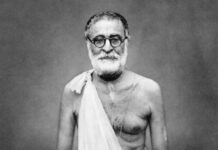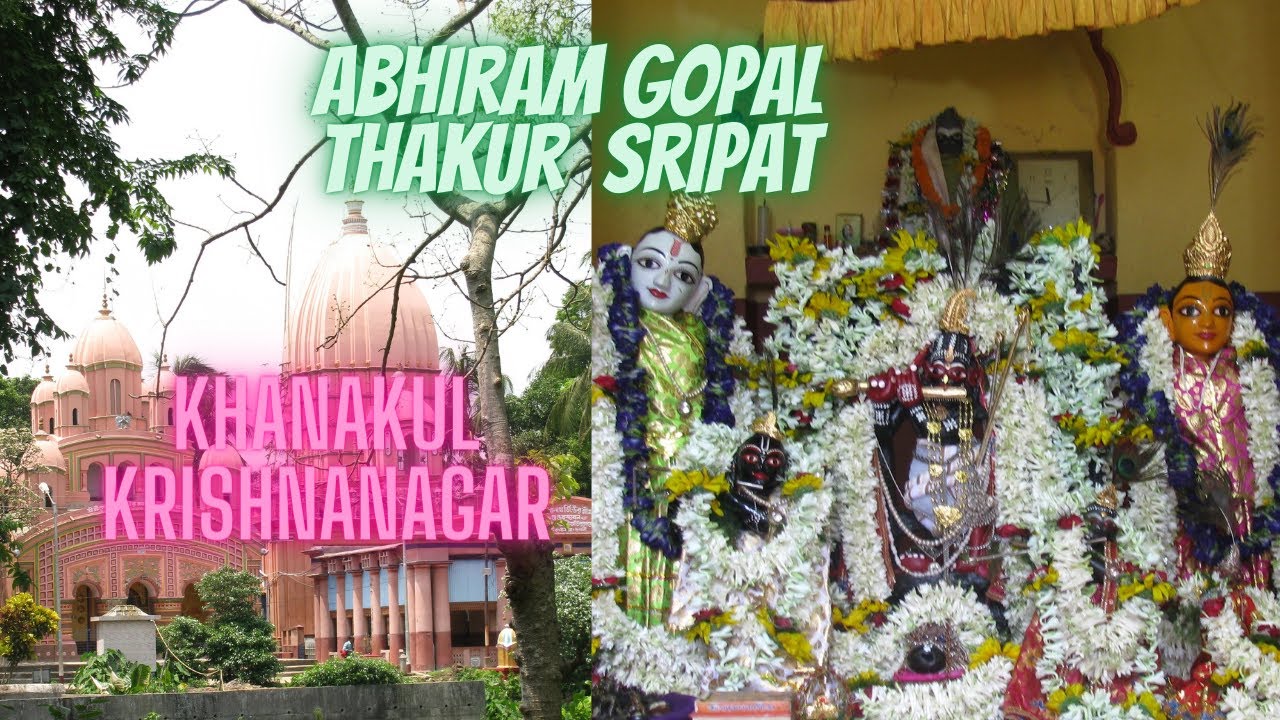
He belonged to the lineage of Lord Caitanya. In Ramalila he was Bharata, in Krsnalila he was Sridama sakha, and in Gauralila one of the twelve Gopalas. A close associate of Nityananda Prabhu, Abhirama Goswami was also known as “Ramadasa”, “Rama”, “Abhirama Thakura”, etc. His Sripata is located at Khanakula Krsnanagar in the Hugli district. Malini Devi was his wife.
In a state of loving ecstacy Abhirama lifted a huge log, which would ordinarily have taken sixteen people to lift, and held it as a flute. (According to Bhaktiratnakara 4.123, It would have taken 100 people to lift it)
It has been said that Abhirama was so spiritually powerful that whenever he offered his humble obeisances to the Deity or Salagrama, the latter would crack. By offering his obeisances to the seven sons of Nityananda Prabhu, Abhirama killed them all. Later when Virabhadra Goswami was born, he was able to survive Abhirama’s pranama. In great joy Abhirama acknowledged Virabhadra as the second embodiment of Lord Gauranga, which he also mentioned in his own writing entitled Sri Virabhadrastaka: “Soyan prasidatu Harih kila Virabhadra.”
Mother Ganga was also glorified in the same way by Abhirama in his Gangastotra (6): “I, Sridama sakha, am moving all over the earth to find that object which can withstand my obeisances. But my dear Mother Ganga! After I offered you obeisances twelve times and you still remained unharmed and smiling, only then did I become aware of your extraordinary spiritual wealth.”
Abhirama always carried a cane named “Jayamangala”. Anyone who was fortunate enough to be touched by it was blessed with the wealth of divine love. Srinivasa Acarya received such a benediction. Abhirama liberated great numbers of pasandis. In the Pata Paryatana it is stated that even the most notorious pasandi trembled in fear at the sight of Abhirama.
It has been said that since the time of Krsna’s appearance Sridama sakha never took birth again, but wandered about in that same form. Later he met Nityananda Prabhu in Vrndavana. In the unpublished work of Vrndavana dasa Thakura entitled Aisaryamrta‑Kavya (109‑111) it is explained that during the Dvapara Yuga, at the time of Vrajalila, Nityananda Prabhu brought Sridama, in his subtle body, out of a mountain cave and took him to Navadvipa, where Nityananda revealed to Sridama the truths regarding Gauralila. But the following extract from Bhaktiratnakara (4.105‑108) says: Abhirama incarnated in the house of a brahmana in order to liberate the fallen jivas. He was erudite in all scriptures, extremely charming, and expert in the art of dancing, vocal and instrumental music. Submitting to the desire of Nityananda Prabhu, he married an extremely qualified girl named Malini, the daughter of a scholarly brahmana.
In most Vaisnava books Abhirama and Ramadasa are mentioned as one and the same person. But the late Jagadvandu Bhadra states, “The late Jagadisvara Gupta mentions Ramadasa as another name of Abhirama; the fact is not so. *****It is explained in the book Abhiramalilamrta that Lord Gauranga requested Abhirama Gupta should be brought from Vrndavana to Navadvipa when Abhirama instead of accompanying Lord Gauranga, revealed the image of Ramadasa generating his force.***** Then Abhirama accompanied Lord Gauranga to Navadvipa where he captivated the world with his dancing, kirtana, and taming of the pasandis. *****Ramadasa, the svarupa of Abhirama, belonged to Sri Nityananda sakha, and Abhirama himself belonged to Sri Caitanya sakha (Gaurapadatarangini P. 21). Abhirama wrote Sri Virabhadrastaka and Sri Gangastotra.
Bhaktiratnakara informs that Abhirama, *****while in a dreaming state, lifted the Deity Sri Sri Gopinatha from beneath the earth at Khanakula Krsnanagar and installed it there. The site from which the deity was lifted is known as “Ramakunda” (Bhaktiratnakara 4.118). He is said to have established the Balimatha at Puri. Abhirama died on the seventh day of the dark fortnight of Vaisaka. BMO p.121 mentions two other unpublished works which give biographical information on Abhirama entitled Abhiramapatala and Abhiramabandana.
Deepen your Bhakti-yoga practice, harmonize relationships, and receive guided coaching — all at Vedavarsity.com