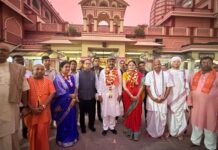




Best Friend is a heartfelt devotional film weaving sankirtan history, personal reflection, and creative outreach, crafted with sincerity and faith through immense challenges. It is also the culmination of a journey that began when a Best Friend filmmaker, Gita Galadauskaite, was a young girl in Lithuania, falling asleep to cassette recordings of devotional classes. Among them was a sankirtan story, likely narrated by Indradyumna Swami, that left such an impression that she remembered it decades later.
Though she had forgotten most of the tiny details of the story she had heard growing up, this particular account remained vivid in her memory. When the pandemic brought isolation and uncertainty into her life as a film extra and now a first-time filmmaker based in Toronto, that childhood memory resurfaced and became the seed of her latest devotional project.
Gita had once staged the story as a theatre production in Lithuania, but every trace of that effort disappeared (photos, files, all of it). The sense of mystery lingered. When Toronto’s strict lockdowns left her navigating months and months of solitude, she searched for something creative, comforting, and grounding.
The idea of telling that sankirtan story again arrived naturally. “I needed an outlet during the isolation time…I needed something to help me, and to do something collectively.” What began as a search for stability slowly expanded into a four-year creative undertaking shaped by persistence and divine arrangement.
Creativity as a Lifeline Through Isolation
From the moment Gita committed to making Best Friend, she stepped into a landscape defined by constraint and uncertainty. With no budget, no professional experience, no car, and no large crew, she relied on the goodwill of everyone, her personal savings, and sheer resourcefulness. “Maybe one rented film light…maybe a borrowed reflector,” she said, recalling the minimal equipment at her disposal. Transporting props and gear required help, and by the mercy of local devotees, that assistance was often available.
What slowed the project most, however, were the unexpected setbacks that followed one after another. Five editors left the project, delaying progress for nearly two years. Each time work resumed, another obstacle emerged. At times, the project felt impossible. “I thought, maybe it’s not meant to be done…Maybe I dream too big,” she admitted.
Yet the pattern became unmistakable. Whenever she let go of personal control, support appeared. A sound designer who appeared early in production contacted her years later after seeing the trailer online, offering to return to the project. These moments reinforced a spiritual lesson that carried her through the hardest phases: “Not a blade of grass moves without Krishna’s will. Whenever I try to be the doer, nothing works. When I let go…Krishna arranges everything.”

Camera test with actor Eric Droski in character as a gang member.

Alleyway shot with Michael Lake as the Preacher and cinematographer Ibrahim Awara lining up the frame.

A temple scene filmed during the pandemic, with the makeup artist stepping in to help mark the take on the clapboard.

Behind-the-scenes moment during the bar scene with actor Nemo Baletic.

Inside the bar set: director-producer Gita works with second cinematographer Ahmad Janbakli, camera assistant Mina, and background actors.

Rehearsing the chase sequence with actors Eric Droski, Matt Daciw, Nemo Baletic, and Michael Lake as the Preacher.
Building Emotional Worlds from Within
The sankirtan story she remembered contained a sequence of events, but not the emotional arcs needed for a full narrative. To create depth, Gita turned to her own life. Every major female character in the film reflects her at different stages of growth. The little girl represents her young self, hearing the story for the first time. The mother embodies the struggles and responsibilities of adulthood. The grandmother symbolizes the wisdom and intention she hopes to carry forward.
The film’s emotional tone emerged from her experience during the pandemic: loneliness, introspection, and the fear of stagnation. These feelings shaped the characters’ inner conflicts. She developed the male characters with equal care, consulting male friends, drawing from their vulnerabilities, and exploring forms of friendship and fear that transcend cultural backgrounds. “Different people will see different things,” she said. “Some will see struggle, some friendship…some Krishna consciousness.”
Bringing Authentic Devotional Life to the Screen
Beyond storytelling, Gita was determined to protect the integrity of devotional representation. “Many secular films released often mock devotees…bedsheets, curtains, crazy people,” she said. “There’s so much ignorance.” Taking full creative control was essential. As writer, director, and producer, she ensured that every devotional detail appeared naturally and respectfully.
Filming inside ISKCON Toronto during the pandemic allowed the team to capture a genuine temple atmosphere: the soft glow of ghee lamps, quiet moments of reading, the subtle sound of bells, the serenity of the Deities, and the presence of Srila Prabhupada woven gently throughout scenes. Vaishnava tilaka, japa beads, kirtan, and simple rituals are shown not as stereotypes, but as lived, organic elements of Hare Krishna life.
The devotional environment made an impression on the non-devotee cast and crew. Many were fascinated by a painting of Nrsimhadeva. “They asked, ‘What is this lion-man?’ And I said, ‘That’s God.’” Teaching an actor how to chant, wear tilaka, or handle japa beads created unplanned but meaningful interactions. Bhakti Marga Swami’s involvement added gravity. “We needed a real guru…his gaze, his energy,” she explained. “You can’t act that.”

The first cast meeting for the female leads: Alicia Ryan as the Mother, Gita as director-producer, Georgia Moniz as the Girl, and Luanne M. Ashe as the Grandmother.

Lunch break at Toronto Govindas: Set designer Dimphy Van Vilsteren, lead actor Michael Lake, director-producer Gita, cinematographer Ibrahim Awara, actor Nemo Baletic, assistant director Christopher John Blue, and camera assistant Maram Ahmed.

A quiet moment in the park with Michael Lake as the Preacher and Christopher John Blue as the Homeless Benchman.

Filming the Girl’s bedroom scene with sound assistant Dylan Lamarre, sound recordist Pournam Abbasi, cinematographer Ibrahim Awara, director-producer Gita, and grip Mahan Punia.
When a Film Becomes Soft Preaching
Although Best Friend was never conceived as a preaching project, it developed into one organically. Crew members found themselves curious about Krishna Consciousness, devotional practices, and the underlying philosophy. Govinda’s restaurant supplied prasadam for filming days. “I told them: I’m sorry, I can’t give you meat…and they respected it,” she said. Additionally, some devotees helped with logistics, giving their association.
For Gita, these quiet exchanges became among the most meaningful outcomes of the entire process. “People who know nothing about Krishna are fascinated…that moved me the most,” she said. The film became a gentle, respectful, and unexpected bridge.
Looking Toward Festivals, Screenings, and Future Outreach
With Best Friend now complete, there will be an exclusive in-person screening in the ISKCON Toronto Temple on January 10th, 2026, followed by submissions to film festivals worldwide. Click here for details. She hopes to translate the film into multiple languages and eventually organize screenings that include kirtan, the film, a Q&A session, and a book table, an immersive yet non-confrontational introduction to Krishna consciousness. “A positive, non-pushy experience of what Krishna consciousness actually is,” she said.
She also hopes the film’s central message will inspire devotees, especially during the December book marathon. “Bad things happen on sankirtan…but Krishna protects you.”
A Quiet Offering to Srila Prabhupada
For Gita, Best Friend is more than a film; it is an offering. “I’m too shy to distribute books,” she admitted. “So this is my five cents toward Srila Prabhupada’s mission.” What began in childhood imagination has become a sincere contribution that now reaches others, devotees, and newcomers alike, with honesty, vulnerability, and spiritual depth.
Deepen your Bhakti-yoga practice, harmonize relationships, and receive guided coaching — all at Vedavarsity.com