“When one is firmly fixed in devotional service, whether he executes one or many processes of devotional service, the waves of love of Godhead will awaken. (134) “There are many devotees who execute only one of the nine processes of devotional service. Nonetheless, they get ultimate success. Devotees like Mahārāja Ambarīṣa execute all nine items, and they also get ultimate success. (135) “‘Mahārāja Parīkṣit attained the highest perfection, shelter at Lord Kṛṣṇa’s lotus feet, simply by hearing about Lord Viṣṇu. Śukadeva Gosvāmī attained perfection simply by reciting Śrīmad- Bhāgavatam. Prahlāda Mahārāja attained perfection by remembering the Lord. The goddess of fortune attained perfection by massaging the transcendental legs of Mahā- Viṣṇu. Mahārāja Pṛthu attained perfection by worshiping the Deity, and Akrūra attained perfection by offering prayers unto the Lord. Vajrāṅgajī [Hanumān] attained perfection by rendering service to Lord Rāmacandra, and Arjuna attained perfection simply by being Kṛṣṇa’s friend. Bali Mahārāja attained perfection by dedicating everything to the lotus feet of Kṛṣṇa.’ (136)
“‘Mahārāja Ambarīṣa always engaged his mind at the lotus feet of Kṛṣṇa, his words in describing the spiritual world and the Supreme Personality of Godhead, his hands in cleansing and washing the Lord’s temple, his ears in hearing topics about the Supreme Lord, his eyes in seeing the Deity of Lord Kṛṣṇa in the temple, his body in embracing Vaiṣṇavas or touching their lotus feet, his nostrils in smelling the aroma of the tulasī leaves offered to Kṛṣṇa’s lotus feet, his tongue in tasting food offered to Kṛṣṇa, his legs in going to places of pilgrimage like Vṛndāvana and Mathurā or to the Lord’s temple, his head in touching the lotus feet of the Lord and offering Him obeisances, and his desires in serving the Lord faithfully. In this way Mahārāja Ambarīṣa engaged his senses in the transcendental loving service of the Lord. As a result, he awakened his dormant loving propensity for the Lord’s service.’ (137-139)
“If a person gives up all material desires and completely engages in the transcendental loving service of Kṛṣṇa, as enjoined in the revealed scriptures, he is never indebted to the demigods, sages or forefathers. (140) “‘One who has given up all material duties and taken full shelter at the lotus feet of Mukunda, who gives shelter to all, is not indebted to the demigods, great sages, ordinary living beings, relatives, friends, mankind or even his forefathers who have passed away.’ (141) “Although the pure devotee does not follow all the regulative principles of varṇāśrama, he worships the lotus feet of Kṛṣṇa. Therefore he naturally has no tendency to commit sin. (142) “If, however, a devotee accidentally becomes involved in a sinful activity, Kṛṣṇa purifies him. He does not have to undergo the regulative form of atonement. (143) “‘One who has given up everything and taken full shelter at the lotus feet of Hari, the Supreme Personality of Godhead, is very dear to Kṛṣṇa. If he is involved in some sinful activity by accident, the Supreme Personality of Godhead, who is seated within everyone’s heart, removes his sins without difficulty.’ (144)
“The path of speculative knowledge and renunciation is not essential for devotional service. Indeed, good qualities such as nonviolence and control of the mind and senses automatically accompany a devotee of Lord Kṛṣṇa. (145) “‘For one who is fully engaged in My devotional service, whose mind is fixed on Me in bhakti- yoga, the path of speculative knowledge and dry renunciation is not very beneficial.’ (146) “‘O hunter, good qualities like nonviolence, which you have developed, are not very astonishing, for those who are engaged in the Lord’s devotional service are never inclined to give pain to others because of envy.’ (147) “My dear Sanātana, I have now in detail described devotional service according to the regulative principles. Now hear from Me about spontaneous devotional service and its characteristics. (148) “The original inhabitants of Vṛndāvana are attached to Kṛṣṇa spontaneously in devotional service. Nothing can compare to such spontaneous devotional service, which is called rāgātmikā bhakti. When a devotee follows in the footsteps of the devotees of Vṛndāvana, his devotional service is called rāgānugā bhakti. (149)
“‘When one becomes attached to the Supreme Personality of Godhead, his natural inclination to love is fully absorbed in thoughts of the Lord. That is called transcendental attachment, and devotional service according to that attachment is called rāgātmikā, or spontaneous devotional service.’ (150) “The primary characteristic of spontaneous love is deep attachment for the Supreme Personality of Godhead. Absorption in thought of Him is a marginal characteristic. (151) “Thus devotional service which consists of rāga [deep attachment] is called rāgātmikā, spontaneous loving service. If a devotee covets such a position, he is considered to be most fortunate. (152) “If one follows in the footsteps of the inhabitants of Vṛndāvana out of such transcendental covetousness, he does not care for the injunctions or reasonings of śāstra. That is the way of spontaneous love. (153) “‘Devotional service in spontaneous love is vividly expressed and manifested by the inhabitants of Vṛndāvana. Devotional service that accords with their devotional service is called rāgānugā bhakti, or devotional service following in the wake of spontaneous loving service.’ (154)
“‘When an advanced, realized devotee hears about the affairs of the devotees of Vṛndāvana— in the mellows of śānta, dāsya, sakhya, vātsalya and mādhurya—he becomes inclined in one of these ways, and his intelligence becomes attracted. Indeed, he begins to covet that particular type of devotion. When such covetousness is awakened, one’s intelligence no longer depends on the instructions of śāstra [revealed scripture] or on logic and argument.’ (155) “There are two processes by which one may execute this rāgānugā bhakti—external and internal. When self- realized, the advanced devotee externally remains like a neophyte and executes all the śāstric injunctions, especially those concerning hearing and chanting. But within his mind, in his original, purified, self- realized position, he serves Kṛṣṇa in Vṛndāvana in his particular way. He serves Kṛṣṇa twenty- four hours a day, all day and night. (156-157)
“‘The advanced devotee who is inclined to spontaneous loving service should follow the activities of a particular associate of Kṛṣṇa’s in Vṛndāvana. He should execute service externally as a regulative devotee as well as internally from his self- realized position. Thus he should perform devotional service both externally and internally.’ (158) “Actually the inhabitants of Vṛndāvana are very dear to Kṛṣṇa. If one wants to engage in spontaneous loving service, he must follow the inhabitants of Vṛndāvana and constantly engage in devotional service within his mind. (159) “‘The devotee should always think of Kṛṣṇa within himself and should choose a very dear devotee who is a servitor of Kṛṣṇa in Vṛndāvana. One should constantly engage in topics about that servitor and his loving relationship with Kṛṣṇa, and one should live in Vṛndāvana. If one is physically unable to go to Vṛndāvana, he should mentally live there.’ (160)
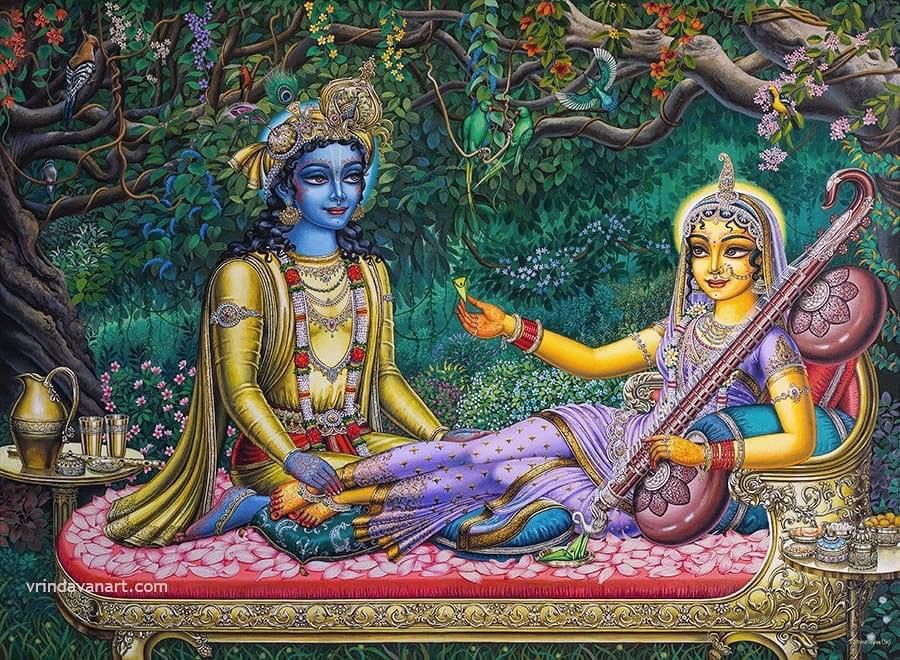
“Kṛṣṇa has many types of devotees—some are servants, some are friends, some are parents, and some are conjugal lovers. Devotees who are situated in one of these attitudes of spontaneous love according to their choice are considered to be on the path of spontaneous loving service. (161) “‘My dear mother, Devahūti! O emblem of peace! My weapon, the disc of time, never vanquishes those for whom I am very dear—for whom I am the Supersoul, son, friend, spiritual master, well- wisher, worshipable Deity and desired goal. Since the devotees are always attached to Me, they are never vanquished by the agents of time.’ (162) “‘Let me offer my respectful obeisances again and again to those who always eagerly meditate upon the Supreme Personality of Godhead as a husband, son, friend, brother, father or intimate friend.’ (163) “If one engages in spontaneous loving service to the Lord, his affection for the lotus feet of Kṛṣṇa gradually increases. (164)
“In the seed of affection, there is attachment which goes by two names, rati and bhāva. The Supreme Personality of Godhead comes under the control of such attachment. (165) That by which one can attain loving service to the Lord I have described in detail as the execution of devotional service, called abhidheya. (166) “My dear Sanātana, I have briefly described the process of devotional service in practice, which is the means for obtaining love of Kṛṣṇa. It cannot be described broadly.” (167) Whoever hears this description of the process of practical devotional service very soon attains shelter at the lotus feet of Kṛṣṇa in love and affection. (168) Praying at the lotus feet of Śrī Rūpa and Śrī Raghunātha, always desiring their mercy, I, Kṛṣṇadāsa, narrate Śrī Caitanya- caritāmṛta, following in their footsteps. (169)
Deepen your Bhakti-yoga practice, harmonize relationships, and receive guided coaching — all at Vedavarsity.com