


“The form of the Lord that descends into the material world to create is called an avatāra, or incarnation. (263) “All the expansions of Lord Kṛṣṇa are actually residents of the spiritual world. But when they descend into the material world, they are called incarnations [avatāras]. (264) “To glance over that material energy and empower her, Lord Saṅkarṣaṇa first incarnates as Lord Mahā- Viṣṇu. (265) “‘In the beginning of the creation, the Lord expanded Himself in the form of the puruṣa incarnation, accompanied by all the ingredients of material creation. First He created the sixteen principal energies suitable for creation. This was for the purpose of manifesting the material universes.’ (266)
“‘Kāraṇābdhiśāyī Viṣṇu [Mahā- Viṣṇu] is the first incarnation of the Supreme Lord, and He is the master of eternal time, space, cause and effects, the mind, the elements, the material ego, the modes of nature, the senses, the universal form of the Lord, Garbhodakaśāyī Viṣṇu and the sum total of all living beings, both moving and nonmoving.’ (267) “That original Personality of Godhead, named Saṅkarṣaṇa, first lies down in the river Virajā, which serves as a border between the material and the spiritual world. As Kāraṇābdhiśāyī Viṣṇu, He is the original cause of the material creation. (268) “The Virajā, or Causal Ocean, is the border between the spiritual and the material world. The material energy is situated on one shore of that ocean, and it cannot enter onto the other shore, which is the spiritual sky. (269)
“‘In the spiritual world, there is neither the mode of passion, the mode of ignorance nor a mixture of both, nor is there adulterated goodness, the influence of time or māyā herself. Only the pure devotees of the Lord, who are worshiped both by demigods and by demons, reside in the spiritual world as the Lord’s associates.’ (270) “Māyā has two functions. One is called māyā, and the other is called pradhāna. Māyā refers to the efficient cause, and pradhāna refers to the ingredients that create the cosmic manifestation. (271) “When the Supreme Personality of Godhead glances over the material energy, she becomes agitated. At that time, the Lord injects the original semen of the living entities. (272) “To impregnate with the seeds of the living entities, the Lord Himself does not directly touch the material energy, but by His specific functional expansion He touches the material energy, and thus the living entities, who are His parts and parcels, are impregnated into material nature. (273)
“‘At a time beyond memory, after agitating the material nature into three qualities, the Supreme Personality of Godhead placed the semen of innumerable living entities within the womb of that material nature. Thus material nature gave birth to the total material energy, known as the hiraṇmaya- mahat- tattva, the original symbolic representation of the cosmic manifestation.’ (274) “‘In due course of time, the Supreme Personality of Godhead [Mahā- Vaikuṇṭhanātha], by the agency of a further expansion of His personal self [Mahā- Viṣṇu], placed the seed of the living entities within the womb of material nature.’ (275) “First the total material energy is manifested, and from this arise the three types of egotism, which are the original sources from which all demigods [controlling deities], senses and material elements expand. (276) “Combining all the different elements, the Supreme Lord created all the universes. Those universes are unlimited in number; there is no possibility of counting them. (277) “The first form of Lord Viṣṇu is called Mahā- Viṣṇu. He is the original creator of the total material energy. The innumerable universes emanate from the pores of His body. (278)
“These universes are understood to be floating in the air that Mahā- Viṣṇu exhales. They are like atomic particles that float in sunshine and pass through the holes of a screen. All these universes are thus created by the exhalation of Mahā- Viṣṇu, and when Mahā- Viṣṇu inhales, they re- enter His body. The unlimited opulences of Mahā- Viṣṇu are completely beyond material conception. (279-280) “‘The Brahmās and other lords of the mundane worlds appear from the pores of Mahā- Viṣṇu and remain alive for the duration of His one exhalation. I adore the primeval Lord, Govinda, of whom Mahā- Viṣṇu is a portion of a plenary portion.’ (281) “Mahā- Viṣṇu is the Supersoul of all the universes. Lying on the Causal Ocean, He is the master of all material worlds. (282) “I have thus explained the truth of the first Personality of Godhead, Mahā- Viṣṇu. I shall now explain the glories of the second Personality of Godhead. (283) “After creating the total number of universes, which are unlimited, Mahā- Viṣṇu expanded Himself into unlimited forms and entered into each of them. (284)
“When Mahā- Viṣṇu entered each of the limitless universes, He saw that there was darkness all around and that there was no place to stay. He therefore began to consider the situation. (285) “With the perspiration produced from His own body, the Lord filled half the universe with water. He then lay down on that water, on the bed of Lord Śeṣa. (286) “A lotus flower then sprouted from the lotus navel of that Garbhodakaśāyī Viṣṇu. That lotus flower became Lord Brahmā’s birthplace. (287) “In the stem of that lotus flower, the fourteen worlds were generated. Then He became Lord Brahmā and manifested the entire universe. (288) “In this way, the Supreme Personality of Godhead in His form of Viṣṇu maintains the entire material world. Since He is always beyond the material qualities, the material nature cannot touch Him. (289) “The Supreme Lord in His form of Rudra [Lord Śiva] brings about the dissolution of this material creation. In other words, only by His will are there creation, maintenance and dissolution of the whole cosmic manifestation. (290)
“Brahmā, Viṣṇu and Śiva are His three incarnations of the material qualities. Creation, maintenance and destruction respectively are under the charge of these three personalities. (291) “Garbhodakaśāyī Viṣṇu, known within the universe as Hiraṇyagarbha and the antaryāmī, or Supersoul, is glorified in the Vedic hymns, beginning with the hymn that starts with the word ‘sahasra- śīrṣā.’ (292) “This second Personality of Godhead, known as Garbhodakaśāyī Viṣṇu, is the master of each and every universe and the shelter of the external energy. Nonetheless, He remains beyond the touch of the external energy. (293) “The third expansion of Viṣṇu is Kṣīrodakaśāyī Viṣṇu, who is the incarnation of the quality of goodness. He is to be counted within both types of incarnations [puruṣa- avatāras and guṇa- avatāras]. (294) “Kṣīrodakaśāyī Viṣṇu is the universal form of the Lord and is the Supersoul within every living entity. He is known as Kṣīrodakaśāyī because He is the Lord who lies on the ocean of milk. He is the maintainer and master of the universe. (295)
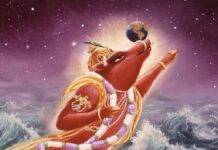
“O Sanātana, I have definitively described the three puruṣa- avatāras of Viṣṇu. Now please hear from Me about the pastime incarnations. (296) “No one can count the innumerable pastime incarnations of Lord Kṛṣṇa, but I shall describe the principal ones. (297) “Some of the pastime incarnations are the fish incarnation, the tortoise incarnation, Lord Rāmacandra, Lord Nṛsiṁha, Lord Vāmana and Lord Varāha. There is no end to them. (298) “‘O Lord of the universe, best of the Yadu dynasty, we are offering our prayers unto You mainly to diminish the heavy burden of the universe. Indeed, You diminished this burden formerly by incarnating in the form of a fish, a horse [Hayagrīva], a tortoise, a lion [Lord Nṛsiṁha], a boar [Lord Varāha] and a swan. You also incarnated as Lord Rāmacandra, Paraśurāma and Vāmana, the dwarf. You have always protected us demigods and the universe in this way. Now please continue.’ (299)
“I have given a few examples of pastime incarnations. Now I will describe the guṇa- avatāras, the incarnations of the material qualities. Please listen. (300) “There are three functions within this material world. Everything here is created, everything is maintained for some time, and everything is finally dissolved. The Lord therefore incarnates Himself as the controllers of the three qualities—sattva- guṇa, rajo- guṇa and tamo- guṇa [goodness, passion and ignorance]. Thus the transactions of the material world take place. (301) “Because of his past pious activities mixed with devotional service, the first- class living entity is influenced by the mode of passion within his mind. (302) “Such a devotee is empowered by Garbhodakaśāyī Viṣṇu. In this way, an incarnation of Kṛṣṇa in the form of Brahmā engineers the total creation of the universe. (303) “‘The sun manifests his brilliance in a gem, although it is stone. Similarly, the original Personality of Godhead, Govinda, manifests His special power in a pious living entity. Thus the living entity becomes Brahmā and manages the affairs of the universe. Let me worship Govinda, the original Personality of Godhead.’ (304)
“If in a kalpa a suitable living entity is not available to take charge of Brahmā’s post, the Supreme Personality of Godhead Himself personally expands and becomes Lord Brahmā. (305) “‘What is the value of a throne to Lord Kṛṣṇa? The masters of the various planetary systems accept the dust of His lotus feet on their crowned heads. That dust makes the holy places sacred, and even Lord Brahmā, Lord Śiva, Lakṣmī and I Myself, who are all portions of His plenary portion, eternally carry that dust on our heads.’ (306) “Lord Kṛṣṇa, the Supreme Personality of Godhead, expands a portion of His plenary portion and, accepting the association of the material mode of ignorance, assumes the form of Rudra to dissolve the cosmic manifestation. (307)
“Rudra, Lord Śiva, has various forms, which are transformations brought about by association with māyā. Although Rudra is not on a level with the jīva- tattvas, he still cannot be considered a personal expansion of Lord Kṛṣṇa. (308) “Milk is transformed into yogurt when it associates with a yogurt culture. Thus yogurt is nothing but milk, but still it is not milk. (309) “‘Milk changes into yogurt when mixed with a yogurt culture, but actually it is constitutionally nothing but milk. Similarly, Govinda, the Supreme Personality of Godhead, assumes the form of Lord Śiva [Śambhu] for the special purpose of material transactions. I offer my obeisances at His lotus feet.’ (310) “Lord Śiva is an associate of the external energy; therefore he is absorbed in the material quality of darkness. Lord Viṣṇu is transcendental to māyā and the qualities of māyā. Therefore He is the Supreme Personality of Godhead. (311)
“‘The truth about Lord Śiva is that he is always covered with three material coverings—vaikārika, taijasa and tāmasa. Because of these three modes of material nature, he always associates with the external energy and egotism itself.’ (312) “‘Śrī Hari, the Supreme Personality of Godhead, is situated beyond the range of material nature; therefore He is the supreme transcendental person. He can see everything inside and outside; therefore He is the supreme overseer of all living entities. If someone takes shelter at His lotus feet and worships Him, he also attains a transcendental position.’ (313) “For the maintenance of the universe, Lord Kṛṣṇa descends as His personal plenary expansion in the form of Viṣṇu. He is the director of the mode of goodness; therefore He is transcendental to the material energy. (314) “Lord Viṣṇu is in the category of svāṁśa because He has opulences almost equal to Kṛṣṇa’s. Kṛṣṇa is the original person, and Lord Viṣṇu is His personal expansion. This is the verdict of all Vedic literatures. (315)
“‘When the flame of one candle is expanded to another candle and placed in a different position, it burns separately, and its illumination is as powerful as the original candle’s. Similarly, the Supreme Personality of Godhead, Govinda, expands Himself in different forms as Viṣṇu, who is equally luminous, powerful and opulent. Let me worship that Supreme Personality of Godhead, Govinda.’ (316) “The conclusion is that Lord Brahmā and Lord Śiva are simply devotee incarnations who carry out orders. However, Lord Viṣṇu, the maintainer, is the personal feature of Lord Kṛṣṇa. (317) “[Lord Brahmā said:] ‘I am engaged by the Supreme Personality of Godhead to create. Following His orders, Lord Śiva dissolves everything. The Supreme Personality of Godhead in His form of Kṣīrodakaśāyī Viṣṇu maintains all the affairs of material nature. Thus the supreme controller of the three modes of material nature is Lord Viṣṇu.’ (318)
“O Sanātana, now just hear about the incarnations who appear during the reign of each Manu [manvantara- avatāras]. They are unlimited, and no one can count them. Just hear of their source. (319) “In one day of Brahmā, there are fourteen changes of the Manus, and during the reign of each of those fourteen Manus, an incarnation is manifested by the Supreme Personality of Godhead. (320) “There are 14 manvantara- avatāras in one day of Brahmā, 420 in one month, and 5,040 in one year. (321) “During the hundred years of Brahmā’s life, there are 504,000 manvantara- avatāras. (322) “The number of manvantara- avatāras for only one universe has been given. One can only imagine how many manvantara- avatāras exist in the innumerable universes. And all these universes and Brahmās exist only during one exhalation of Mahā- Viṣṇu. (323) “There is no limit to the exhalations of Mahā- Viṣṇu. Just see how impossible it is to speak or write of only the manvantara- avatāras! (324)
“In the Svāyambhuva- manvantara, the avatāra is named Yajña. In the Svārociṣa- manvantara, he is named Vibhu. In the Auttama- manvantara, He is named Satyasena, and in the Tāmasa-manvantara, He is named Hari. (325) “In the Raivata- manvantara, the avatāra is named Vaikuṇṭha, and in the Cākṣuṣa- manvantara, He is named Ajita. In the Vaivasvata- manvantara, He is named Vāmana, and in the Sāvarṇya- manvantara, He is named Sārvabhauma. In the Dakṣa- sāvarṇya- manvantara, he is named Ṛṣabha. (326) “In the Brahma- sāvarṇya- manvantara, the avatāra is named Viṣvaksena, and in the Dharma- sāvarṇya, he is named Dharmasetu. In the Rudra- sāvarṇya he is named Sudhāmā, and in the Deva- sāvarṇya, he is named Yogeśvara. (327) “In the Indra- sāvarṇya- manvantara, the avatāra is named Bṛhadbhānu. These are the names of the fourteen avatāras in the fourteen manvantaras. (328)
Deepen your Bhakti-yoga practice, harmonize relationships, and receive guided coaching — all at Vedavarsity.com