At that time, Śrī Vallabha Bhaṭṭa was staying at Āḍāila- grāma, and when he heard that Śrī Caitanya Mahāprabhu had arrived, he went to His place to see Him. (61) Vallabha Bhaṭṭācārya offered Śrī Caitanya Mahāprabhu his obeisances, and the Lord embraced him. After that, they discussed topics about Kṛṣṇa for some time. (62) Śrī Caitanya Mahāprabhu felt great ecstatic love when they began discussing Kṛṣṇa, but the Lord checked His feelings because He felt shy before Vallabha Bhaṭṭa. (63) Although the Lord restrained Himself externally, ecstatic love raged within. There was no checking that. Vallabha Bhaṭṭa was astonished to detect this. (64)
Thereafter, Vallabha Bhaṭṭa invited Śrī Caitanya Mahāprabhu for lunch, and the Lord introduced the brothers Rūpa and Vallabha to him. (65) From a distance, the brothers Rūpa Gosvāmī and Śrī Vallabha fell on the ground and offered obeisances to Vallabha Bhaṭṭa with great humility. (66) When Vallabha Bhaṭṭācārya walked toward them, they ran away to a more distant place. Rūpa Gosvāmī said, “I am untouchable and most sinful. Please do not touch me.” (67) Vallabha Bhaṭṭācārya was very much surprised at this. Śrī Caitanya Mahāprabhu, however, was very pleased, and He therefore spoke to him this description of Rūpa Gosvāmī. (68)
Śrī Caitanya Mahāprabhu said, “Don’t touch him, for he belongs to a very low caste. You are a follower of Vedic principles and are a well experienced performer of many sacrifices. You also belong to the aristocracy.” (69) Hearing the holy name constantly vibrated by the two brothers, Vallabha Bhaṭṭācārya could understand the hints of Śrī Caitanya Mahāprabhu. (70) Vallabha Bhaṭṭācārya said, “Since these two are constantly chanting the holy name of Kṛṣṇa, how can they be untouchable? On the contrary, they are most exalted.” (71) Vallabha Bhaṭṭācārya then recited the following verse: “‘My dear Lord, one who always keeps Your holy name on his tongue becomes greater than an initiated brāhmaṇa. Although he may be born in a family of dog- eaters and may therefore, by material calculation, be the lowest among men, he is still glorious. This is the wonderful effect of chanting the holy name of the Lord. It is therefore concluded that one who chants the holy name of the Lord should be understood to have performed all kinds of austerities and great sacrifices mentioned in the Vedas. He has already taken his bath in all the holy places of pilgrimage, he has studied all the Vedas, and he is actually an Aryan.’” (72)
Śrī Caitanya Mahāprabhu was very pleased to hear Vallabha Bhaṭṭa quoting from śāstra about the position of a devotee. The Lord praised him personally, and, feeling ecstatic love of Godhead, began to quote many verses from śāstra. (73) Śrī Caitanya Mahāprabhu said, “‘A person who has the pure characteristics of a brāhmaṇa due to devotional service, which is like a blazing fire burning to ashes all the sinful reactions of past lives, is certainly saved from the consequences of sinful acts, such as taking birth in a lower family. Even though he may be born in a family of dog- eaters, he is recognized by learned scholars. But although a person may be a learned scholar in Vedic knowledge, he is not recognized if he is an atheist. (74) “‘For a person devoid of devotional service, birth in a great family or nation, knowledge of the revealed scriptures, performance of austerities and penance, and chanting of Vedic mantras are all like ornaments on a dead body. Such ornaments simply serve the concocted pleasures of the general populace.’” (75)
When he saw the Lord’s ecstatic love, Vallabha Bhaṭṭācārya was certainly very much astonished. He was also astonished by the Lord’s knowledge of the essence of devotional service, as well as by His personal beauty and influence. (76) Vallabha Bhaṭṭācārya then put Śrī Caitanya Mahāprabhu and His associates aboard a boat and took them to his own place to offer them lunch. (77) While crossing the river Yamunā, Śrī Caitanya Mahāprabhu saw the glossy black water and was immediately bewildered with ecstatic love. (78) Indeed, as soon as Śrī Caitanya Mahāprabhu saw the river Yamunā, He immediately made a great sound and jumped into the water. Everyone was filled with fear and trembling to see this. (79) They all hastily grabbed Śrī Caitanya Mahāprabhu and pulled Him out of the water. Once on the boat’s platform, the Lord began to dance. (80)
Due to the Lord’s heavy weight, the boat began to tilt. It began filling up with water and was on the verge of sinking. (81) Śrī Caitanya Mahāprabhu tried to restrain Himself as far as possible before Vallabhācārya, but although He tried to keep calm, His ecstatic love could not be checked. (82) Seeing the circumstances, Śrī Caitanya Mahāprabhu finally became calm so that the boat was able to reach the shore of Āḍāila and land there. (83) Fearing for the Lord’s welfare, Vallabha Bhaṭṭācārya stayed in His association. After arranging for His bath, the Bhaṭṭācārya took the Lord to his own house. (84) When Śrī Caitanya Mahāprabhu arrived at his home, Vallabha Bhaṭṭācārya, being greatly pleased, offered the Lord a nice sitting place and personally washed His feet. (85) Vallabha Bhaṭṭācārya and his whole family then sprinkled that water over their heads. They then offered the Lord new underwear and outer garments. (86)
Vallabhācārya worshiped the Lord with great pomp, offering scents, incense, flowers and lamps, and with great respect he induced Balabhadra Bhaṭṭācārya [the Lord’s cook] to cook. (87) Thus Śrī Caitanya Mahāprabhu was offered lunch with great care and affection. The brothers Rūpa Gosvāmī and Śrī Vallabha were also offered food. (88) Vallabha Bhaṭṭācārya first offered the remnants of the Lord’s food to Śrīla Rūpa Gosvāmī, and then to Kṛṣṇadāsa. (89) The Lord was then given spices to purify His mouth. Afterwards He was made to rest, and Vallabha Bhaṭṭācārya personally massaged His legs. (90) While Vallabha Bhaṭṭācārya was massaging Him, the Lord asked him to go take prasādam. After taking prasādam, he returned to the lotus feet of the Lord. (91) At that time Raghupati Upādhyāya of the Tiruhitā district arrived. He was a very learned scholar, a great devotee and a respectable gentleman. (92)
Raghupati Upādhyāya first offered his respects to Śrī Caitanya Mahāprabhu, and the Lord gave him His blessings, saying, “Always stay in Kṛṣṇa consciousness.” (93) Raghupati Upādhyāya was very pleased to hear the Lord’s blessings. The Lord then asked him to describe Kṛṣṇa. (94) When Raghupati Upādhyāya was requested to describe Kṛṣṇa, he began to recite some verses he had personally composed about Kṛṣṇa’s pastimes. Hearing those verses, Śrī Caitanya Mahāprabhu was overwhelmed with ecstatic love. (95) Raghupati Upādhyāya recited, “Those who are afraid of material existence worship the Vedic literature. Some worship smṛti, the corollaries to the Vedic literature, and others worship the Mahābhārata. As far as I am concerned, I worship Kṛṣṇa’s father, Mahārāja Nanda, in whose courtyard the Supreme Personality of Godhead, the Absolute Truth, is playing.” (96) When Raghupati Upādhyāya was requested by the Lord to recite more, he immediately offered his respects to the Lord and granted His request. (97)
“To whom can I speak who will believe me when I say that Kṛṣṇa, the Supreme Personality of Godhead, is hunting the gopīs in the bushes by the banks of the river Yamunā? In this way the Lord demonstrates His pastimes.” (98) Śrī Caitanya Mahāprabhu requested Raghupati Upādhyāya to continue speaking about the pastimes of Śrī Kṛṣṇa. Thus the Lord was absorbed in ecstatic love, and His mind and body slackened. (99) When Raghupati Upādhyāya saw Śrī Caitanya Mahāprabhu’s ecstatic symptoms, he decided that the Lord was not a human being but Kṛṣṇa Himself. (100) Śrī Caitanya Mahāprabhu asked Raghupati Upādhyāya, “According to your decision, who is the foremost being?” Raghupati Upādhyāya replied, “Lord Śyāmasundara is the supreme form.” (101) “Of all Kṛṣṇa’s abodes, which do you think is the best?” Raghupati Upādhyāya said, “Madhu- purī, or Mathurā- dhāma, is certainly the best.” (102)
Śrī Caitanya Mahāprabhu asked, “Of the three ages of Kṛṣṇa known as childhood, boyhood and fresh youth, which do you consider best?” Raghupati Upādhyāya replied, “Fresh youth is the best age.” (103) When Śrī Caitanya Mahāprabhu asked, “Among all the mellows, which do you consider best?” Raghupati Upādhyāya replied, “The mellow of conjugal love is supermost.” (104) Śrī Caitanya Mahāprabhu then said, “You have certainly given first- class conclusions.” After saying this, He began to recite the full verse in a faltering voice. (105) “‘The form of Śyāmasundara is the supreme form, the city of Mathurā is the supreme abode, Lord Kṛṣṇa’s fresh youth should always be meditated upon, and the mellow of conjugal love is the supreme mellow.’” (106) Śrī Caitanya Mahāprabhu then embraced Raghupati Upādhyāya in ecstatic love. Raghupati Upādhyāya also was overwhelmed by love, and he began to dance. (107)
Vallabha Bhaṭṭācārya was struck with wonder to see Śrī Caitanya Mahāprabhu and Raghupati Upādhyāya dance. He even brought forward his two sons and made them fall down at the Lord’s lotus feet. (108) Upon hearing that Śrī Caitanya Mahāprabhu had arrived, all the villagers went to see Him. Simply by seeing Him, they all became devotees of Kṛṣṇa. (109) All the brāhmaṇas of the village were eager to extend invitations to the Lord, but Vallabha Bhaṭṭācārya forbade them to do so. (110) Vallabha Bhaṭṭa then decided not to keep Śrī Caitanya Mahāprabhu at Āḍāila because the Lord had jumped into the river Yamunā in ecstatic love. Therefore he decided to bring Him to Prayāga. (111) Vallabha Bhaṭṭa said, “If anyone likes, he can go to Prayāga and extend invitations to the Lord.” In this way he took the Lord with him and departed for Prayāga. (112)
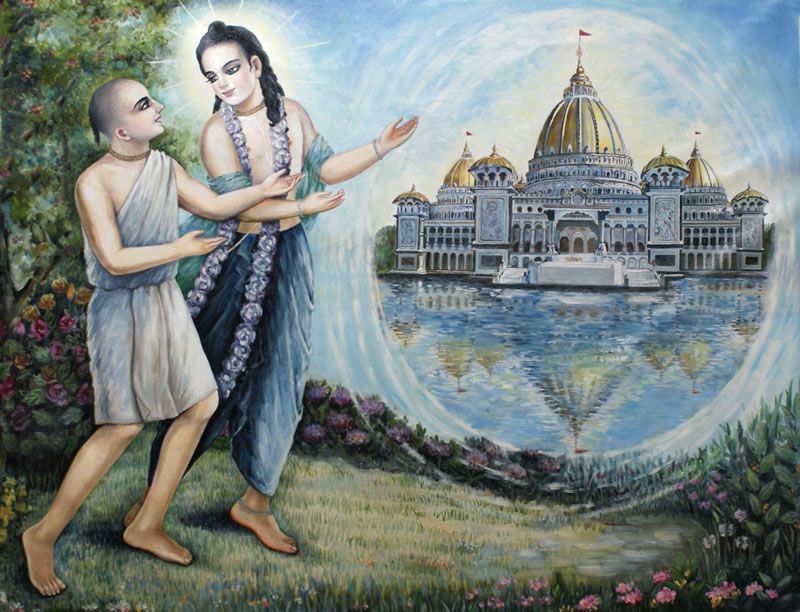
Vallabha Bhaṭṭācārya avoided the river Yamunā. Putting the Lord on a boat in the river Ganges, he went with Him to Prayāga. (113) Due to the great crowds in Prayāga, Śrī Caitanya Mahāprabhu went to a place called Daśāśvamedha- ghāṭa. It was there that the Lord instructed Śrī Rūpa Gosvāmī and empowered him in the philosophy of devotional service. (114) Śrī Caitanya Mahāprabhu taught Śrīla Rūpa Gosvāmī the ultimate limit of the truth about Lord Kṛṣṇa, the truth about devotional service and the truth about transcendental mellows, culminating in conjugal love between Rādhā and Kṛṣṇa. Finally He told Rūpa Gosvāmī about the ultimate conclusions of Śrīmad- Bhāgavatam. (115) Śrī Caitanya Mahāprabhu taught Rūpa Gosvāmī all the conclusions He had heard from Rāmānanda Rāya and duly empowered him so that he could understand them. (116)
By entering the heart of Rūpa Gosvāmī, Śrī Caitanya Mahāprabhu empowered him to ascertain properly the conclusions of all truths. He made him an experienced devotee whose decisions correctly agreed with the verdicts of the disciplic succession. Thus Śrī Rūpa Gosvāmī was personally empowered by Śrī Caitanya Mahāprabhu. (117) In his book Caitanya- candrodaya, Kavi- karṇapūra, the son of Śivānanda Sena, has elaborately described the meeting between Śrī Rūpa Gosvāmī and Śrī Caitanya Mahāprabhu. (118) “In the course of time, the transcendental news of Kṛṣṇa’s pastimes in Vṛndāvana was almost lost. To enunciate explicitly those transcendental pastimes, Śrī Caitanya Mahāprabhu empowered Śrīla Rūpa Gosvāmī and Sanātana Gosvāmī with the nectar of His mercy to carry out this work in Vṛndāvana.” (119) “From the very beginning, Śrīla Rūpa Gosvāmī was deeply attracted by the transcendental qualities of Śrī Caitanya Mahāprabhu. Thus he was permanently relieved from family life. Śrīla Rūpa Gosvāmī and his younger brother, Vallabha, were blessed by Śrī Caitanya Mahāprabhu. Although the Lord was transcendentally situated in His transcendental eternal form, at Prayāga He told Rūpa Gosvāmī about transcendental ecstatic love of Kṛṣṇa. The Lord then embraced him very fondly and bestowed all His mercy upon him.” (120)
“Indeed, Śrīla Rūpa Gosvāmī, whose dear friend was Svarūpa Dāmodara, was the exact replica of Śrī Caitanya Mahāprabhu, and he was very, very dear to the Lord. Being the embodiment of Śrī Caitanya Mahāprabhu’s ecstatic love, Rūpa Gosvāmī was naturally very beautiful. He very carefully followed the principles enunciated by the Lord, and he was a competent person to explain properly the pastimes of Lord Kṛṣṇa. Śrī Caitanya Mahāprabhu expanded His mercy to Śrīla Rūpa Gosvāmī just so he could render service by writing transcendental literatures.” (121) The characteristics of Śrīla Rūpa Gosvāmī have thus been described in various places by the poet Kavi- karṇapūra. An account has also been given of how Śrī Caitanya Mahāprabhu bestowed His causeless mercy upon Śrīla Rūpa Gosvāmī and Śrīla Sanātana Gosvāmī. (122) Śrīla Rūpa Gosvāmī and Sanātana Gosvāmī were the objects of love and honor for all the great stalwart devotees of Śrī Caitanya Mahāprabhu. (123)
If someone returned to his country after seeing Vṛndāvana, the associates of the Lord would ask him questions. (124) They would ask those returning from Vṛndāvana, “How are Rūpa and Sanātana doing in Vṛndāvana? What are their activities in the renounced order? How do they manage to eat?” These were the questions asked. (125) The Lord’s associates would also ask, “How is it that Rūpa and Sanātana are engaging in devotional service twenty- four hours daily?” At that time the person who had returned from Vṛndāvana would praise Śrīla Rūpa and Sanātana Gosvāmīs. (126) “The brothers actually have no fixed residence. They reside beneath trees—one night under one tree and the next night under another. (127) “Śrīla Rūpa and Sanātana Gosvāmī beg a little food from the houses of brāhmaṇas. Giving up all kinds of material enjoyment, they take only some dry bread and fried chickpeas. (128) “They carry only waterpots, and they wear torn quilts. They always chant the holy names of Kṛṣṇa and discuss His pastimes. In great jubilation, they also dance. (129) “They engage almost twenty- four hours daily in rendering service to the Lord. They usually sleep only an hour and a half, and some days, when they continuously chant the Lord’s holy name, they do not sleep at all. (130) “Sometimes they write transcendental literatures about devotional service, and sometimes they hear about Śrī Caitanya Mahāprabhu and spend their time thinking about the Lord.” (131)
Deepen your Bhakti-yoga practice, harmonize relationships, and receive guided coaching — all at Vedavarsity.com