


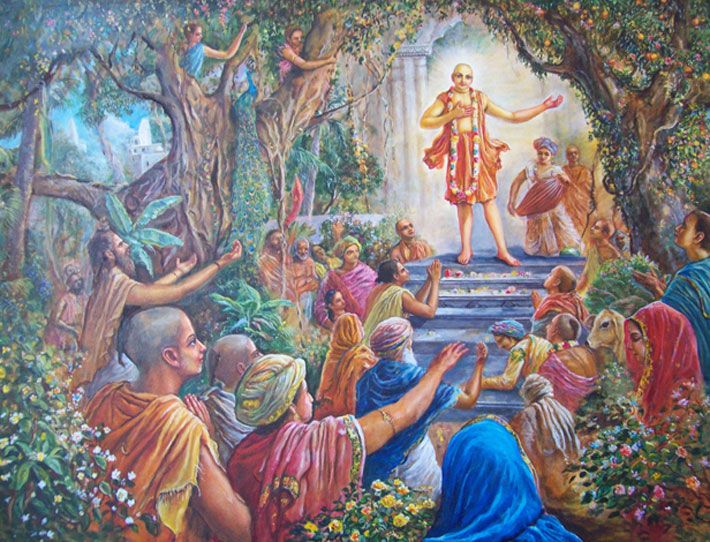
There is no one as merciful as Śrī Caitanya Mahāprabhu within all three worlds. Simply by seeing Him from a distance, one is overwhelmed with love of Godhead. (121) The Lord then got into a new boat and crossed the river. Walking in the full moonlight, He finally reached the town known as Caturdvāra. (122) The Lord spent the night there and in the morning took His bath. At that time, remnants of Lord Jagannātha’s food arrived. (123) Following the King’s orders, the superintendent of the temple sent large quantities of prasādam every day, and it was carried by many persons. (124) After accepting the prasādam, Śrī Caitanya Mahāprabhu stood up and started to go, chanting the holy names, “Hari! Hari!” (125)
Rāmānanda Rāya, Mardarāja and Śrī Haricandana always went with Śrī Caitanya Mahāprabhu and rendered various services. (126) Paramānanda Purī Gosvāmī, Svarūpa Dāmodara, Jagadānanda, Mukunda, Govinda, Kāśīśvara, Haridāsa Ṭhākura, Vakreśvara Paṇḍita, Gopīnātha Ācārya, Dāmodara Paṇḍita, Rāmāi, Nandāi and many other devotees accompanied the Lord. I have mentioned only the chief devotees. No one can describe the total number. (127-129) When Gadādhara Paṇḍita started to go with the Lord, he was forbidden to come and was asked not to give up the vow of kṣetra- sannyāsa. (130) When he was requested to return to Jagannātha Purī, Gadādhara Paṇḍita told the Lord, “Wherever You are staying is Jagannātha Purī. Let my so- called kṣetra- sannyāsa go to hell.” (131)
When Śrī Caitanya Mahāprabhu asked Gadādhara Paṇḍita to remain at Jagannātha Purī and engage in Gopīnātha’s service, Gadādhara Paṇḍita replied, “One renders service to Gopīnātha a million times simply by seeing Your lotus feet.” (132) Śrī Caitanya Mahāprabhu then said, “If you abandon His service, it will be My fault. It is better that you remain here and render service. That will be My satisfaction.” (133) The Paṇḍita replied, “Do not worry. All the faults will be on my head. I shall not accompany You but shall go alone. (134) “I shall go to see Śacīmātā, but I shall not go for Your sake. I shall be responsible for the abandoning of my vow and service to Gopīnātha.” (135) Thus Gadādhara Paṇḍita Gosvāmī traveled alone, but when they all arrived at Kaṭaka, Śrī Caitanya Mahāprabhu called him, and he went into the Lord’s company. (136) No one can understand the loving intimacy between Gadādhara Paṇḍita and Śrī Caitanya Mahāprabhu. Gadādhara Paṇḍita gave up his vow and service to Gopīnātha just as one gives up a piece of straw. (137)
Gadādhara Paṇḍita’s behavior was very pleasing to Śrī Caitanya Mahāprabhu’s heart. Nevertheless, the Lord took his hand and spoke to him, displaying the anger of love. (138) “You have abandoned Gopīnātha’s service and broken your vow to live in Purī. All that is now complete because you have come so far. (139) “Your wanting to go with Me is simply a desire for sense gratification. In this way, you are breaking two religious principles, and because of this I am very unhappy. (140) “If you want My happiness, please return to Nīlācala. You will simply condemn Me if you say any more about this matter.” (141) Saying this, Śrī Caitanya Mahāprabhu got into a boat, and Gadādhara Paṇḍita immediately fell down unconscious. (142) Śrī Caitanya Mahāprabhu ordered Sārvabhauma Bhaṭṭācārya to take Gadādhara Paṇḍita with him. The Bhaṭṭācārya told Gadādhara Paṇḍita, “Get up! Such are the pastimes of Śrī Caitanya Mahāprabhu. (143)
“You should know that Lord Kṛṣṇa Himself violated His own promise just to keep the promise of Grandfather Bhīṣma. (144) “‘Intending to make my promise true, Lord Kṛṣṇa broke His own promise not to take up a weapon at Kurukṣetra. With His outer garment falling off, Lord Śrī Kṛṣṇa jumped from His chariot, picked up a wheel and came running at me to kill me. Indeed, He rushed at me like a lion going to kill an elephant, and He caused the whole earth to tremble.’ (145) “Similarly, tolerating separation from you, Śrī Caitanya Mahāprabhu has protected your vow with great endeavor.” (146) In this way Sārvabhauma Bhaṭṭācārya revived Gadādhara Paṇḍita. Then both of them, very much grief- stricken, returned to Jagannātha Purī, Nīlācala. (147) All the devotees would abandon all kinds of duties for Śrī Caitanya Mahāprabhu’s sake, yet the Lord did not like the devotees’ giving up their promised duties. (148)
All these are the misgivings of loving affairs. Whoever listens to these incidents gets the shelter of Śrī Caitanya Mahāprabhu’s lotus feet very soon. (149) When Śrī Caitanya Mahāprabhu and His party arrived at Yājapura, the Lord asked the two government officers who had come with Him to return. (150) Śrī Caitanya Mahāprabhu bade farewell to the officers, and Rāya Rāmānanda continued on with the Lord. The Lord talked to Rāmānanda Rāya about Śrī Kṛṣṇa day and night. (151) In each and every village, in compliance with the King’s order, government officers constructed new houses and filled each of them with stocks of grain. Thus they served the Lord. (152) Śrī Caitanya Mahāprabhu finally arrived at Remuṇā, where He bade farewell to Śrī Rāmānanda Rāya. (153) When Rāmānanda Rāya fell to the ground and lost consciousness, Śrī Caitanya Mahāprabhu took him upon His lap and began to cry. (154)
Caitanya Mahāprabhu’s feelings of separation from Rāmānanda Rāya are very difficult to describe. Indeed, it is almost intolerable to do so, and therefore I cannot describe them further. (155) When Śrī Caitanya Mahāprabhu finally arrived at the border of the state of Orissa, a government officer came there to meet Him. (156) For two or four days, the government officer served the Lord. He also gave the Lord detailed information of what was ahead. (157) He informed the Lord that the territory ahead was ruled by a Muslim governor who was a drunkard. Out of fear of this king, no one could walk the road freely. (158) The jurisdiction of the Muslim government extended up to Pichaladā. Due to fear of the Muslims, no one would cross the river. (159) Mahārāja Pratāparudra’s government officer further informed Śrī Caitanya Mahāprabhu that He should stay at the Orissa border for some days so that a peaceful agreement could be negotiated with the Muslim governor. In that way, the Lord would be able to cross the river peacefully in a boat. (160)
At that time, a follower of the Muslim governor arrived at the Orissa encampment dressed in disguise. (161) The Muslim spy saw the wonderful characteristics of Śrī Caitanya Mahāprabhu, and when he returned to the Muslim governor, he told him, “A mendicant has come from Jagannātha Purī with many liberated persons. (162-163) “All these saintly people incessantly chant the Hare Kṛṣṇa mahā- mantra, and they all laugh, dance, chant and cry. (164) “Many millions upon millions of people come to see Him, and after they see Him, they cannot return home. (165) “All these people become like madmen. They simply chant the holy name of Kṛṣṇa and dance. Sometimes they even cry and roll on the ground. (166) “Actually these things cannot even be described. One can understand them only by seeing. Considering His influence, I accept Him as the Supreme Personality of Godhead.” (167)
After saying this, the messenger began to chant the holy names of Hari and Kṛṣṇa. He also began to laugh and cry, dance and sing exactly like a madman. (168) When the Muslim governor heard this, his mind changed. He then sent his secretary to the representative of the Orissan government. (169) The Muslim secretary came to see Śrī Caitanya Mahāprabhu. When he offered his respects to the Lord’s lotus feet and uttered the holy name of the Lord, “Kṛṣṇa, Kṛṣṇa,” he also was overwhelmed with ecstatic love. (170) After calming down, the Muslim secretary offered his respects and informed the representative of the Orissan government, “The Muslim governor has sent me here. (171) “If you agree, the Muslim governor will come here to meet Śrī Caitanya Mahāprabhu and then return. (172) “The Muslim governor is very eager, and he has submitted this petition with great respect. It is a proposal for peace. You need not fear that we will fight.” (173)
Upon hearing this proposal, the representative of the Orissan government, the mahā- pātra, was very much astonished. He thought, “The Muslim governor is a drunkard. Who has changed his mind? (174) “It must be Śrī Caitanya Mahāprabhu Himself who has changed the Muslim’s mind. Due to His presence and even due to His remembrance, the whole world is liberated.” (175) After thinking this, the mahā- pātra immediately informed the Muslim secretary, “It is a great fortune for your governor. Let him come visit Śrī Caitanya Mahāprabhu. (176) “However, let me make it understood that he should come here without weapons. He may bring with him five or seven servants.” (177) The secretary returned to the Muslim governor and informed him of this news. Dressing himself like a Hindu, the Muslim governor then came to see Śrī Caitanya Mahāprabhu. (178) Upon seeing Śrī Caitanya Mahāprabhu from a distant place, the Muslim governor fell to the ground and offered obeisances. Tears came to his eyes, and he was jubilant with ecstatic emotions. (179)
Deepen your Bhakti-yoga practice, harmonize relationships, and receive guided coaching — all at Vedavarsity.com