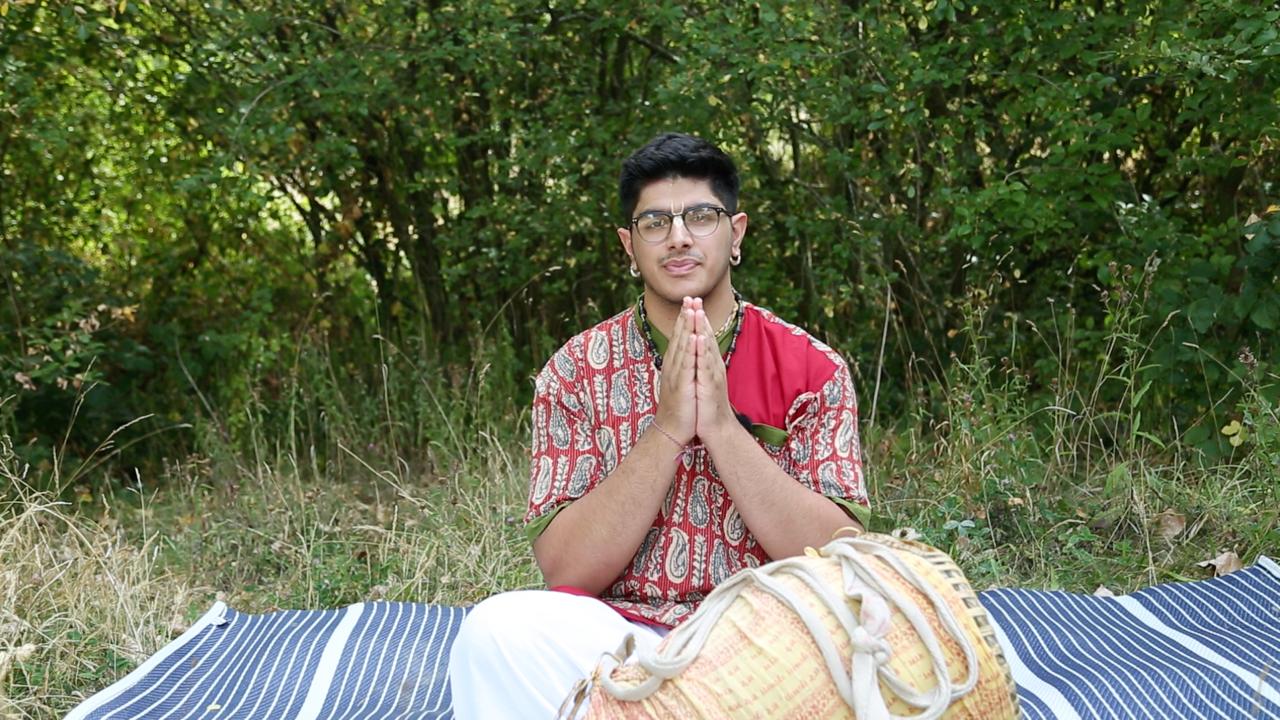
When Balram Thanki speaks about the mridanga, his voice settles into a steady rhythm of its own. The drum has shaped most of his life, and the memories tied to it come easily to mind when he talks. Personally, the mridanga is history, service, identity, and a teacher all at once for him. That connection sits at the heart of The Mridanga Circle, an online training and community platform that teaches devotees how to play the Mridanga with proper technique, heritage, and devotional understanding.
“It started off as a small project,” he said. “Somehow, a lot of devotees around the world have come to like the content we’re sharing. I’m very grateful for that.” The initiative now offers structured training, community spaces, and teachings grounded in lineages such as Narottam Dās Ṭhākur and other ācāryas who carried forward the tradition of praising the Holy names of Krishna through the revered beats of the Balaram drum.
The story stretches back to his early years, long before the idea of a website ever surfaced.
Early Foundations
Balram grew up in a devotee family between Stoke-on-Trent and Manchester, where temple weekends and community service shaped his childhood. Youth gatherings, japa walks, Bhagavatam readings, and festival service filled his routine. Much of it came from his parents’ enthusiasm. “Parents just go off on one,” he said with a laugh. “So many programs, so many yatras. As kids, we just come along, and somehow you absorb that culture.”
His connection to the Mridanga began with a simple moment at home. “My dad said, here’s a YouTube video. Try and learn one beat and see how it goes.” That single beat drew him in, and it did not take long for the instrument to anchor itself in his daily life. “I got hooked on it. Ever since then, I’ve been obsessed with the Mridanga.”
His enthusiasm faced a challenge familiar to many young devotees. Smaller temples often lack trained players. “There was never a culture of encouraging each other to learn,” he said. “You just had to scavenge for ways to learn the Mridanga.” He watched videos repeatedly and asked senior players questions at festivals. Every answer opened another door.
Those years of piecing things together shaped his understanding of what a future platform could offer.
Discovering the Depth Behind Technique
As he grew older, he began to uncover the instrument’s heritage. Teachings on symbolism and philosophical meaning changed his relationship with the drum. Learning that Narottam Dās Ṭhākur had formalized the purest school of Mridanga playing helped him see the instrument as part of a lineage. Understanding that traditional clay Mridangas carry thirty-two leather straps, reflecting the thirty-two syllables of The Mahā-Mantra, shifted his approach to practice. Realizing the drum is considered an expansion of Lord Balarāma deepened that connection.
“My whole thought of the Mridanga changed,” he said. “It’s like another layer opens, and your whole world around it expands.”
A moment during a youth retreat in Spain brought the lesson home. He described a senior devotee leading Jaya Rādhā Mādhava with a simple beat. The rhythm was plain, but the mood was strong. “He played it with so much devotion that it sounded better than the advanced patterns we usually aspire to master,” he recalled. That experience clarified something that technique alone could not offer.
“If the Mridanga isn’t used to serve Krishna, it can’t even be called a Mridanga,” he said. “That very word means serving Krishna in pure absorption.” This realization eventually shaped the foundation of The Mridanga Circle.

Building the Platform
The Mridanga Circle now offers a guided course that takes beginners into steady temple-level playing. The curriculum mixes technique and devotional understanding. The platform’s membership space adds another layer with weekly prompts, reflections, discussions, and community updates. Students use it to ask questions, share discoveries, and connect. Many treat it like an ongoing satsanga space.
“Most of the Instagram captions I’ve posted are like diary entries,” he said. “My realizations, my experiences… I want to inspire others to share theirs too.”
The community now includes devotees from the United States, India, the United Kingdom, Croatia, and other parts of Europe. Many come from temples that never had formal training available. Some join to improve their service. Others join to understand the heritage behind the beats they already know.
Several stories stand out. One involves a retreat in New Māyāpur where a young devotee sat with him for nearly four hours discussing beats, mood, and philosophy. That devotee took those insights back to his temple in the United States. Senior players there learned ideas they had never heard before, too. Their kīrtan mood changed. Their playing changed. That young devotee later told him that the conversation altered the way their entire community approached the instrument.
Moments like these confirmed the need for a central place to learn properly.
A Cultural Shift
A major part of his mission is to foster a respectful, thoughtful culture around this sacred instrument. Many players grow up learning beats without understanding the devotional meaning behind them. He hopes to change this. “A robotic mentality,” as he described it, rarely engages the heart. He encourages students to uncover their own natural expression. “We all have a different relationship with Krishna,” he said. “That means a different offering, a different flavour. Show it.”
He also teaches students to treat the Mridanga with care. And often explains that the drum responds when a player treats it with warmth and attention. “A guest needs care and personal attention,” he said. “The Mridanga is no different.”
This approach is already influencing small communities. More devotees are now interested in learning the instrument with a thoughtful, devotional mindset. The shift is slow but steady.
Looking Ahead
The long-term vision for The Mridanga Circle includes expanding its reach, supporting temples with limited training, and offering retreats that connect students to historical Mridanga sites in the Vaishnava tradition. He hopes to build a global network of players who understand technique and meaning equally. Plans for the future also include adding more teachings on lineage and devotional history to the online space.
“I just want to see more Mridanga players in our movement,” he said. “And I want them to play with meaning. With absorption. With purity.”
The Mridanga Circle continues to grow, and its story is still unfolding. For devotees who want to learn more or join the community, Balram can be reached on Instagram
Deepen your Bhakti-yoga practice, harmonize relationships, and receive guided coaching — all at Vedavarsity.com