


Overview
For Śrī Rādhāṣṭamī, we present this lecture by Prabhupāda Bhaktisiddhānta Sarasvatī Ṭhākura given on Thursday, 26th August, 1925, at Kolkata Gauḍīya Maṭha, on the occasion of Rādhāṣṭamī. Amongst other topics, Sarasvatī Ṭhākura talks about the pre-eminent position of Rādhārāṇī, how Rūpa Gosvāmī’s descriptions of the afternoon pastimes of Rādhā-Govinda surpasses the narrations of Nimbārkācārya, the prerequisite to understand higher topics, and Śrī Rūpa and Jīva Gosvāmī’s opinions on Svākiya and Parakīya-rasa.
yasyāḥ kadāpi vasasāñcala-khelanottha
dhanyāti-dhanya pavanena kṛtārthamānī
yogendra-durgama-gatir madhusūdano’pi
tasyā namo’stu vṛṣabhānubhuvo diśe’pi
May our respects be offered unto Śrīmatī Vṛṣabhānu-nandinī, by whose flowing garment the wind, becoming supremely blessed, touched the body of Kṛṣṇa, and thereby made Śrī Nanda-nandana feel most fulfilled – who Himself is most difficult to attain, even for the monarchs amongst yogīs.
This statement has been sung by Tridaṇḍipāda Śrī Prabodhānanda Sarasvatī in his Śrī Rādhā-rasa-sudhā-nidhi. Śrī Prabodhānanda himself is a great yogī; in kṛṣṇa-līlā he is Tuṅgavidyā. Following in the footsteps of Śrī Prabodhānanda-pāda, we too offer our obeisance unto the daughter of Vṛṣabhānu.
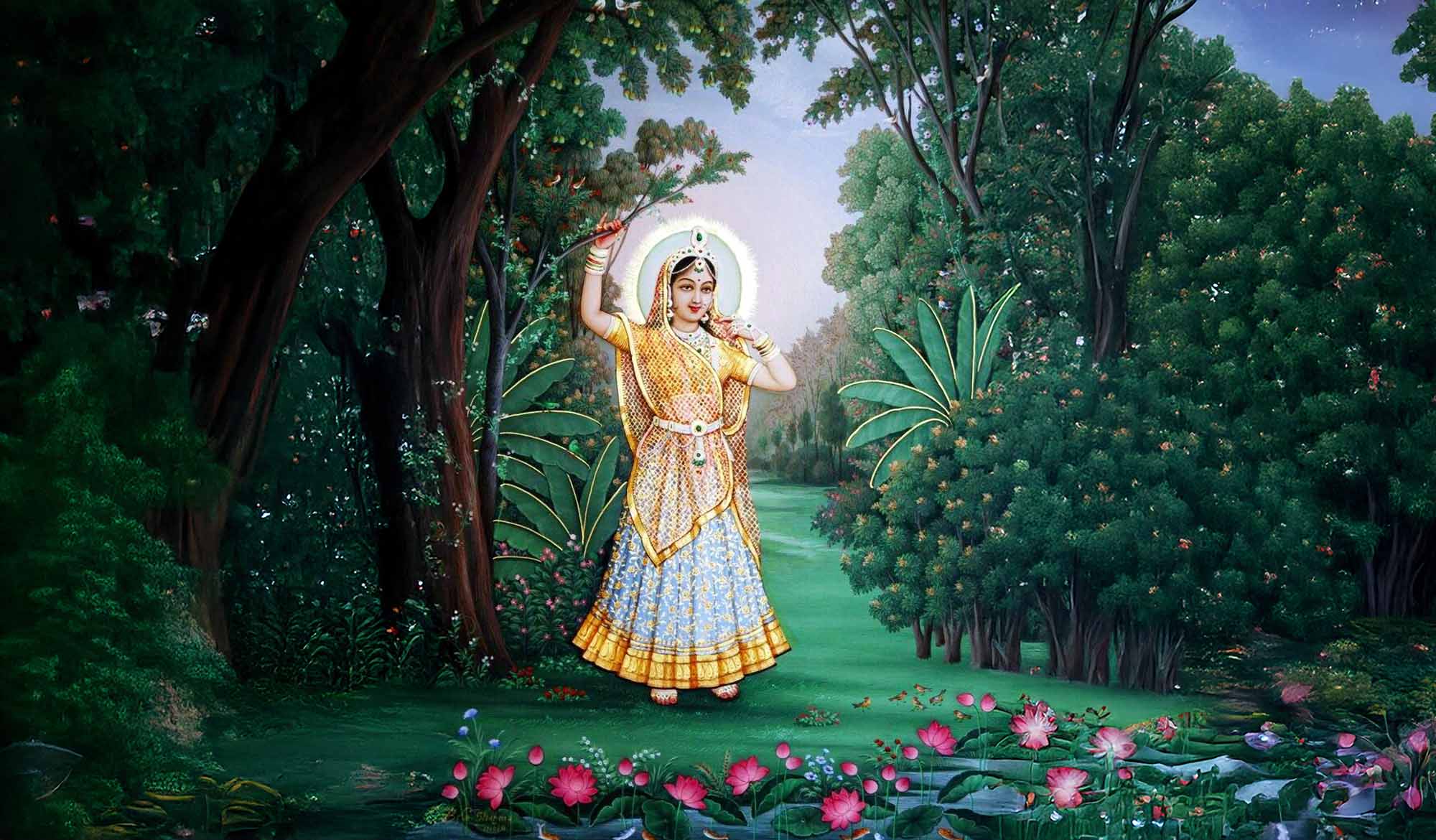
Śrī Rādhā – The Enchantress of Govinda
In this world, there exists many kinds of objects that serve as the very abodes of beauty, charm, and qualities. Śrī Kṛṣṇacandra is the shelter of all rasas, as well as the foundation of qualities such as beauty, charm etc. He is the fundamental āśraya-tattva of all opulence, strength, and knowledge. Moreover, how great is His essential nature of that supremely perfect Bhagavān, who is both the āśraya (the abode of divine love) and the viṣaya (the object of divine love)? It is beyond human comprehension, and even beyond the conception of many mukta-puruṣas, or liberated souls. Śrī Kṛṣṇa, by whose majesty and sweetness the whole universe is charmed, who becomes captivated by His own beauty, is Himself enchanted by Her. The greatness of She who enchants even Madana-mohana, the bewilderer of the universe, is beyond the power of language to convey to others.
The Glories of Śrī Rādhā, the Āśraya-Vigraha, are Solely Known and Proclaimed by Kṛṣṇa Himself.
Although Kṛṣṇa is the viṣaya–tattva (the object of love), still, He is the viṣaya of the āśraya (Śrī Rādhā). In the material world, there are classifications of distinctions and material relationships that exist between men and women – there are higher and lower bhāvas, and mutual differences. However, between Śrīmatī Rādhikā and Śrī Kṛṣṇa, such types of distinctions or material relationships do not exist. Vṛṣabhānu-nandinī is not inferior to Kṛṣṇa. Śrī Kṛṣṇa Himself, as both the relisher (āsvādaka) and the relished (āsvādita), eternally assumes two forms. If Śrīmatī Rādhikā’s beauty were not greater than Kṛṣṇa’s, whose unparalleled beauty enchants even Himself, then it cannot be possible for Her to enchant Him. Śrīmatī Rādhā is Bhuvana-mohana-mana-mohinī (the enchantress of the mind of Kṛṣṇa, who charms the world), Hari-hṛṅga-mañjarī (the tender bud embracing Hari’s body), Mukunda-madhu-mādhavī (the sweet mādhavī blossom of Mukunda), Pūrṇa-candra-kṛṣṇa-pūrṇima-svarūpiṇī (the embodiment of the full moon to the full moon-like Kṛṣṇa), and Kṛṣna-kāntā-gaṇa-śiromaṇi-svarūpā (the personified crest-jewel amongst those who are Kṛṣṇa’s beloved). The ontological truth of Vṛṣabhānu-nandinī cannot be explained in the language of an individual jīva, or even of the collective jīvas. The sevaka (servant) has no such language by which he can properly describe his sevya-vastu (the object of his service). Yet service alone is capable of describing the ontological truth of the servant. Hence, it is Bhagavān Kṛṣṇacandra Himself who can reveal to us the tattva of Śrīmatī Rādhārāṇī.
There is also another who is capable of making the tattva of Govindānandinī the object of realisation for our purified ātmā; that is, one who directly serves both Vṛṣabhānu’s daughter and Kṛṣṇa – that is, Śrī Gurudeva, the intimate associate of Śrī Gaurasundara, or those who are the very potency of Gaura. That Kṛṣṇacandra, who is rādhā-bhāva-dyuti-suvalita-tanu (who has assumed a form endowed with Rādhā’s heart and halo), in other words, who has accepted Her mood and splendour – that Kṛṣṇacandra alone can reveal Śrīmatī’s glories within the mundane world. His most beloved servants can also speak of that supreme tattva, but apart from them, no one else is capable.
Prior to Śrī Gaurasundara’s Teachings, Narrations About the Midday Service of Śrīmatī Were Unknown
Previously, the way in which narrations concerning the Daughter of Vṛṣabhānu were propagated in the world – in other words, the way that Ācārya Nimbārkapāda described the method of worshipping Śrī Rādhā-Govinda to Śrīnivāsācārya and others – in that, the glories of Śrīmatī were not revealed in the material world in such an elaborate manner. To those who had absolutely no right of entry into the midday pastimes (madhyahnika–līlā), the accounts of the nocturnal pastimes (niśa-līlā) of Śrī Rādhā-Govinda had become greatly honoured by them. The narrations of the nocturnal pastimes on the banks of the Yamunā which Śrī Nimbārka-pāda has sung, are far surpassed in comparison by the excellent descriptions of the sweet midday pastimes of Śrī Rādhā-Govinda, as spoken by Śrī Rūpa-pāda, the most beloved of Śrī Gaurasundara, and his followers, as they are much more elevated and complete. Before the advent of Śrī Gaurasundara, based upon the doctrine of Acintya-bhedābheda and in contrast to the deliberations of Dvaita-advaita philosophy, no worshipper or ācārya was able to properly describe the excellence of rasa, the confidential plane of Goloka, and the ever-fresh, unparalleled playful pastimes that unfold beneath the transcendental desire-trees in the kuñjas along the banks of Rādhā-kuṇḍa. Some of them were merely acquainted with the accounts of the pastimes at the rāsa-sthalī. But in what manner Vṛṣabhānu-nandinī achieves the right of serving Kṛṣṇa at midday – previously, no one ever had the eligibility to enter into that service of sweetness and beauty. Attracted by the sound of the flute, so many of Kṛṣṇa’s maidservants – unmarried girls, married women etc. – had attained the qualification to participate in the rāsa-sthalī. But the fortune of entering into the zenith of līlā specified by the phrase, dolāraṇyāmbu-vaṁśī-hṛti-rati-madhupānārka-pūjādi-līlau* which has been described by Śrī Rūpa, is not attainable by anyone other than the Gauḍīyas, the associates of Gaura, who serve in madhura-rasa. This topic is not known to anyone of the Nimbārka sampradāya.
* Dolāraṇyāmbu-vaṁśī-hṛti-rati-madhupānārka-pūjādi-līlau – They engage in various pastimes – playing on a swing, wandering in the forest, sporting in the water, hiding the flute, drinking honey-beverages, worshipping the sun and so on. (Govinda-līlāmṛta 8.1)
The Divine Mellows of Madhura-Rasa Are Beyond the Reach of Those Who Take Refuge in Mundane Rasa
The exalted status of Śrīmatī’s pālya-dāsīs (personal maidservants) is not within the grasp of human understanding. No one except Her own associates, who are eternally engaged in the intimate service of Vārṣabhānavī, can know all these topics. The day when you have no perception whatsoever of the external world, when trivial morality, austerity, karma, jñāna, and endeavours in yoga will seem to be things fit to be rejected, when even accounts of the awe-filled Śrī Nārāyaṇa will seem to be distasteful, and when even the dance at the rāsa-sthalī will not seem to be such a great topic – on that day alone will you be able to understand these matters.
Matters concerning Śrī Rādhā-Govinda’s service cannot be expressed in the language of any country. When the words svakīya and pārakīya are spoken,* we mix them with our own conception of sensual pleasure. For this reason, those who are qualified to speak, hear, and understand the pastimes of Śrī Rādhā-Govinda are extremely rare – it would not even be an exaggeration to say that such people do not exist in this world.
* Svakīya means legal conjugal mellows; pārakīya means paramourship.
The Misconceptions and Misunderstanding of the Prākṛta Sahajiyās
One group of prākṛta-sahajiyās says that Śrī Rūpa-pāda displayed madness for pārakīya–sevā, but Śrī Jīva was not like that. The decisions of those who judge through their mundane senses and arrive at a conclusion are not in accordance with the actual truth. Śrī Jīva-pāda, the foremost of Śrī Rūpa’s followers, was established in the position of ācārya after Śrī Rūpa Gosvāmī. The prākṛta-sahajiyās sect falsely imagines or alleges that Śrī Jīva-pāda, by describing the marriage of Śrī Rādhā-Govinda in the text of Gopāla Campū, and by following the path of deliberation in the Sandarbhas, has silenced the pure pārakīya doctrine, as propounded by Śrī Rūpa. In reality, this is not the case. We have observed such misconceptions in the prākṛta-sahajiyā tradition going back two or three hundred years. Even today, that notion is seen to be prevalent in the prākṛta-sahajiyā community. Śrī Jīva-pāda is the ācārya of the Rūpānuga Gauḍīyas. He has endeavoured to protect insignificant jīvas as ourselves, from straying on the wrong path. Thus, for those who are overcome by perverted tastes, who lack the capacity to understand spiritual diversity, Śrījīva-pāda has shown such a deliberation on the true siddhānta so that all dull, materialistic people may not fall into great difficulty.
Even such persons who have attained the apex of morality, who have attained expertise in renunciation, observance of great vows, and dharma are not capable of understanding even a particle of these astonishing pastimes. Such are the transcendental pārakīya pastimes that are full of astonishment. Because unqualified persons are incapable of understanding it, in certain places, Śrī Jīva-pāda has presented conceptions based on morality according to the eligibility of the adhikārī. Through this, no fault arises in kṛṣṇa-bhajana. The lawful marriage of Rādhā-Govinda, as described in Gopāla Campū, is not an attack on Their pārakīya–bhāva.
Śrīmatī Rādhikā, the foremost Heroine of pārakīya–rasa and Daughter of Vṛṣabhānu, having completely renounced all worldly desires – including the familial bonds with Her husband Abhimanyu – is prepared at all times to serve the Son of the king of Vraja, who is the Absolute Truth beyond duality. Yet the sahajiyās, who fully consider this through mundane intelligence, may think that She was attached to worldly enjoyment. In reality, such a view is a misunderstanding of Her supreme, selfless devotion. But even compared to Arundhatī,* the chastity of Vṛṣabhānu-nandinī is greater. Pati-vratya-dharma (the marital duty of a chaste wife) has entirely arisen from Vārṣabhānavī alone. The essence of all good morality is contained in the lotus feet of Vṛṣabhānu-nandinī.
yāṅra pati-vratā-dharma vāñche arundhatī
Arundhatī desires the pati-vratya-dharma of Rādhikā (Caitanya-caritāmṛta, Madhya-līlā 8.184)
*Arundhatī is the wife of Vasiṣṭha Muni, and is famous for her chastity to her husband.
An Analysis of Rasa, or Rati, and Samāgrī
Śrī Kṛṣṇa is the origin (aṁśī) of all viṣṇu-tattva. Śrīmatī is the origin (aṁśīnī) of all all Mahā-Lakṣmīs. Śrī Kṛṣṇa, as the aṁśī–avatārī (origin of all avatāras), expands as various avatāras such as prābhava, vaibhava, and the puruṣas. Similarly, aṁśīnī Śrīmatī Rādhikā expands as the Lakṣmīs, Mahishīs (queens of Dvārakā), and the beautiful women of Vraja. Śrī Kṛṣṇa alone is the Master of all, and Śrī Vṛṣabhānu-nandinī alone is eternally qualified to serve Him. Thus, She is nothing other than His nitya-kāntā-śiromaṇi (the crest-jewel amongst His eternal lovers).
Śrī Kṛṣṇa is the only viṣaya (enjoyer). All jīvātmās, possessing sthayī-rati (eternal attachment), are the āśraya (the source of enjoyment) of that bhagavat-tattva. Śānta (neutrality), dāsya (servitude), sakhya (friendship), vātsalya (parental affection), and mādhurya (conjugal love) – these are the five kinds of rati (attachment) or sthayī-bhāva (permanent ecstatic moods) in relation to Śrī Kṛṣṇa. This rati, in the form of sthayī-bhāva though itself a form of bliss, attains the state of rasa when it unites with the components of rasa, or samāgrī. The samāgrī is of four types:
- Vibhāva (voluntary symptoms of bhāva)
- Anubhāva (involuntary symptoms of bhāva)
- Sāttvika (ecstatic symptoms)
- Vyabhicārī, or Sañcārī (transitory bhāvas)
For relishing rati, there are two kinds of vibhāva – ālambana (supportive) and uddīpana (stimulative). There are two types of ālambana – viṣaya (enjoyer) and āśraya (the object of enjoyment). He who is the object of rati – in other words, toward whom the attachment is operative – is the ālambana in the form of the viṣaya. That is, the ālambana in the form of the viṣaya is the goal of rati, and He who is the support of rati, meaning, in whom rati is present – is the ālambana in the form of the āśraya.
The Divine Abode and Uninterrupted Time
In Vaikuṇṭha and other dhāmas, all three phases of time exist simultaneously. In this material world, which is an inferior reflection of Vaikuṇṭha and other realms, the good fortune of the past or future are not experienced in the present – it is not so in the original, transcendental Vaikuṇṭha and other spiritual worlds. There, all good fortune is experienced simultaneously at the same moment in time.
An Analysis of the Mutual Relationship Between the Viṣaya and the Āśraya
In Goloka, advaya-jñāna Śrī Kṛṣṇa, the Absolute Truth beyond duality, is the sole viṣaya, and the infinite jīvātmās are the āśraya. Those who are the āśraya are not separate from the viṣaya, nor are they secondary entities. They are the āśraya of the advaya-jñāna viṣaya. The relationship between the viṣaya and the āśraya is that they are one in essence (vastutva) and many in potency (śaktitva). The sahajiyas, who are fixed in material sense-perception, are incapable of understanding this topic of viṣaya and āśraya. For those who believe in the non-differentiated Absolute (nirviṣeśa-vāda), there is no place for the viṣaya and the āśraya.
In his treatise on poetics named Sāhitya Darpana, Śrīla Narahari Tīrtha, under the name ‘Viśvanātha Kavirāja’ from his previous āśrama, was unable to properly describe the viṣaya and āśraya to this extent. Indeed, even the author of the Kāvya Prakāśa, or Bharata Muni have been incapable of describing it. In the writings of Śrīla Rūpā-pāda, the topic of the transcendental viṣaya and āśraya have been clearly revealed.
Although for the viṣaya-tattva, countless jīvātmās exist as the āśraya, for Vrajendra-nanda, the primary form of the āśraya-tattva is fivefold. In the madhura-rasa, it is Śrī Vṛṣabhānu-nandinī; in vātsalya-rasa, it is Nanda-Yaśodā; in sakhya-rasa, it is Subala and others; in dāsya-rasa, it is Raktaka and others; and in śānta-rasa, it is the cows, deer, the flute, etc. In śānta-rasa, the subtly conscious transcendental entities – the cows, deer, flute, kadamba trees, the banks of the Yāmuna etc. – continuously serve Śrī Kṛṣṇa unknowlingly.
Considerations of Qualified Participants in Madhura-Rasa etc.
Only those who no longer have the leisure to waste on matters of the external world are capable of understanding the essence of these topics. In order to show this, Śrīla Rūpa-pāda enacted the renunciation of worldly things – eating dry roṭis and chickpeas, spending each night under a different tree – and by showing the ideal of renunciation for the pleasure of Kṛṣṇa, he granted the eligibility and qualification to understand all these matters.
In the position and condition in which we are situated, the ontological truths about Śrī Rādhā, the very embodiment of Kṛṣṇa’s love, cannot become perceivable to our gross material senses. The Daughter of Vṛṣabhānu is the āśraya-jātiya (the abode of love) of Kṛṣṇa, the Supreme Reality. In that realm where neither the gross world, the subtle world, nor even the non-differentiated perception of pure consciousness exists – in that transcendental abode where the wondrous divine playful pastimes are fully present – Śrī Rādhikā is present, occupying the supreme position within it. She climbs upon Kṛṣṇa’s chest to serve Him; and for His service; She even goes so far as to goad Him or scold Him. All these matters are not something to be grasped merely by ascending through the higher stages of ordinary human reasoning, nor are they a matter of simply reaching the stage of consciousness acknowledged by the impersonalists. Yet, only one in whom the greed for attaining Kṛṣṇa has arisen, can, by their own inner disposition, realise the essence of all these topics.
The Ontology and Glories of Śrīmatī Vārṣabhānavī
Śrīmatī Rādhikā is the original form of Kāminī who belongs to svayaṁ-rupa Śrī Kāmadeva (Kṛṣṇa as the transcendental God of love). Śrī Rūpa Gosvāmī himself is surrendered to that Vṛṣabhānu-nandinī, who is the original source of all transcendental women. Just as Śrī Kṛṣṇa is the aṁśī (source of all male avatāras), similarly, Śrīmatī is the aṁśiṇī (source of all female avatāras). In the description of Śrīmatī Vṛṣabhānu-nandinī’s nature (Caitanya-caritāmṛta, Madhya-līlā, 8.177) it is found:
kṛṣṇa-līlā-manovṛtti-sakhī āśa-pāśa
The sakhīs are Her mental functions, which are concentrated on the pastimes of Kṛṣṇa.
Thousands upon yutheśvarīs (group leaders) amongst the gopīs, along with the thousands upon thousands of maidservants of the original aṣṭa-sakhīs, are serving Vṛṣabhānu-nandinī at every moment. The sakhīs in the form of Her mental functions are of eight types:
- Abhisārikā (preparing a romantic rendezvous)
- Vāsaka-sajjā (decorating herself)
- Utkanthitā (anxiety due to a delay)
- Khaṇḍitā (jealous)
- Vipralabdhā (dejected)
- Kalahantaritā (separated due to an argument)
- Proṣita-bhartṛkā (feeling separation from the beloved)
- Svādhina-bhartṛkā (controlling the beloved)
Vṛṣabhānu-nandinī, through various servitors, enriches the Lord’s service with the mood of vipralambha (separation), thus producing wonderful transcendental pastimes. Vṛṣabhānu-nandinī has eight sakhīs in the eight directions. Vārṣabhānavī fully possesses the eight moods of the eight sakhīs simultaneously. Kṛṣṇa is the taster of all bhāvas, the relisher of all rasas, the object of all love – taking all those moods as complete instruments, She becomes fulfilled in whatever Kṛṣṇa desires and remains eternally absorbed in the bliss of intimate service to Śrī Kṛṣṇa.
The Ontology and Abundance of Qualities of Śrī Kṛṣṇa
Although all sixty-four qualities of Śrī Kṛṣṇa are fully resplendent at all times in Śrī Nārāyaṇa in their pure, spiritual form, they are present in Śrī Kṛṣṇa in an even more extraordinary way. Moreover, the four unique and heroic qualities of Śrī Kṛṣṇa are not manifested even in Śrī Nārāyaṇa. The surge of the waves of Śrī Kṛṣṇa’s pastimes astound all the worlds. There is nothing equal or superior to the beautiful form that He possesses. He is the player of the flute that captivates the minds of the three worlds. He is resplendent with the unparalleled prema of śṛṅgara-rasa, surrounded by His most beloved circle of companions. In other words, He eternally resides in His spiritual abode, endowed with four extraordinary qualities – līlā-mādhurī (sweet pastimes), rūpa-mādhurī (a sweet form), veṇu-mādhurī (with a sweet flute), and bhakta-mādhurī (with sweet devotees). These four qualities are found in Śrī Kṛṣṇa alone; even Nārāyaṇa does not possess them.
An Analysis of the Distinction and Characteristics of the Conscious and Unconscious worlds.
This material world is a perverted reflection of the spiritual realm. In the transcendental abode there is One who is to be served, and all others are His servants. Also, in the material world, the number of both the served and the servants is many. In the spiritual world, the only happiness of the One Worshipable Object is itself the eternal, spiritual interest of the servants. This material world is but a mutated reflection of that spiritual realm, where there have been, are, and will be many objects of service and many servants. In this material world, the interests of the servant and the served are mutually different. Here, if the service becomes a hindrance to the servant’s own happiness, he abandons his service to the served. In brief, this means that in this place, selflessness, either in the served or the servant, does not exist, and everything here is either lacking in single-minded purpose, or tainted with the defect of disloyalty.*
*Translator’s Note: The original word that Sarasvatī Ṭhākura uses here is vyabhicāra which has been translated as ‘disloyalty.’ However, a more common translation is ‘infidelity’ or ‘adultery.’ Considering that the jīva is female by constitution and is to be enjoyed by Kṛṣṇa, any enjoyment that the jīva engages in which is not centred on Kṛṣṇa is considered to be adultery, just as when a wife has an illicit affair with another person.
The wife serves the husband for her own temporary, selfish interests, and the husband loves the wife for his own enjoyment or sense gratification – in other words, the interests of the husband and wife are not one. In this case, however chaste the wife may be, or however moral the husband may be, since they are bound by the nature of the body and the mind, their endeavours are haitukī (dependent upon a motive), anaikāntikī (uncertain), and avyavasāyātmikā (without consistency). Apart from the sole service to Kṛṣṇa, which is the dharma of the ātmā, there is no service anywhere that is free from disloyalty. The affection of parents toward their son in this material world, the reverence of a son toward the parents — even within that, there is gross or subtle desires for sense-enjoyment, or disloyalty. In the realm of the body and mind, there is only the relation of enjoyer and enjoyed; hence, the pure relation of served and servitor does not exist, nor can it exist.
The knowledge of non-duality is found in Vrajandra-nandana. Where there is only Personality who possesses all potencies, or the viṣaya-tattva – where there is no second Person – there, disloyalty cannot occur. There, the viṣaya is one – ekam evādvitīyam (‘He is one without a second’ – Chāndogya Upaniṣad 6.2.1). Potency is infinite – that means, in considering śaktima-tattva (the principle of the Possessor of potency) and śakti-tattva (the principle of the potency itself), non-dual knowledge perceives the oneness of the viṣaya, or the Supreme, and the āśraya, or the potency, to be infinite. The Śvetāśvatara Upaniṣad (6.8) says:
na tasya kāryaṁ karaṇaṁ ca vidyate na tat samaś cābhyadhikaś ca dṛśyate
parāsya śaktir vividhaiva śrūyate svābhāvikī jñāna-bala-kriyā ca
He has no work to perform, nor any instrument to fulfil it; nor is anyone seen to be His equal or superior. His supreme potency is indeed spoken of as manifold, and knowledge, strength, and action are naturally inherent within Him.
An Analysis of the Relationship between the Potency and the Possessor of Potency
Although the principle of non-dual knowledge and the Possessor of potency are one Reality, since the potencies are numerous, during analysis, various distinct attributes in the potency are observed. The followers of Viśiṣṭādvaita have analysed the distinctiveness of the potency – in other words, in Viśiṣṭādvaita, the non-duality of the Supreme Reality and the distinctiveness of potency are established. Therefore, in that philosophy, there is no consideration of pure kevalādvaita (non-duality), devoid of any relation to the āśraya.
The Means of Attaining the Shelter of the Āśraya-Vigraha
In this Devī-dhāma, all objects of enjoyment may be measured with the aid of sensory perception. Yet no one, by means of that sensory-knowledge, should confuse the sovereign of the transcendental realm, Vṛṣabhānu-nandinī, along with Her associates (in other words, the āśraya-tattva rasikas of the fourfold rasas) with the viṣaya-tattva (Kṛṣṇa). In the terminology of the rhetoricians, they are spoken of as the viṣaya and āśraya; in philosophical language, as śaktimān and śakti; and in the devotees’ language, as sevyā (the served) and sevaka (the servant). If we can take shelter of the eternal āśraya-vigraha, then we will, in truth, attain realisation of the viṣaya. Refuge at the lotus feet of Vṛṣabhānu-nandinī, which is described as sudurlabhād api sudurlabhā (‘more rare than rare’) had not been revealed in such a clear and complete way to the finite vibhinnāṁśa-jīvas before the pastimes of Śrī Gaura. Śrī-Gaurasundara, who is rādhā-bhāva-dyuti-suvalita (who is adormed with the heart and halo of Śrī Rādhā), anarpita-carīṁ-prema-pradātā (who had not previously bestowed prema), and mahā-vadānya (most magnanimous) has properly revealed this confidential topic to the jīvas of this world.
Apart From the Gauḍīyas, Other Vaiṣṇava Ācāryas Lack Realisation of Service to Śrī Rādhā
Even when speaking of Ācārya Nimbārka-pāda’s worship of Śrī Vṛṣabhānu-nandinī, it does not display such profundity. This is because, since there is mention of svakīya-vāda in it, it actually has only culminated in aiming at the worship of Rukmiṇī-vallabha.
parakīyā-bhāve ati rasera ullāsa
vraja vinā ihāra anyatra nāhi vāsa
vraja-vadhū-gaṇera ei bhāva niravadhi
tāra madhye śrī-rādhāya bhāvera avadhi
There is an extreme abundance of pārakīya-bhāva – this is not present anywhere except for Vraja. This bhāva is infinite amongst the gopīs of Vraja, and amongst them, the limits of that bhāva is found in Śrī Rādhā. (Caitanya-caritāmṛta, Ādi-līlā 4.47-48)
gopī-ānugatya vinā aiśvarya-jñāne
bhajileha nāhi pāya vrajendra-nandane
Without following the gopīs, one worships with the conception of reverence, and one will never attain the Son of the king of Vraja. (Caitanya-caritāmṛta, Madhya-līlā 8,230)
Considering his allegiance to Śrī Viṣṇu-Svāmipāda, even though Līlāśuka Śrī Bilvamaṅgala has sung about pastimes based on madhura-rasa in the book Kṛṣṇa Karṇāmṛta, nevertheless therein the supreme wonder of the midday pastimes of the Daughter of Vṛṣabhānu, as propagated by Śrīman Mahāprabhu, have not been revealed. Indeed, they have not even been sung in the book Gīta Govinda of Śrī Jayadeva. We can know from Śrī Jayadeva’s Gīta Govinda that at the time of the rāsa dance, Śrīmatī Vārṣabhānavī, being considered ordinary and equal to the other gopīs, abandoned the rāsa-sthālī due to wounded pride. After the Daughter of Vṛṣabhānu left the rāsa-sthalī, due to Kṛṣṇa’s act of searching for Her alone, it was proven in the highest way that Śrīmatī is indeed Kṛṣṇākarṣiṇī (the one who attracts Kṛṣṇa).
Śrīmatī Vārṣabhānavī is the Original Form of the Supreme Potency
The confidential topic of Vṛṣabhānu-nandinī has been spoken in the Śrīmad Bhāgavata only in the form of subtle indications. Topics concerning Śrīmatī Rādhikā are most mysterious and esoteric, so Śrī Śukadeva has only described them in the Śrīmad Bhāgavata in an indirect manner, in order to conceal them from ordinary readers who are averse to the Lord. Śrīmatī Vārṣabhānavī is the mother of the universe. She is the mother of all entities who originated from the potency. She is the source of the various manifestations of potencies, their qualities, and natures also. As Parameśvarī, She is the para-śakti, the supreme potency, of Parameśvara Śrī Kṛṣṇa in His own original form (svayaṁ rūpa). That which is indicated by saying śaktimad-vastu (the Supreme Possessor of potencies) is the very same thing that is signified by saying śakti (potency). Śrīmatī is worshipable to Baladeva and others. Eeveryone up to Śrī Anaṅga Mañjarī is always busy in serving Śrīmatī Rādhikā. This goddess, Śrī Anaṅga Mañjarī, is celebrated as another form of Śrī Nityānanda-Baladēva Prabhu.
Supreme Auspiciousness is Found in Taking Shelter in Those Who Are Sheltered by Śrī Vārṣabhānavī
Shame upon those who do not recognise the shelter of the divine feet of Śrī Vārṣabhānavī as most desirable. Those who have taken shelter of Śrī Vārṣabhānavī are supremely fortunate! If we can take shelter of those who have obtained the great refuge of that Vārṣabhānavī, then our supreme auspiciousness will be achieved. Therefore:
dīvyad-vṛndāraṇya-kalpa-drumādhaḥ-
śrīmad-ratnāgāra-siṁhāsana-sthau
śrīmad-rādhā-śrīla-govinda-devau
preṣṭhālībhiḥ sevyamānau smarāmi
(Caitanya-caritāmṛta, Ādi-līlā 1.16)
I remember Śrī Rādhā-Govinda, who are seated upon a jewelled throne within the divinely effulgent Vṛndāvana, beneath a wish-fulfilling spiritual tree, surrounded by Śrī Rūpa Mañjarī and the other dedicated maid-servants, together with Śrī Lalitā and the other beloved sakhīs.
(Translated by Swami Bhaktivijñāna Giri)
Deepen your Bhakti-yoga practice, harmonize relationships, and receive guided coaching — all at Vedavarsity.com