In this way, Śrī Caitanya Mahāprabhu described the good qualities of His devotees one after the other. He then embraced them and bade them farewell. (181) Due to the impending separation from Śrī Caitanya Mahāprabhu, all the devotees began to cry. The Lord was also morose due to separation from the devotees. (182) Gadādhara Paṇḍita remained with Śrī Caitanya Mahāprabhu, and he was given a place to live at Yameśvara. (183) Śrī Caitanya Mahāprabhu remained at Jagannātha Purī, Nīlācala, with Paramānanda Purī, Jagadānanda, Svarūpa Dāmodara, Dāmodara Paṇḍita, Govinda and Kāśīśvara. It was Śrī Caitanya Mahāprabhu’s daily practice to see Lord Jagannātha in the morning. (184-185) One day Sārvabhauma Bhaṭṭācārya came before Śrī Caitanya Mahāprabhu with folded hands and submitted a request. (186) Since all the Vaiṣṇavas had returned to Bengal, there was a good chance that the Lord would accept an invitation. (187)
Sārvabhauma Bhaṭṭācārya said, “Please accept my invitation for lunch for one month.” The Lord replied, “That is not possible, because it is against the religious principles of a sannyāsī.” (188) Sārvabhauma then said, “Please accept the invitation for twenty days.” But Śrī Caitanya Mahāprabhu replied, “It is not a religious principle of the renounced order.” (189) When Sārvabhauma requested Caitanya Mahāprabhu to accept lunch for fifteen days, the Lord said, “I shall accept lunch at your place for one day only.” (190) Sārvabhauma Bhaṭṭācārya then caught hold of the Lord’s lotus feet and submissively begged, “Please accept lunch for at least ten days.” (191) In this way, by and by, Śrī Caitanya Mahāprabhu reduced the duration to five days. Thus for five days He regularly accepted the Bhaṭṭācārya’s invitation to lunch. (192) After this, Sārvabhauma Bhaṭṭācārya said, “My Lord, there are ten sannyāsīs with You.” (193)
Sārvabhauma Bhaṭṭācārya then submitted that Paramānanda Purī Gosvāmī would accept a five- day invitation at his place. This had already been settled before the Lord. (194) Sārvabhauma Bhaṭṭācārya said, “Dāmodara Svarūpa is my intimate friend. He will come sometimes with You and sometimes alone. (195) “The other eight sannyāsīs will accept invitations for two days each. In this way there will be engagements for each and every day during the entire month. (196) “If all the sannyāsīs came together, it would not be possible for me to pay them proper respects. Therefore I would be an offender. (197) “Sometimes You will come alone to my place, and sometimes You will be accompanied by Svarūpa Dāmodara.” (198) Having this arrangement confirmed by Śrī Caitanya Mahāprabhu, the Bhaṭṭācārya became very glad and immediately invited the Lord to his house on that very day. (199) Sārvabhauma Bhaṭṭācārya’s wife was known as Ṣāṭhīra Mātā, the mother of Ṣāṭhī. She was a great devotee of Śrī Caitanya Mahāprabhu, and she was affectionate like a mother. (200)
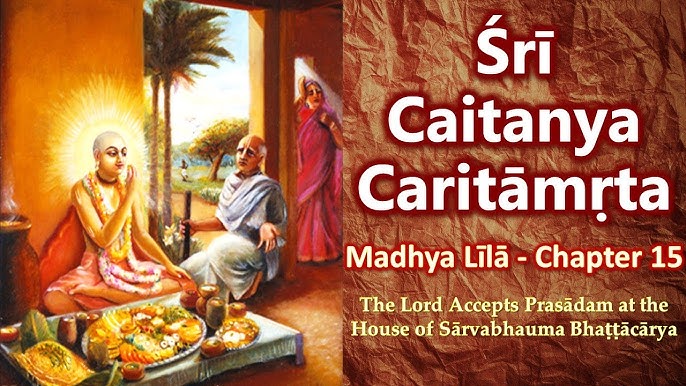
After returning to his home, Sārvabhauma Bhaṭṭācārya gave orders to his wife, and his wife, Ṣāṭhīra Mātā, began cooking with great pleasure. (201) At Sārvabhauma Bhaṭṭācārya’s house, there was always a full stock of food. Whatever spinach, vegetables, fruit and so on were required, he collected and brought back home. (202) Sārvabhauma Bhaṭṭācārya personally began to help Ṣāṭhīra Mātā cook. She was very experienced, and she knew how to cook nicely. (203) On the southern side of the kitchen were two rooms for offering food, and in one of them the food was offered to Śālagrāma Nārāyaṇa. (204) The other room was for Śrī Caitanya Mahāprabhu’s lunch. The Lord’s lunchroom was very secluded, and it was newly constructed by the Bhaṭṭācārya. (205)
The room was so constructed that there was only one door opening on the outside, which served as an entrance for Śrī Caitanya Mahāprabhu. There was another door attached to the kitchen, and it was through this door that the food was brought. (206) First, three mānas of cooked rice—almost six pounds—was poured onto a big banana leaf. (207) Then the whole stack of rice was mixed with so much yellowish and fragrant clarified butter that it began to overflow the leaf. (208) There were a number of pots made of the bark of banana trees and the leaves of the keyā plant. These pots were filled with various cooked vegetables and placed on all sides of the leaf. (209) There were about ten kinds of spinach, a soup called sukhta, which was made with bitter nimba leaves, a pungent preparation made with black pepper, a mild cake made of fried curd, and buttermilk mixed with small fried pieces of dhal. (210)
There were preparations of dugdha- tumbī, dugdha- kuṣmāṇḍa, vesara, lāphrā, mocā- ghaṇṭa, mocā- bhājā and other vegetables. (211) There were unlimited quantities of vṛddha- kuṣmāṇḍa- baḍī, phula- baḍī, fruits and various roots. (212) Other preparations included eggplant mixed with newly grown nimba leaves fried together, light baḍī, fried paṭola and fried rounds of squash and pumpkin. (213) There was a soup made with fried urad dhal and mung dhal, defeating nectar. There were also sweet chutney and five or six kinds of sour preparations, beginning with baḍāmla. (214) There were baḍās made of mung dhal, of urad dhal and of sweet bananas, and there were sweet- rice cakes, coconut cakes and various other cakes. (215)
There were kāṅji- baḍā, dugdha- ciḍā, dugdha- laklakī and various cakes that I am unable to describe. (216) Sweet rice mixed with ghee was poured into an earthen pot and mixed with cāṅpā- kalā, condensed milk and mango. (217) Other preparations included a very delicious churned curd and a variety of sandeśa sweetmeats. Indeed, all the various eatables available in Bengal and Orissa were prepared. (218) Thus the Bhaṭṭācārya prepared a great variety of food and spread a fine cloth over a white wooden platform. (219) On two sides of the stack of food were pitchers filled with scented cold water. The flowers of the tulasī tree were placed atop the mound of rice. (220) Sārvabhauma Bhaṭṭācārya also included several types of food that had been offered to Lord Jagannātha. These included sweetballs known as amṛta- guṭikā, sweet rice and cakes. All these were kept separate. (221) When everything was ready, Śrī Caitanya Mahāprabhu came there alone after finishing His midday duties. He knew the heart of Sārvabhauma Bhaṭṭācārya. (222)
After Sārvabhauma Bhaṭṭācārya washed the Lord’s feet, the Lord entered the room to take His lunch. (223) Śrī Caitanya Mahāprabhu was a little astonished to see the gorgeous arrangement, and gesturing, He spoke to Sārvabhauma Bhaṭṭācārya. (224) “This is most uncommon! How was this arrangement of rice and vegetables finished within six hours? (225) “Even a hundred men cooking on a hundred stoves could not possibly finish all these preparations within so short a time. (226) “I hope the food has already been offered to Kṛṣṇa, since I see there are tulasī flowers on it. (227) “You are most fortunate, and your endeavor is successful, for you have offered such wonderful food to Rādhā- Kṛṣṇa. (228) “The color of the rice is so attractive and its aroma so good that it appears Rādhā and Kṛṣṇa have directly taken it. (229) “My dear Bhaṭṭācārya, your fortune is very great. How much shall I praise you? I also am very fortunate to be able to take the remnants of this food. (230) “Take away Kṛṣṇa’s sitting place and put it aside. Then give Me prasādam on a different plate.” (231)
Sārvabhauma Bhaṭṭācārya said, “It is not so wonderful, my Lord. Everything has been made possible by the energy and mercy of Him who will eat the food. (232) “My wife and I did not especially exert ourselves in the cooking. He by whose power the food has been prepared knows everything. (233) “Now please sit in this place and take Your lunch.” Caitanya Mahāprabhu replied, “This place is worshipable because it was used by Kṛṣṇa.” (234) The Bhaṭṭācārya said, “Both the food and the sitting place are the Lord’s mercy. If You can eat the remnants of the food, what is the offense in Your sitting in this place?” (235) Caitanya Mahāprabhu then said, “Yes, you have spoken correctly. The śāstras enjoin that the devotee can partake of everything left by Kṛṣṇa. (236) “‘My dear Lord, the garlands, scented substances, garments, ornaments and other such things that have been offered to You may later be used by Your servants. By partaking of these things and eating the remnants of food You have left, we will be able to conquer the illusory energy.’” (237) Śrī Caitanya Mahāprabhu then said, “There is so much food here that it is impossible to eat it all.” The Bhaṭṭācārya replied, “I know how much You can eat. (238)
“After all, at Jagannātha Purī You eat fifty- two times a day, and each time You eat hundreds of buckets filled with prasādam. (239) “At Dvārakā, You keep sixteen thousand queens in sixteen thousand palaces. Also, there are eighteen mothers and numerous friends and relatives of the Yadu dynasty. (240) “In Vṛndāvana You also have Your father’s elder brothers, Your father’s younger brothers, maternal uncles, husbands of Your father’s sisters and many cowherd men. There are also cowherd boyfriends, and You eat twice a day, morning and evening, in the house of each and every one. (241) “Indeed,” Sārvabhauma Bhaṭṭācārya continued, “at the Govardhana- pūjā ceremony You ate stacks of rice. In comparison to that, this small quantity is not even a morsel for You. (242) “You are the Supreme Personality of Godhead, whereas I am a most insignificant living being. Therefore please accept a little quantity of food from my house.” (243) Hearing this, Śrī Caitanya Mahāprabhu smiled and sat down to eat. The Bhaṭṭācārya, with great pleasure, first offered Him the prasādam from the Jagannātha temple. (244)
Deepen your Bhakti-yoga practice, harmonize relationships, and receive guided coaching — all at Vedavarsity.com