


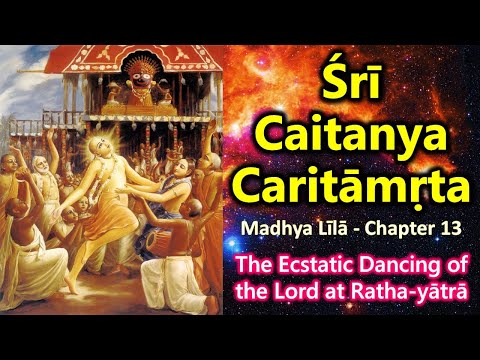
I wish the grace of Lord Caitanya Mahāprabhu, by whose mercy even one who is fallen can describe the pastimes of the Lord. (1) All glories to Śrī Kṛṣṇa Caitanya and Prabhu Nityānanda! All glories to Advaitacandra! And all glories to the devotees of Lord Śrī Caitanya Mahāprabhu! (2) All glories to the listeners of Śrī Caitanya- caritāmṛta! Please hear the description of the dancing of Lord Caitanya Mahāprabhu at the Ratha- yātrā festival. His dancing is very enchanting. Please hear of it with great attention. (3) The next day, Śrī Caitanya Mahāprabhu and His personal associates got up in the dark and attentively took their early- morning baths. (4)
Śrī Caitanya Mahāprabhu and His personal associates then went to see the ceremony of Pāṇḍu- vijaya. During this ceremony, Lord Jagannātha leaves His throne and gets up onto the car. (5) King Pratāparudra in person, as well as his entourage, allowed the Pāṇḍu- vijaya ceremony to be seen by all the associates of Śrī Caitanya Mahāprabhu. (6) Śrī Caitanya Mahāprabhu and His prominent devotees—Advaita Ācārya, Nityānanda Prabhu and others— were very happy to observe how Lord Jagannātha began the Ratha- yātrā. (7) The very strongly built dayitās [carriers of the Jagannātha Deity] were as powerful as drunken elephants. They manually carried Lord Jagannātha from the throne to the car. (8) While carrying the Deity of Lord Jagannātha, some of the dayitās took hold of the shoulders of the Lord, and some caught His lotus feet. (9) The Lord Jagannātha Deity was bound at the waist by a strong, thick rope made of silk. From two sides the dayitās caught hold of this rope and raised the Deity. (10)
Strong, puffed- up cotton pads called tulīs were spread out from the throne to the car, and the heavy Deity of Lord Jagannātha was carried from one pillowlike pad to the next by the dayitās. (11) While the dayitās carried the heavy Jagannātha Deity from one pad to the next, some of the pads broke, and the cotton contents floated into the air. When they broke, they made a heavy cracking sound. (12) Lord Jagannātha is the maintainer of the whole universe. Who can carry Him from one place to another? The Lord moves by His personal will just to perform His pastimes. (13) While the Lord was transported from the throne to the car, tumultuous sounds were made on various musical instruments. Śrī Caitanya Mahāprabhu was chanting “Maṇimā! Maṇimā!” but He could not be heard. (14)
While the Lord was being carried from the throne to the car, King Pratāparudra personally engaged in the Lord’s service by cleansing the road with a broom that had a golden handle. (15) The King sprinkled the road with sandalwood- scented water. Although he was the owner of the royal throne, he engaged in menial service for the sake of Lord Jagannātha. (16) Although the King was the most exalted respectable person, still he accepted menial service for the Lord; he therefore became a suitable candidate for receiving the Lord’s mercy. (17) Upon seeing the King engaged in such menial service, Caitanya Mahāprabhu became very happy. Simply by rendering this service, the King received the mercy of the Lord. (18) Everyone was astonished to see the decorations on the Ratha car. The car appeared to be newly made of gold, and it was as high as Mount Sumeru. (19) The decorations included bright mirrors and hundreds and hundreds of cāmaras [white whisks made of yak tails]. On top of the car were a neat and clean canopy and a very beautiful flag. (20)
The car was also decorated with silken cloth and various pictures. Many brass bells, gongs and ankle bells rang. (21) For the pastimes of the Ratha- yātrā ceremony, Lord Jagannātha got aboard one car, and His sister, Subhadrā, and elder brother, Balarāma, got aboard two other cars. (22) For fifteen days the Lord had remained in a secluded place with the supreme goddess of fortune and had performed His pastimes with her. (23) Having taken permission from the goddess of fortune, the Lord came out to ride on the Ratha car and perform His pastimes for the pleasure of the devotees. (24) The fine, white sand spread all over the path resembled the bank of the Yamunā, and the small gardens on both sides looked just like those in Vṛndāvana. (25) As Lord Jagannātha rode in His car and saw the beauty on both sides, His mind was filled with pleasure. (26) The pullers of the car were known as gauḍas, and they pulled with great pleasure. However, the car sometimes went very fast and sometimes very slow. (27)
Sometimes the car would stand still and not move, even though it was pulled very vigorously. The chariot therefore moved by the will of the Lord, not by the strength of any ordinary person. (28) As the car stood still, Śrī Caitanya Mahāprabhu gathered all His devotees and, with His own hand, decorated them with flower garlands and sandalwood pulp. (29) Paramānanda Purī and Brahmānanda Bhāratī were both personally given garlands and sandalwood pulp from the very hands of Śrī Caitanya Mahāprabhu. This increased their transcendental pleasure. (30) Similarly, when Advaita Ācārya and Nityānanda Prabhu felt the touch of the transcendental hand of Śrī Caitanya Mahāprabhu, They were very pleased. (31) The Lord also gave garlands and sandalwood pulp to the performers of saṅkīrtana. The two chief performers were Svarūpa Dāmodara and Śrīvāsa Ṭhākura. (32) There were altogether four parties of kīrtana performers, comprising twenty- four chanters. In each party there were also two mṛdaṅga players, making an additional eight persons. (33)
When the four parties were formed, Śrī Caitanya Mahāprabhu, after some consideration, divided the chanters. (34) Śrī Caitanya Mahāprabhu ordered Nityānanda Prabhu, Advaita Ācārya, Haridāsa Ṭhākura and Vakreśvara Paṇḍita to dance in each of the four respective parties. (35) Svarūpa Dāmodara was chosen as the leader of the first party and was given five assistants to respond to his chanting. (36) The five who responded to the singing of Svarūpa Dāmodara were Dāmodara Paṇḍita, Nārāyaṇa, Govinda Datta, Rāghava Paṇḍita and Śrī Govindānanda. (37) Advaita Ācārya Prabhu was ordered to dance in the first group. The Lord then formed another group with Śrīvāsa Ṭhākura as the chief man. (38) The five singers who responded to the singing of Śrīvāsa Ṭhākura were Gaṅgādāsa, Haridāsa, Śrīmān, Śubhānanda and Śrī Rāma Paṇḍita. Śrī Nityānanda Prabhu was appointed as a dancer. (39) Another group was formed consisting of Vāsudeva, Gopīnātha and Murāri. All these were responsive singers, and Mukunda was the chief singer. (40)
Another two persons, Śrīkānta and Vallabha Sena, joined as responsive singers. In this group, the senior Haridāsa [Haridāsa Ṭhākura] was the dancer. (41) The Lord formed another group, appointing Govinda Ghoṣa as leader. In this group the younger Haridāsa, Viṣṇudāsa and Rāghava were the responding singers. (42) Two brothers named Mādhava Ghoṣa and Vāsudeva Ghoṣa also joined this group as responsive singers. Vakreśvara Paṇḍita was the dancer. (43) There was a saṅkīrtana party from the village known as Kulīna- grāma, and Rāmānanda and Satyarāja were appointed the dancers in this group. (44) There was another party that came from Śāntipura and was formed by Advaita Ācārya. Acyutānanda was the dancer, and the rest of the men were singers. (45) Another party was formed by the people of Khaṇḍa. These people were singing in a different place. In that group, Narahari Prabhu and Raghunandana were dancing. (46)
Four parties chanted and danced in front of Lord Jagannātha, and on either side was another party. Yet another was at the rear. (47) There were altogether seven parties of saṅkīrtana, and in each party two men were beating drums. Thus fourteen drums were being played at once. The sound was tumultuous, and all the devotees became mad. (48) All the Vaiṣṇavas came together like an assembly of clouds. As the devotees chanted the holy names in great ecstasy, tears fell from their eyes like rain. (49) When the saṅkīrtana resounded, it filled the three worlds. Indeed, no one could hear any sounds or musical instruments other than the saṅkīrtana. (50) Lord Caitanya Mahāprabhu wandered through all seven groups chanting the holy name, “Hari, Hari!” Raising His arms, He shouted, “All glories to Lord Jagannātha!” (51) Lord Caitanya Mahāprabhu then exhibited another mystic power by performing pastimes simultaneously in all seven groups. (52)
Everyone said, “Lord Caitanya Mahāprabhu is present in my group. Indeed, He does not go anywhere else. He is bestowing His mercy upon us.” (53) Actually, no one could see the inconceivable potency of the Lord. Only the most confidential devotees, those in pure, unalloyed devotional service, could understand. (54) Lord Jagannātha was very much pleased by the saṅkīrtana, and He brought His car to a standstill just to see the performance. (55) King Pratāparudra was also astonished to see the saṅkīrtana. He became inactive and was converted to ecstatic love of Kṛṣṇa. (56) When the King informed Kāśī Miśra of the glories of the Lord, Kāśī Miśra replied, “O King, your fortune has no limit!” (57) The King and Sārvabhauma Bhaṭṭācārya were both aware of the Lord’s activities, but no one else could see the tricks of Lord Caitanya Mahāprabhu. (58) Only a person who has received the mercy of the Lord can understand. Without the Lord’s mercy, even the demigods, headed by Lord Brahmā, cannot understand. (59)
Śrī Caitanya Mahāprabhu had been very satisfied to see the King accept the menial task of sweeping the street, and for this humility the King received the mercy of Śrī Caitanya Mahāprabhu. He could therefore observe the mystery of Śrī Caitanya Mahāprabhu’s activities. (60) Although the King had been refused an interview, he was indirectly bestowed causeless mercy. Who can understand the internal potency of Śrī Caitanya Mahāprabhu? (61) When the two great personalities Sārvabhauma Bhaṭṭācārya and Kāśī Miśra saw Caitanya Mahāprabhu’s causeless mercy upon the King, they were astonished. (62) Lord Śrī Caitanya Mahāprabhu performed His pastimes for some time in this way. He personally sang and induced His personal associates to dance. (63) According to His need, the Lord sometimes exhibited one form and sometimes many. This was being executed by His internal potency. (64)
Indeed, the Personality of Godhead forgot Himself in the course of His transcendental pastimes, but His internal potency [līlā- śakti], knowing the intentions of the Lord, made all arrangements. (65) Just as Lord Śrī Kṛṣṇa formerly performed the rāsa- līlā dance and other pastimes at Vṛndāvana, Lord Śrī Caitanya Mahāprabhu performed uncommon pastimes moment after moment. (66) Śrī Caitanya Mahāprabhu’s dancing before the Ratha- yātrā car could be perceived only by pure devotees. Others could not understand. Descriptions of Lord Kṛṣṇa’s uncommon dancing can be found in the revealed scripture Śrīmad- Bhāgavatam. (67) In this way Śrī Caitanya Mahāprabhu danced in great jubilation and inundated all the people with waves of ecstatic love. (68) Thus Lord Jagannātha mounted His car, and Lord Śrī Caitanya Mahāprabhu inspired all His devotees to dance in front of it. (69)
Deepen your Bhakti-yoga practice, harmonize relationships, and receive guided coaching — all at Vedavarsity.com