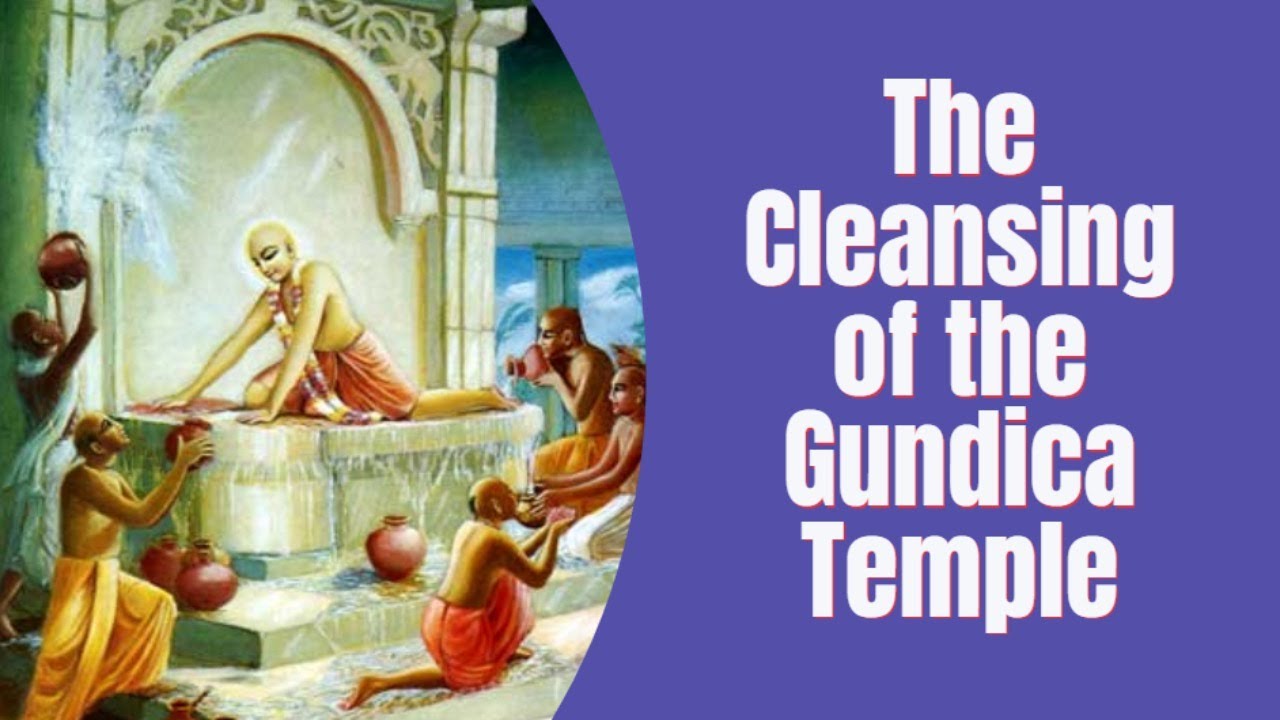
In this way all the rooms were cleansed with a hundred waterpots. After the rooms had been cleansed, the minds of the devotees were as clean as the rooms. (105) When the temple was cleansed, it was purified, cool and pleasing, just as if the Lord’s own pure mind had appeared. (106) Since hundreds of men were engaged in bringing water from the lake, there was no place to stand on the banks. Consequently someone began to draw water from a well. (107) Hundreds of devotees brought water in the pots, and hundreds took the empty pots away to fill them up again. (108) With the exception of Nityānanda Prabhu, Advaita Ācārya, Svarūpa Dāmodara, Brahmānanda Bhāratī and Paramānanda Purī, everyone was engaged in filling the waterpots and bringing them there. (109) Many of the waterpots were broken when people collided with one another, and hundreds of men had to bring new waterpots to fill. (110)
Some people were filling the pots, and others were washing the rooms, but everyone was engaged in chanting the holy name of Kṛṣṇa and Hari. (111) One person begged for a waterpot by chanting the holy names “Kṛṣṇa, Kṛṣṇa,” and another delivered a pot while chanting “Kṛṣṇa, Kṛṣṇa.” (112) Whenever anyone had to speak, he did so by uttering the holy name of Kṛṣṇa. Consequently, the holy name of Kṛṣṇa became an indication for everyone who wanted something. (113) As Śrī Caitanya Mahāprabhu was vibrating the holy name of Kṛṣṇa in ecstatic love, He Himself was performing the work of hundreds of men. (114) It appeared as though Śrī Caitanya Mahāprabhu were cleansing and washing with a hundred hands. He approached every devotee just to teach him how to work. (115)
When He saw someone doing nicely, the Lord praised him, but if He saw that someone was not working to His satisfaction, He immediately chastised that person, not bearing him any grudge. (116) The Lord would say, “You have done well. Please teach this to others so that they may act in the same way.” (117) As soon as they heard Śrī Caitanya Mahāprabhu say this, everyone became ashamed. Thus the devotees began to work with great attention. (118) They washed the Jagamohana area and then the place where food was kept. All other places were also washed. (119) In this way the meeting place was washed, the entire yard, the raised sitting places, the kitchen and every other room. (120) Thus all places around the temple were thoroughly washed within and without. (121) After everything was thoroughly washed, a Vaiṣṇava from Bengal, who was very intelligent and simple, came and poured water on the lotus feet of the Lord. (122)
The Gauḍīya Vaiṣṇava then took that water and drank it himself. Seeing that, Śrī Caitanya Mahāprabhu felt a little unhappy and was also outwardly angry. (123) Although the Lord was certainly satisfied with him, He became angry externally in order to establish the etiquette of religious principles. (124) The Lord then called for Svarūpa Dāmodara and told him, “Just see the behavior of your Bengali Vaiṣṇava. (125) “This person from Bengal has washed My feet within the temple of the Personality of Godhead. Not only that, but he has drunk the water himself. (126) “I now do not know what My destination is because of this offense. Indeed, your Bengali Vaiṣṇava has greatly implicated Me.” (127) At this point Svarūpa Dāmodara Gosvāmī caught the Gauḍīya Vaiṣṇava by the neck and, giving him a little push, ejected him from the Guṇḍicā Purī temple and made him stay outside. (128)
After Svarūpa Dāmodara Gosvāmī returned within the temple, he requested Śrī Caitanya Mahāprabhu to excuse that innocent person. (129) After this incident, Śrī Caitanya Mahāprabhu was very satisfied. He then asked all of the devotees to sit down in two lines on both sides. (130) The Lord then personally sat down in the middle and picked up all kinds of straw, grains of sand and dirty things. (131) While Śrī Caitanya Mahāprabhu was picking up the straws and grains of sand, He said, “I shall gather everyone’s collection, and I shall ask whoever has collected less than all the others to pay a fine of sweet cakes and sweet rice.” (132) In this way all the quarters of the Guṇḍicā temple were completely cleansed and cleared. All quarters were cool and spotless, like one’s cleansed and pacified mind. (133) When the water from the different rooms was finally let out through the halls, it appeared as if new rivers were rushing out to meet the waters of the ocean. (134) Outside the gateway of the temple, all the roads were also cleansed, and no one could tell exactly how this was done. (135)
Śrī Caitanya Mahāprabhu also cleansed the Nṛsiṁha temple inside and outside. Finally, He rested a few minutes and then began dancing. (136) All around Śrī Caitanya Mahāprabhu all the devotees performed congregational chanting. The Lord, just like a maddened lion, danced in the middle. (137) As usual, when Caitanya Mahāprabhu danced, there were perspiration, trembling, fading, tears, jubilation and roaring. Indeed, the tears from His eyes washed His body and those before Him. (138) In this way Śrī Caitanya Mahāprabhu washed the bodies of all the devotees with the tears from His eyes. The tears poured like the rains in the month of Śrāvaṇa. (139) The sky was filled with the great and loud chanting of saṅkīrtana, and the earth shook from the jumping and dancing of Lord Caitanya Mahāprabhu. (140)
Śrī Caitanya Mahāprabhu always liked the loud chanting of Svarūpa Dāmodara. Therefore when Svarūpa Dāmodara sang, Śrī Caitanya Mahāprabhu danced and jumped high in jubilation. (141) The Lord thus chanted and danced for some time. Finally, understanding the circumstances, He stopped. (142) Śrī Caitanya Mahāprabhu then ordered Śrī Gopāla, the son of Advaita Ācārya, to dance. (143) While dancing in ecstatic love, Śrī Gopāla fainted and fell to the ground unconscious. (144) When Śrī Gopāla fainted, Advaita Ācārya hastily took him upon His lap. Seeing that he was not breathing, He became very much agitated. (145) Advaita Ācārya and others began to chant the holy name of Lord Nṛsiṁha and sprinkle water. The roaring of the chant was so great that it seemed to shake the entire universe. (146) When the boy did not regain consciousness after some time, Advaita Ācārya and the other devotees began to cry. (147)
Then Śrī Caitanya Mahāprabhu placed His hand on the chest of Śrī Gopāla and said loudly, “Gopāla, stand up.” (148) As soon as Gopāla heard the voice of Śrī Caitanya Mahāprabhu, he immediately came to his senses. All the devotees then began to dance, chanting the holy name of Hari. (149) This incident has been described in detail by Vṛndāvana dāsa Ṭhākura. Therefore I have described it only in brief. (150) After taking rest, Śrī Caitanya Mahāprabhu and all the devotees departed to take their baths. (151) After bathing, the Lord stood on the bank of the lake and put on dry garments. After offering obeisances to Lord Nṛsiṁhadeva, whose temple was nearby, the Lord entered a garden. (152) In the garden, Śrī Caitanya Mahāprabhu sat down with the other devotees. Vāṇīnātha Rāya then came and brought all kinds of mahā- prasādam. (153) Kāśī Miśra and Tulasī, the superintendent of the temple, brought as much prasādam as five hundred men could eat. Seeing the large quantity of prasādam, which consisted of rice, cakes, sweet rice and a variety of vegetables, Śrī Caitanya Mahāprabhu was very satisfied. (154-155)
Deepen your Bhakti-yoga practice, harmonize relationships, and receive guided coaching — all at Vedavarsity.com