Mahārāja Pratāparudra took the Bhaṭṭācārya’s advice and firmly decided to follow his instructions. Thus he felt transcendental happiness. (59) When the King asked the Bhaṭṭācārya when the bathing ceremony [Snāna- yātrā] of Lord Jagannātha would take place, the Bhaṭṭācārya replied that there were only three days left before the ceremony. (60) After thus encouraging the King, Sārvabhauma Bhaṭṭācārya returned home. On the day of Lord Jagannātha’s bathing ceremony, Śrī Caitanya Mahāprabhu was very happy at heart. (61) Upon seeing the bathing ceremony of Lord Jagannātha, Śrī Caitanya Mahāprabhu became very happy. But when Lord Jagannātha retired after the ceremony, Lord Caitanya became very unhappy because He could not see Him. (62) Due to separation from Lord Jagannātha, Śrī Caitanya Mahāprabhu felt the same great anxiety the gopīs feel in separation from Kṛṣṇa. In this condition He gave up all association and went to Ālālanātha. (63) The devotees who had followed the Lord came into His presence and requested Him to return to Purī. They submitted that the devotees from Bengal were coming to Puruṣottama- kṣetra. (64)
In this way Sārvabhauma Bhaṭṭācārya brought Lord Caitanya back to Jagannātha Purī. He then went to King Pratāparudra and informed him of the Lord’s arrival. (65) At this time, Gopīnātha Ācārya came there while Sārvabhauma Bhaṭṭācārya was with King Pratāparudra. Being a brāhmaṇa, he offered his benediction to the King and addressed Sārvabhauma Bhaṭṭācārya as follows. (66) “About two hundred devotees are coming from Bengal. All of them are greatly advanced and specifically devoted to Śrī Caitanya Mahāprabhu. (67) “All of them have already arrived on the bank of Lake Narendra and are waiting there. I desire residential quarters and prasādam arrangements for them.” (68) The King replied, “I shall give orders to the attendant in the temple. He will arrange for everyone’s residential quarters and prasādam, as you desire. (69)
“Sārvabhauma Bhaṭṭācārya, please show me, one after another, all of Śrī Caitanya Mahāprabhu’s devotees who are coming from Bengal.” (70) Sārvabhauma Bhaṭṭācārya requested the King, “Go up on the roof of the palace. Gopīnātha Ācārya knows every one of the devotees. He will identify them for you. (71) “Actually I do not know any of them, although I have a desire to know them. Since Gopīnātha Ācārya knows them all, he will give you their names.” (72) After Sārvabhauma said this, he went up to the top of the palace with the King and Gopīnātha Ācārya. At this time all the Vaiṣṇava devotees from Bengal drew closer to the palace. (73) Svarūpa Dāmodara and Govinda, taking the flower garlands and prasādam of Lord Jagannātha, proceeded to where all the Vaiṣṇavas were standing. (74) Lord Śrī Caitanya Mahāprabhu first sent those two persons in advance. The King inquired, “Who are these two? Please let me know their identities.” (75)
Śrī Sārvabhauma Bhaṭṭācārya replied, “Here is Svarūpa Dāmodara, who is practically the second expansion of the body of Śrī Caitanya Mahāprabhu. (76) “The second person is Govinda, Lord Caitanya’s personal servant. The Lord has sent garlands and remnants of Lord Jagannātha’s food with these two persons simply to honor the devotees from Bengal.” (77) At the beginning, Svarūpa Dāmodara came forward and garlanded Advaita Ācārya. Govinda next came and offered a second garland to Advaita Ācārya. (78) When Govinda offered his obeisances by falling down flat before Advaita Ācārya, Advaita Ācārya asked Svarūpa Dāmodara about his identity, for He did not know Govinda at that time. (79) Svarūpa Dāmodara informed Him, “Govinda was the servant of Īśvara Purī. He is very highly qualified. (80) “Īśvara Purī ordered Govinda to serve Śrī Caitanya Mahāprabhu. Thus the Lord keeps him by His side.” (81) The King inquired, “To whom did Svarūpa Dāmodara and Govinda offer the two garlands? His bodily effulgence is so great that He must be a very great devotee. Please let me know who He is.” (82)
Gopīnātha Ācārya replied, “His name is Advaita Ācārya. He is honored even by Śrī Caitanya Mahāprabhu, and He is therefore the topmost devotee. (83) “Here are Śrīvāsa Paṇḍita, Vakreśvara Paṇḍita, Vidyānidhi Ācārya and Gadādhara Paṇḍita. (84) “Here are Ācāryaratna, Purandara Paṇḍita, Gaṅgādāsa Paṇḍita and Śaṅkara Paṇḍita. (85) “Here are Murāri Gupta, Paṇḍita Nārāyaṇa and Haridāsa Ṭhākura, the deliverer of the whole universe. (86) “Here is Hari Bhaṭṭa, and there is Nṛsiṁhānanda. Here are Vāsudeva Datta and Śivānanda Sena. (87) “Here also are Govinda Ghoṣa, Mādhava Ghoṣa and Vāsudeva Ghoṣa. They are three brothers, and their saṅkīrtana, congregational chanting, pleases the Lord very much. (88) “Here is Rāghava Paṇḍita, here is Ācārya Nandana, there is Śrīmān Paṇḍita, and here are Śrīkānta and Nārāyaṇa.” (89) Gopīnātha Ācārya continued to point out the devotees: “Here is Śuklāmbara. See, there is Śrīdhara. Here is Vijaya, and there is Vallabha Sena. Here is Puruṣottama, and there is Sañjaya. (90)
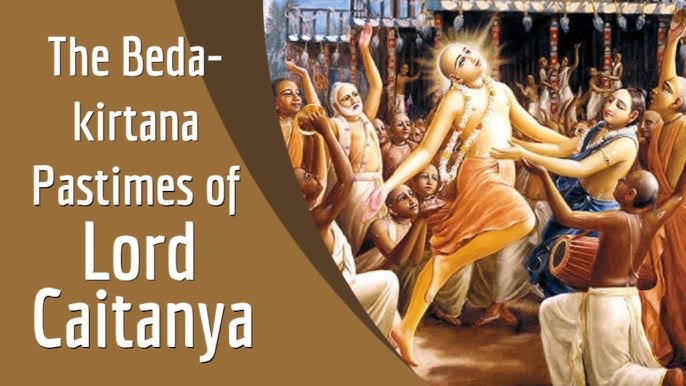
“And here are all the residents of Kulīna- grāma, such as Satyarāja Khān and Rāmānanda. Indeed, all of them are present here. Please see. (91) “Here are Mukunda dāsa, Narahari, Śrī Raghunandana, Cirañjīva and Sulocana, all residents of Khaṇḍa. (92) “How many names shall I speak to you? All the devotees you see here are associates of Śrī Caitanya Mahāprabhu, who is their life and soul.” (93) The King said, “Upon seeing all these devotees, I am very much astonished, for I have never seen such an effulgence. (94) “Indeed, their effulgence is like the brilliance of a million suns. Nor have I ever heard the Lord’s names chanted so melodiously. (95) “I have never before seen such ecstatic love, nor heard the vibration of the holy name of the Lord chanted in such a way, nor seen such dancing during saṅkīrtana.” (96) Sārvabhauma Bhaṭṭācārya replied, “This sweet transcendental sound is a special creation of the Lord known as prema- saṅkīrtana, congregational chanting in love of Godhead. (97)
“In this Age of Kali, Śrī Caitanya Mahāprabhu has descended to preach the religion of Kṛṣṇa consciousness. Therefore the chanting of the holy names of Lord Kṛṣṇa is the religious principle for this age. (98) “Anyone who worships Lord Caitanya Mahāprabhu by congregational chanting should be understood to be very intelligent. One who does not do so must be considered a victim of this age and bereft of all intelligence. (99) “‘In the Age of Kali, intelligent persons perform congregational chanting to worship the incarnation of Godhead who constantly sings the name of Kṛṣṇa. Although His complexion is not blackish, He is Kṛṣṇa Himself. He is accompanied by His associates, servants, weapons and confidential companions.’” (100) The King said, “According to evidence given in the revealed scriptures, it is concluded that Lord Śrī Caitanya Mahāprabhu is Lord Kṛṣṇa Himself. Why, then, are learned scholars sometimes indifferent to Him?” (101) The Bhaṭṭācārya replied, “A person who has received but a small fraction of mercy from Śrī Caitanya Mahāprabhu can understand that He is Lord Kṛṣṇa. No one else can. (102)
“If the mercy of Śrī Caitanya Mahāprabhu is not bestowed upon a person—regardless of how learned a scholar that person may be and regardless of his seeing or listening— he cannot accept Lord Caitanya as the Supreme Personality of Godhead. (103) “[Lord Brahmā said:] ‘My Lord, if one is favored by even a slight trace of the mercy of Your lotus feet, he can understand the greatness of Your personality. But those who speculate to understand the Supreme Personality of Godhead are unable to know You, even though they continue to study the Vedas for many years.’” (104) The King said, “Instead of visiting the temple of Lord Jagannātha, all the devotees are running toward the residence of Śrī Caitanya Mahāprabhu.” (105) Sārvabhauma Bhaṭṭācārya replied, “This is spontaneous love. All the devotees are very anxious to meet Śrī Caitanya Mahāprabhu. (106) “First the devotees will meet Śrī Caitanya Mahāprabhu and then take Him with them to the temple to see Lord Jagannātha.” (107) The King said, “The son of Bhavānanda Rāya named Vāṇīnātha, along with five or seven other men, went there to obtain the remnants of Lord Jagannātha’s food. (108)
“Indeed, Vāṇīnātha has already gone to the residence of Lord Śrī Caitanya Mahāprabhu and has taken a huge quantity of mahā- prasādam. Please let me know the reason for this.” (109) Sārvabhauma Bhaṭṭācārya said, “Understanding that all the devotees have come, Lord Caitanya gave the sign, and therefore Vāṇīnātha and the others have brought such great quantities of mahā- prasādam.” (110) The King then asked the Bhaṭṭācārya, “Why have the devotees not observed the regulations for visiting the pilgrimage place, such as fasting, shaving and so on? Why have they first eaten prasādam?” (111) The Bhaṭṭācārya told the King, “What you have said is right according to the regulative principles governing the visiting of holy places, but there is another path, which is the path of spontaneous love. According to those principles, there are subtle intricacies involved in the execution of religious principles. (112)
“The scriptural injunctions for shaving and fasting are indirect orders of the Supreme Personality of Godhead. However, when there is a direct order from the Lord to take prasādam, naturally the devotees take prasādam as their first duty. (113) “When mahā- prasādam is not available, there must be fasting, but when the Supreme Personality of Godhead directly orders one to take prasādam, neglecting such an opportunity is offensive. (114) “When Śrī Caitanya Mahāprabhu is distributing prasādam with His transcendental hand, who will neglect such an opportunity and accept the regulative principle of fasting? (115) “Previously the Lord gave me mahā- prasādam rice one morning, and I ate it just sitting on my bed, without having even washed my mouth. (116) “The man to whom the Lord shows His mercy by inspiring him within the heart takes shelter only of Lord Kṛṣṇa and abandons all Vedic and social customs. (117) “‘When one is inspired by the Lord, who is sitting in everyone’s heart, he does not care for social custom or Vedic regulative principles.’” (118)
Deepen your Bhakti-yoga practice, harmonize relationships, and receive guided coaching — all at Vedavarsity.com