


When the Tattvavādī Vaiṣṇavas first saw Śrī Caitanya Mahāprabhu, they considered Him a Māyāvādī sannyāsī. Therefore they did not talk to Him. (250) Later, after seeing Śrī Caitanya Mahāprabhu in ecstatic love, they were struck with wonder. Then, considering Him a Vaiṣṇava, they gave Him a nice reception. (251) Śrī Caitanya Mahāprabhu could understand that the Tattvavādīs were very proud of their Vaiṣṇavism. He therefore smiled and began to speak to them. (252) Considering them very proud, Caitanya Mahāprabhu began His discussion. (253) The chief ācārya of the Tattvavāda community was very learned in the revealed scriptures. Śrī Caitanya Mahāprabhu humbly questioned him. (254) Caitanya Mahāprabhu said, “I do not know very well the aim of life and how to achieve it. Please tell Me of the best ideal for humanity and how to attain it.” (255) The ācārya replied, “When the activities of the four castes and the four āśramas are dedicated to Kṛṣṇa, they constitute the best means whereby one can attain the highest goal of life. (256)
“When one dedicates the duties of varṇāśrama- dharma to Kṛṣṇa, he is eligible for five kinds of liberation. Thus he is transferred to the spiritual world in Vaikuṇṭha. This is the highest goal of life and the verdict of all revealed scriptures.” (257) Śrī Caitanya Mahāprabhu said, “According to the verdict of the śāstras, the process of hearing and chanting is the best means to attain loving service to Kṛṣṇa. (258) ‘This process entails hearing, chanting and remembering the holy name, form, pastimes, qualities and entourage of the Lord, offering service according to the time, place and performer, worshiping the Deity, offering prayers, always considering oneself the eternal servant of Kṛṣṇa, making friends with Him and dedicating everything unto Him. These nine items of devotional service, when directly offered to Kṛṣṇa, constitute the highest attainment of life. This is the verdict of the revealed scriptures.’ (259-260)
“When one comes to the platform of loving service to Lord Kṛṣṇa by executing these nine processes, beginning with hearing and chanting, he has attained the fifth platform of success and the limit of life’s goals. (261) “‘When a person is actually advanced and takes pleasure in chanting the holy name of the Lord, who is very dear to him, he is agitated and loudly chants the holy name. He also laughs, cries, becomes agitated and chants just like a madman, not caring for outsiders.’ (262) “In every revealed scripture there is condemnation of fruitive activities. It is advised everywhere to give up engagement in fruitive activities, for no one can attain the highest goal of life, love of Godhead, by executing them. (263) “‘Occupational duties are described in the religious scriptures. If one analyzes them, he can fully understand their qualities and faults and then give them up completely to render service unto the Supreme Personality of Godhead. A person who does so is considered a first- class man.’ (264)
“‘Abandon all varieties of religion and just surrender unto Me. I shall deliver you from all sinful reactions. Do not fear.’ (265) “‘As long as one is not satiated by fruitive activity and has not awakened his taste for devotional service by śravaṇaṁ kīrtanaṁ viṣṇoḥ, one has to act according to the regulative principles of the Vedic injunctions.’ (266) “Pure devotees reject the five kinds of liberation; indeed, for them liberation is very insignificant because they see it as hellish.(267) “‘Pure devotees always reject the five kinds of liberation, which include living in the spiritual Vaikuṇṭha planets, possessing the same opulences as those possessed by the Supreme Lord, having the same bodily features as the Lord’s, associating with the Lord and merging into the body of the Lord. The pure devotees do not accept these benedictions without the service of the Lord.’ (268)
“‘It is very difficult to give up material opulence, land, children, society, friends, riches, wife or the blessings of the goddess of fortune, which are desired even by great demigods. But King Bharata did not desire such things, and this was quite befitting his position, because for a pure devotee whose mind is always engaged in the service of the Lord, even liberation, or merging into the existence of the Lord, is insignificant. And what to speak of material opportunities?’ (269) “‘A person who is a devotee of Lord Nārāyaṇa is not afraid of a hellish condition, because he considers it the same as elevation to the heavenly planets or liberation. The devotees of Lord Nārāyaṇa are accustomed to seeing all these things on the same level.’ (270) “Both liberation and fruitive activity are rejected by devotees. You are trying to establish these things as life’s goal and the process for attaining it.” (271)
Śrī Caitanya Mahāprabhu continued speaking to the Tattvavādī ācārya: “Seeing that I am a mendicant in the renounced order of life, you have been playing with Me in a duplicitous way. You have not actually described the process and ultimate objective.” (272) After hearing Śrī Caitanya Mahāprabhu, the ācārya of the Tattvavāda sampradāya became very much ashamed. Upon observing Śrī Caitanya Mahāprabhu’s rigid faith in Vaiṣṇavism, he was struck with wonder. (273) The Tattvavādī ācārya replied, “What You have said is certainly factual. It is the conclusion of all the revealed scriptures of the Vaiṣṇavas. (274) “Still, whatever Madhvācārya has established as the formula for our party we practice as a party policy.” (275) Śrī Caitanya Mahāprabhu said, “Both the fruitive worker and the speculative philosopher are considered nondevotees. We see both elements present in your sampradāya. (276)
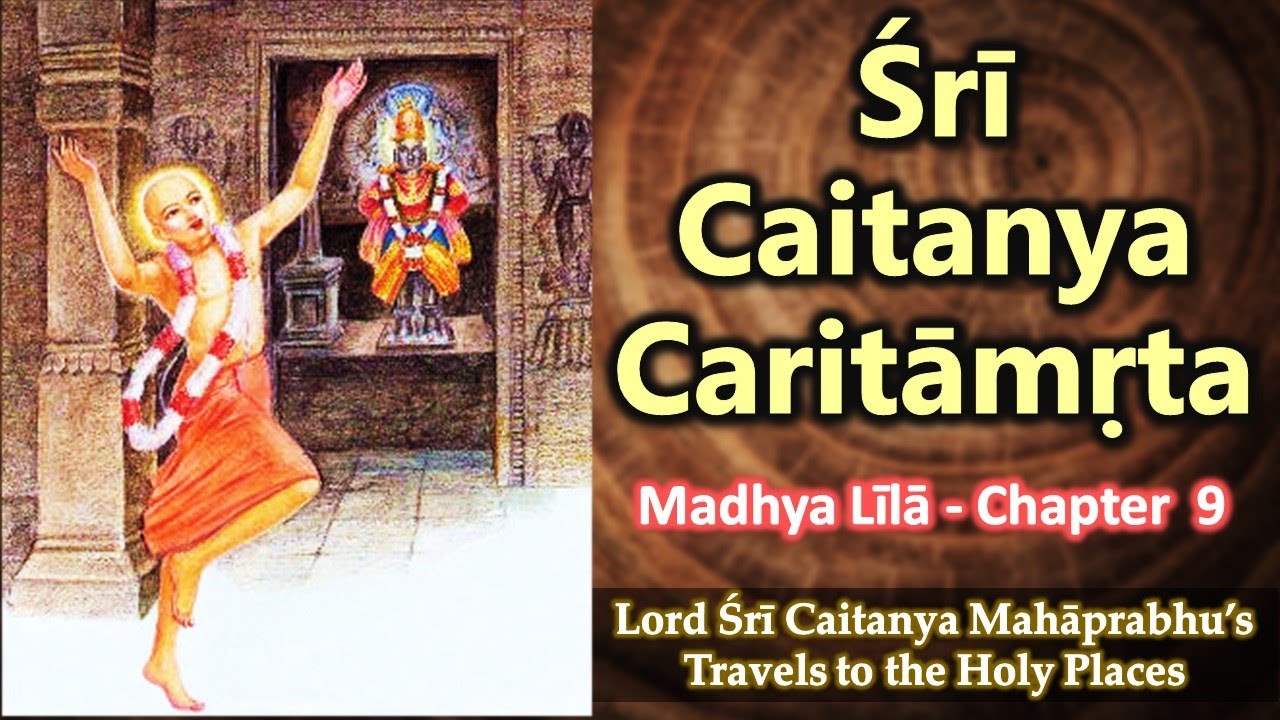
“The only qualification that I see in your sampradāya is that you accept the form of the Lord as truth.” (277) Thus Śrī Caitanya Mahāprabhu broke the pride of the Tattvavādīs to pieces. He then went to the holy place known as Phalgu- tīrtha. (278) Śrī Caitanya Mahāprabhu, the son of mother Śacī, next went to Tritakūpa, and after seeing the Viśālā Deity there, He went to the holy place known as Pañcāpsarā- tīrtha. (279) After seeing Pañcāpsarā, Śrī Caitanya Mahāprabhu went to Gokarṇa. While there, He visited the temple of Lord Śiva, and then He went to Dvaipāyani. Śrī Caitanya Mahāprabhu, the crown jewel of all sannyāsīs, then went to Sūrpāraka- tīrtha. (280) Śrī Caitanya Mahāprabhu then visited the town of Kolāpura, where He saw the goddess of fortune in the temple of Kṣīra- bhagavatī and saw Lāṅga- gaṇeśa in another temple, known as Cora- pārvatī. (281) From there Śrī Caitanya Mahāprabhu went to Pāṇḍarapura, where He happily saw the temple of Viṭhṭhala Ṭhākura. (282) Śrī Caitanya Mahāprabhu chanted and danced in various ways as usual. A brāhmaṇa, seeing Him in ecstatic love, was very pleased and invited the Lord to his home for lunch. (283)
The brāhmaṇa offered Śrī Caitanya Mahāprabhu food with great respect and love. After finishing His lunch, the Lord received auspicious news. (284)Śrī Caitanya Mahāprabhu received word that Śrī Raṅga Purī, one of the disciples of Śrī Mādhavendra Purī, was present in that village at the home of a brāhmaṇa. (285) Hearing this news, Śrī Caitanya Mahāprabhu immediately went to see Śrī Raṅga Purī at the brāhmaṇa’s home. Upon entering, the Lord saw him sitting there. (286) As soon as Śrī Caitanya Mahāprabhu saw Śrī Raṅga Purī, He immediately offered him obeisances in ecstatic love, falling flat on the ground. The symptoms of transcendental transformation were visible—namely, tears, jubilation, trembling and perspiration. (287) Upon seeing Śrī Caitanya Mahāprabhu in such an ecstatic mood, Śrī Raṅga Purī said, “Your Holiness, please get up. (288) “Your Holiness is certainly related to Śrī Mādhavendra Purī, without whom there is no fragrance of ecstatic love.” (289) After saying this, Śrī Raṅga Purī lifted Śrī Caitanya Mahāprabhu up and embraced Him. As they embraced shoulder to shoulder, they both began to cry in ecstasy. (290)
After some moments, they came to their senses and became patient. Śrī Caitanya Mahāprabhu then informed Śrī Raṅga Purī about His relationship with Īśvara Purī. (291) They were both inundated by the wonderful ecstasy of love that was aroused in them. Finally they sat down and respectfully began to converse. (292) In this way they discussed topics about Lord Kṛṣṇa continually for five to seven days. (293) Out of curiosity, Śrī Raṅga Purī asked Śrī Caitanya Mahāprabhu about His birthplace, and the Lord informed him that it was Navadvīpa- dhāma. (294) Śrī Raṅga Purī had formerly gone to Navadvīpa with Śrī Mādhavendra Purī, and he therefore remembered the incidents that had taken place there. (295) As soon as Śrī Raṅga Purī recalled Navadvīpa, he also recalled accompanying Śrī Mādhavendra Purī to the house of Jagannātha Miśra, where Raṅga Purī had taken lunch. He even remembered the taste of an unprecedented curry made of banana flowers. (296) Śrī Raṅga Purī also remembered the wife of Jagannātha Miśra. She was very devoted and chaste. As for her affection, she was exactly like the mother of the universe. (297)
He also remembered how Śrī Jagannātha Miśra’s wife, Śacīmātā, was expert in cooking. He recalled that she was very affectionate toward the sannyāsīs and fed them exactly like her own sons. (298) Śrī Raṅga Purī also remembered that one of her deserving sons had accepted the renounced order at a very young age. His name was Śaṅkarāraṇya. (299) Śrī Raṅga Purī informed Śrī Caitanya Mahāprabhu that the sannyāsī named Śaṅkarāraṇya had attained perfection in that holy place, Pāṇḍarapura. (300) Śrī Caitanya Mahāprabhu said, “In My previous āśrama, Śaṅkarāraṇya was My brother and Jagannātha Miśra was My father.” (301) After finishing his talks with Śrī Caitanya Mahāprabhu, Śrī Raṅga Purī started for Dvārakā- dhāma. (302) After Śrī Raṅga Purī departed for Dvārakā, Śrī Caitanya Mahāprabhu remained with the brāhmaṇa at Pāṇḍarapura for four more days. He took His bath in the Bhīmā River and visited the temple of Viṭhṭhala. (303)
Deepen your Bhakti-yoga practice, harmonize relationships, and receive guided coaching — all at Vedavarsity.com