


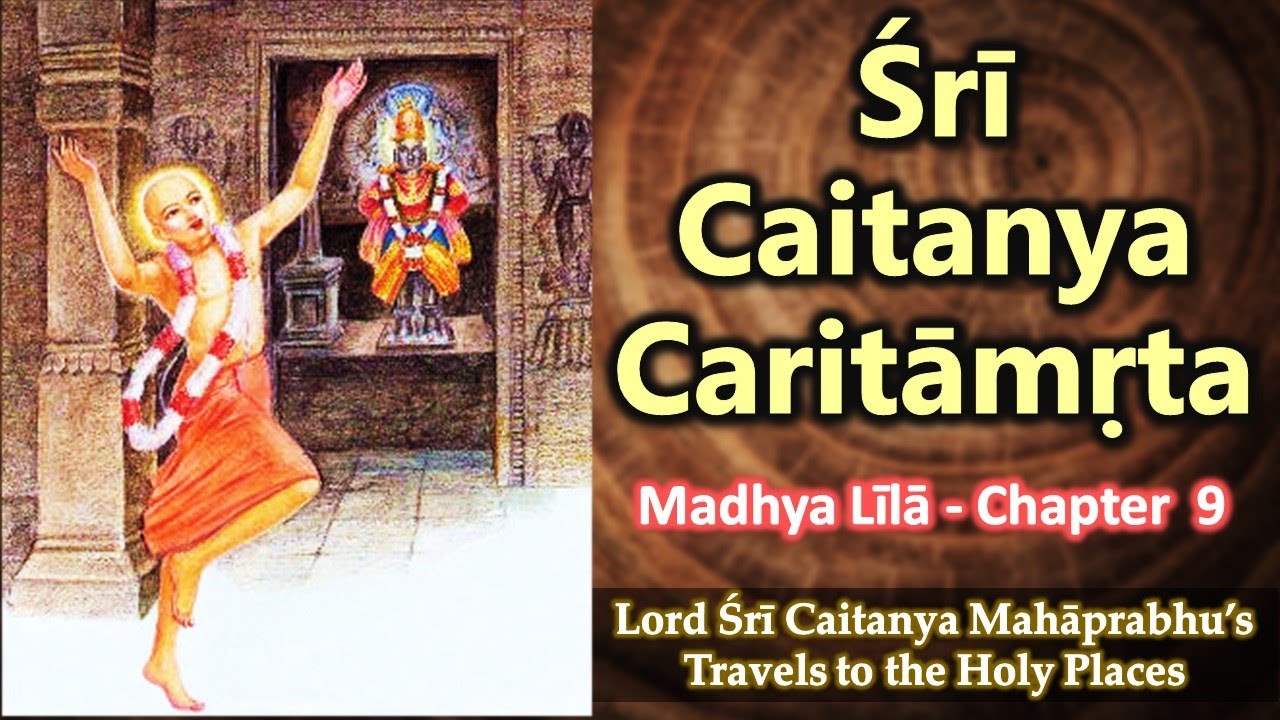
Lord Śrī Caitanya Mahāprabhu converted the inhabitants of South India. These people were as strong as elephants, but they were in the clutches of the crocodiles of various philosophies, such as the Buddhist, Jain and Māyāvāda philosophies. With His disc of mercy the Lord delivered them all by converting them into Vaiṣṇavas, devotees of the Lord. (1) All glories to Lord Śrī Caitanya Mahāprabhu! All glories to Lord Nityānanda Prabhu! All glories to Śrī Advaita Prabhu! And all glories to all the devotees of Śrī Caitanya Mahāprabhu! (2) Śrī Caitanya Mahāprabhu’s tour of South India was certainly very extraordinary because He visited many thousands of places of pilgrimage there. (3) On the plea of visiting all those holy places, the Lord converted many thousands of residents and thus delivered them. Simply by touching the holy places, He made them into great places of pilgrimage. (4)
I cannot chronologically record all the places of pilgrimage visited by Lord Śrī Caitanya Mahāprabhu. I can only summarize everything by saying that the Lord visited all holy places right and left, coming and going. (5) Because it is impossible for me to record all these places in chronological order, I will simply make a token gesture of recording them. (6) As previously stated, all the residents of the villages visited by Lord Caitanya became Vaiṣṇavas and began to chant Hari and Kṛṣṇa. In this way, in all the villages visited by the Lord, everyone became a Vaiṣṇava, a devotee. (7-8) In South India there were many types of people. Some were philosophical speculators, and some were fruitive workers, but in any case there were innumerable nondevotees. (9) By the influence of Śrī Caitanya Mahāprabhu, all these people abandoned their own opinions and became Vaiṣṇavas, devotees of Kṛṣṇa. (10) At the time, all the South Indian Vaiṣṇavas were worshipers of Lord Rāmacandra. Some were Tattvavādīs, and some were followers of Rāmānujācārya. (11)
After meeting Śrī Caitanya Mahāprabhu, all those different Vaiṣṇavas became devotees of Kṛṣṇa and began chanting the Hare Kṛṣṇa mahā- mantra. (12) “‘O Lord Rāmacandra, descendant of Mahārāja Raghu, kindly protect me! O Lord Kṛṣṇa, killer of the Keśī demon, kindly protect me!’” (13) While walking on the road, Śrī Caitanya Mahāprabhu used to chant this Rāma Rāghava mantra. Chanting in this way, He arrived at the banks of the Gautamī- gaṅgā and took His bath there. (14) Śrī Caitanya Mahāprabhu then went to Mallikārjuna- tīrtha and saw the deity of Lord Śiva there. He also induced all the people to chant the Hare Kṛṣṇa mahā- mantra. (15) There he saw Lord Mahādeva [Śiva], the servant of Lord Rāma. He then went to Ahovala- nṛsiṁha. (16) Upon seeing the Ahovala- nṛsiṁha Deity, Caitanya Mahāprabhu offered many prayers unto the Lord. He then went to Siddhavaṭa, where He saw the Deity of Rāmacandra, the Lord of Sītādevī. (17)
Upon seeing the Deity of Lord Rāmacandra, the descendant of King Raghu, the Lord offered His prayers and obeisances. Then a brāhmaṇa invited the Lord to take lunch. (18) That brāhmaṇa constantly chanted the holy name of Rāmacandra. Indeed, but for chanting Lord Rāmacandra’s holy name, that brāhmaṇa did not speak a word. (19) That day, Lord Caitanya remained there and accepted prasādam at his house. After bestowing mercy upon him in this way, the Lord proceeded ahead. (20) At the holy place known as Skanda- kṣetra, Lord Śrī Caitanya Mahāprabhu visited the temple of Skanda. From there He went to Trimaṭha, where He saw the Viṣṇu Deity Trivikrama. (21) After visiting the temple of Trivikrama, the Lord returned to Siddhavaṭa, where He again visited the house of the brāhmaṇa, who was now constantly chanting the Hare Kṛṣṇa mahā- mantra. (22) After finishing His lunch there, Śrī Caitanya Mahāprabhu asked the brāhmaṇa, “My dear friend, kindly tell Me what your position is now. (23)
“Formerly you were constantly chanting the holy name of Lord Rāma. Why are you now constantly chanting the holy name of Kṛṣṇa?” (24) The brāhmaṇa replied, “This is all due to Your influence, Sir. After seeing You, I have lost my lifelong practice. (25) “From my childhood I have been chanting the holy name of Lord Rāmacandra, but upon seeing You I chanted the holy name of Lord Kṛṣṇa just once. (26) “Since then, the holy name of Kṛṣṇa has been tightly fixed upon my tongue. Indeed, since I have been chanting the holy name of Kṛṣṇa, the holy name of Lord Rāmacandra has gone far away. (27) “From my childhood I have been collecting the glories of the holy name from revealed scriptures. (28) “‘The Supreme Absolute Truth is called Rāma because the transcendentalists take pleasure in the unlimited true pleasure of spiritual existence.’ (29) “‘The word “kṛṣ” is the attractive feature of the Lord’s existence, and “ṇa” means spiritual pleasure. When the verb “kṛṣ” is added to the affix “ṇa,” it becomes “Kṛṣṇa,” which indicates the Absolute Truth.’ (30)
“As far as the holy names of Rāma and Kṛṣṇa are concerned, they are on an equal level, but for further advancement we receive some specific information from the revealed scriptures. (31) “[Lord Śiva addressed his wife, Durgā:] ‘O Varānanā, ‘I chant the holy name of Rāma, Rāma, Rāma and thus enjoy this beautiful sound. This holy name of Rāmacandra is equal to one thousand holy names of Lord Viṣṇu.’ (32) “‘The pious results derived from chanting the thousand holy names of Viṣṇu three times can be attained by only one utterance of the holy name of Kṛṣṇa.’ (33) “According to this statement of the śāstras, the glories of the holy name of Kṛṣṇa are unlimited. Still I could not chant His holy name. Please hear the reason for this. (34) “My worshipable Lord has been Lord Rāmacandra, and by chanting His holy name I received happiness. Because I received such happiness, I chanted the holy name of Lord Rāma day and night. (35) “By Your appearance, Lord Kṛṣṇa’s holy name also appeared, and at that time the glories of Kṛṣṇa’s name awoke in my heart. (36)
“Sir, You are that Lord Kṛṣṇa Himself. This is my conclusion.” Saying this, the brāhmaṇa fell down at the lotus feet of Śrī Caitanya Mahāprabhu. (37) After showing mercy to the brāhmaṇa, Lord Śrī Caitanya Mahāprabhu left the next day and arrived at Vṛddhakāśī, where He visited the temple of Lord Śiva. (38) Śrī Caitanya Mahāprabhu then left Vṛddhakāśī and proceeded further. In one village He saw that most of the residents were brāhmaṇas, and He took His rest there. (39) Due to the influence of Lord Caitanya Mahāprabhu, many millions of men came just to see Him. Indeed, the assembly being unlimited, its members could not be counted. (40) The Lord’s bodily features were very beautiful, and in addition He was always in the ecstasy of love of Godhead. Simply by seeing Him, everyone began chanting the holy name of Kṛṣṇa, and thus everyone became a Vaiṣṇava devotee. (41)
There are many kinds of philosophers. Some are logicians who follow Gautama or Kaṇāda. Some follow the Mīmāṁsā philosophy of Jaimini. Some follow the Māyāvāda philosophy of Śaṅkarācārya, and others follow Kapila’s Sāṅkhya philosophy or the mystic yoga system of Pataṣjali. Some follow the smṛti- śāstra composed of twenty religious scriptures, and others follow the Purāṇas and the tantra- śāstra. In this way there are many different types of philosophers. (42) All of these adherents of various scriptures were ready to present the conclusions of their respective scriptures, but Śrī Caitanya Mahāprabhu broke all their opinions to pieces and established His own cult of bhakti based on the Vedas, Vedānta, the Brahma- sūtra and the philosophy of acintya- bhedābheda- tattva. (43) Śrī Caitanya Mahāprabhu established the devotional cult everywhere. No one could defeat Him. (44) Being thus defeated by Lord Śrī Caitanya Mahāprabhu, all these philosophers and their followers entered into His cult. In this way Lord Caitanya made South India into a country of Vaiṣṇavas. (45)
When the nonbelievers heard of the erudition of Śrī Caitanya Mahāprabhu, they came to Him with great pride, bringing their disciples with them. (46) One of them was a leader of the Buddhist cult and was a very learned scholar. To establish the nine philosophical conclusions of Buddhism, he came before the Lord and began to speak. (47) Although the Buddhists are unfit for discussion and should not be seen by Vaiṣṇavas, Caitanya Mahāprabhu spoke to them just to decrease their false pride. (48) The scriptures of the Buddhist cult are chiefly based on argument and logic, and they contain nine chief principles. Because Śrī Caitanya Mahāprabhu defeated the Buddhists in their argument, they could not establish their cult. (49) The teacher of the Buddhist cult set forth the nine principles, but Śrī Caitanya Mahāprabhu broke them to pieces with His strong logic. (50) All mental speculators and learned scholars were defeated by Śrī Caitanya Mahāprabhu, and when the people began to laugh, the Buddhist philosophers felt both shame and fear. (51) The Buddhists could understand that Lord Śrī Caitanya Mahāprabhu was a Vaiṣṇava, and they returned home very unhappy. Later, however, they began to plot against the Lord. (52)
Deepen your Bhakti-yoga practice, harmonize relationships, and receive guided coaching — all at Vedavarsity.com