


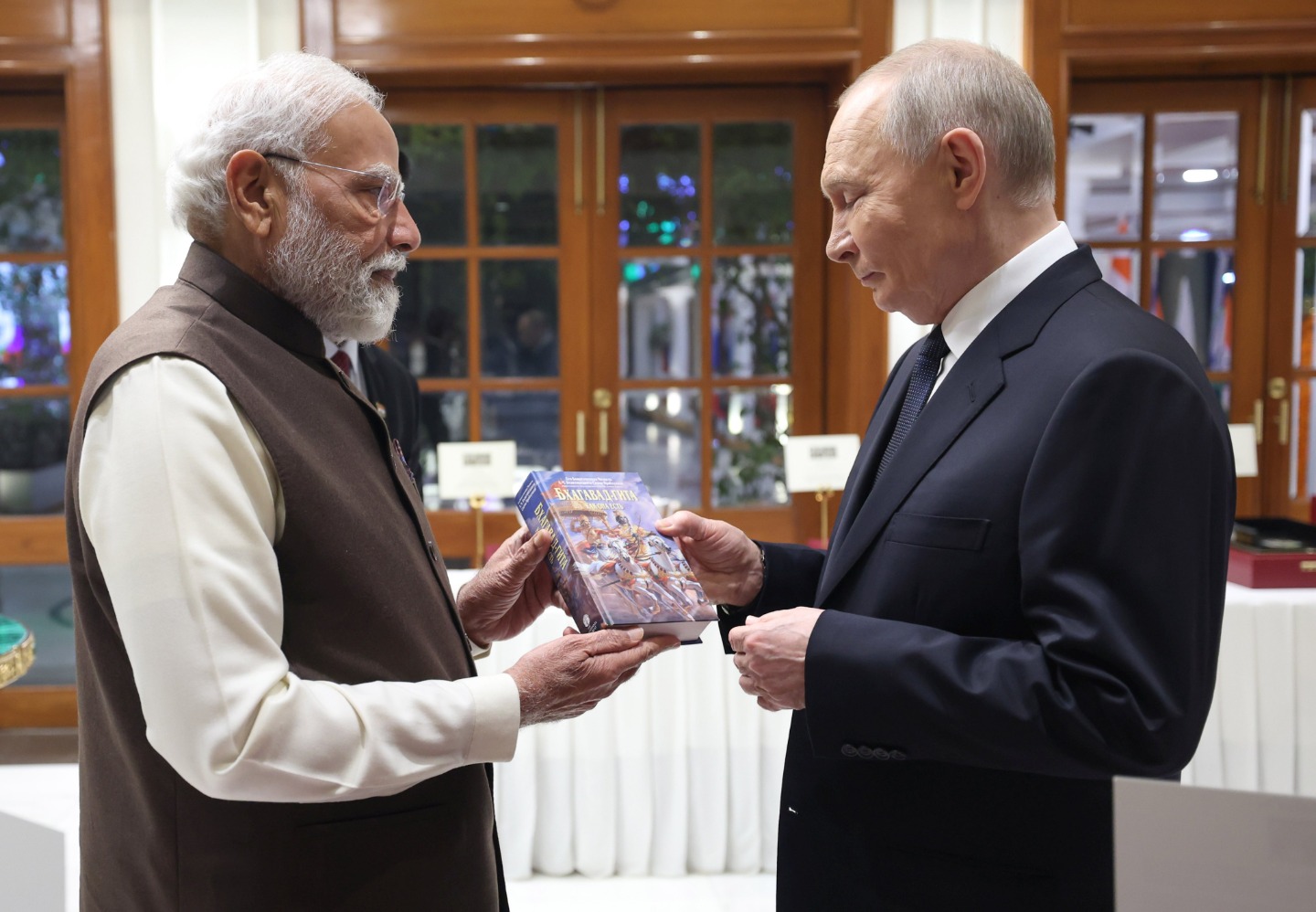
Prime Minister Narendra Modi’s decision to gift a Russian edition of the Bhagavad-gītā to President Vladimir Putin during the latter’s state visit to India carries deep spiritual and historical significance for India–Russia relations. The book presented is the Russian translation of Bhagavad-gītā As It Is by His Divine Grace A. C. Bhaktivedanta Swami Prabhupāda, founder-ācārya of ISKCON, whose commentary has become one of the most widely read editions of the Gītā worldwide.
Modi–Putin meeting and the Gītā
Welcoming President Putin at Delhi’s Palam Airport on 4 December 2025, Prime Minister Modi stepped beyond usual protocol by personally receiving him with a warm embrace and accompanying him in the same car to a private dinner at his residence. During this interaction, he presented a Russian copy of Bhagavad-gītā As It Is and later wrote on his official X account that the teachings of the Gītā offer inspiration to millions across the world.
Putin is in India for a two-day visit to attend the 23rd India–Russia Annual Summit, during which the two sides are expected to sign more than ten inter-governmental agreements and over fifteen commercial MoUs. His programme includes paying homage at Mahatma Gandhi’s memorial at Rajghat, holding bilateral talks with the Prime Minister, and participating in a business forum focused on expanding economic cooperation.
About “Bhagavad-gītā As It Is”
Bhagavad-gītā As It Is is the translation and commentary on the Bhagavad-gītā by A. C. Bhaktivedanta Swami Prabhupāda, who is revered in the Gauḍīya Vaiṣṇava tradition as the founder-ācārya of the International Society for Krishna Consciousness (ISKCON). First published by the Bhaktivedanta Book Trust in 1968, this edition has since been translated into around eighty languages, including Russian, with more than one hundred million copies distributed globally.
The Russian edition gifted to President Putin represents the same disciplic understanding of the Gītā that has guided the worldwide Hare Krishna movement, making it not only a state gift but also a spiritual bridge between Indian Vaiṣṇava paramparā and Russian readers. Scholars and diplomats have often noted that Prabhupāda’s edition is distinctive because it presents the original Sanskrit, transliteration, word-for-word meanings, translation, and extensive purports that explain the text through the lens of bhakti-yoga.
Earlier controversy and its resolution in Russia
The gifting of Bhagavad-gītā As It Is in Russian also recalls an important episode in recent India–Russia cultural history. In 2011, a public prosecutor in Tomsk, Russia, sought to have the Russian edition of Bhagavad-gītā As It Is declared “extremist” literature, alleging that certain commentaries incited religious hatred, which led to widespread concern in India and among international Hindu communities.
The case triggered strong reactions from Indian Parliament, religious leaders of multiple faiths, and the academic community in both countries, who emphasized that the Gītā is a revered scripture promoting self-discipline, duty, and spiritual harmony. In December 2011, the district court rejected the plea to ban the book, and in March 2012 the appeal court upheld this decision, after which Russian prosecutors dropped further challenges—an outcome welcomed as a victory for religious freedom and for the dignity of the Gītā in Russia.
Significance for India–Russia spiritual diplomacy
Presenting Bhagavad-gītā As It Is in Russian translation at the highest political level symbolizes how India’s spiritual heritage is being placed at the center of its contemporary diplomacy with Russia. The gesture underscores that the Gītā is not merely a Hindu scripture confined to India but a universal text that has deeply influenced seekers, scholars, and leaders across cultures, including in Russia where translations have circulated since the eighteenth century.
For the Vaiṣṇava community and devotees associated with ISKCON and similar institutions, the fact that the edition chosen is by ISKCON’s founder-ācārya highlights the continuing role of Prabhupāda’s translations in carrying the message of Kṛṣṇa-bhakti to foreign lands. For platforms like Vedavarsity, this event offers a contemporary example of how classical śāstra, presented “as it is” in the paramparā, can serve as a living link between nations, peoples, and civilisations in the modern world.
Deepen your Bhakti-yoga practice, harmonize relationships, and receive guided coaching — all at Vedavarsity.com