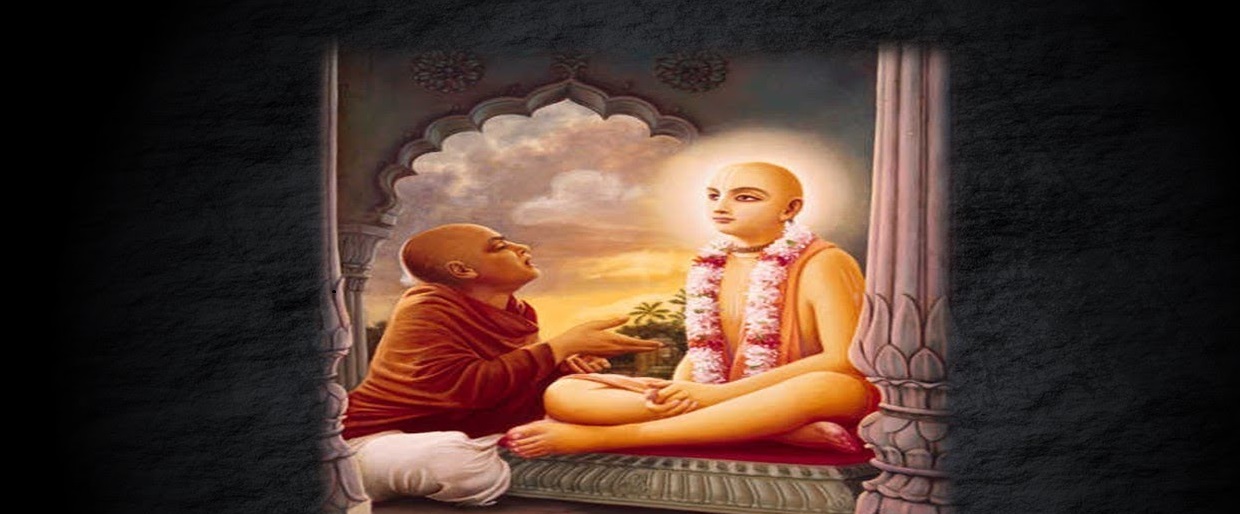
As they danced and embraced, spiritual symptoms manifested in their bodies. They perspired, trembled and shed tears, and the Lord began to speak in His ecstasy. (229) Śrī Caitanya Mahāprabhu said, “Today I have conquered the three worlds very easily. Today I have ascended to the spiritual world.” (230) Caitanya Mahāprabhu continued, “I think that today all My desires have been fulfilled because I see that Sārvabhauma Bhaṭṭācārya has acquired faith in the mahā- prasādam of Lord Jagannātha. (231) “Indeed, today you have undoubtedly taken shelter of the lotus feet of Kṛṣṇa, and Kṛṣṇa, without reservation, has become very merciful toward you. (232) “My dear Bhaṭṭācārya, today you have been released from material bondage in the bodily conception of life; you have cut to pieces the shackles of the illusory energy. (233) “Today your mind has become fit to take shelter of the lotus feet of Kṛṣṇa because, surpassing the Vedic regulative principles, you have eaten the remnants of food offered to the Lord. (234)
“‘When a person takes shelter of the lotus feet of the Supreme Personality of Godhead without reservation, the unlimited, merciful Lord bestows His causeless mercy upon him. Thus he can pass over the insurmountable ocean of nescience. Those whose intelligence is fixed in the bodily conception, who think, “I am this body,” are fit food for dogs and jackals. The Supreme Lord never bestows His mercy upon such people.’” (235) After speaking to Sārvabhauma Bhaṭṭācārya in this way, Śrī Caitanya Mahāprabhu returned to His residence. From that day on, the Bhaṭṭācārya was free because his false pride had been dismantled. (236) From that day on, Sārvabhauma Bhaṭṭācārya did not know anything but the lotus feet of Lord Caitanya Mahāprabhu, and from that day he could explain the revealed scriptures only in accordance with the process of devotional service. (237) Seeing that Sārvabhauma Bhaṭṭācārya was firmly fixed in the cult of Vaiṣṇavism, Gopīnātha Ācārya, his brother- in- law, began to dance, clap his hands and chant, “Hari! Hari!” (238) The next day, the Bhaṭṭācārya went to visit the temple of Lord Jagannātha, but before he reached the temple, he went to see Caitanya Mahāprabhu. (239)
When he met Lord Caitanya Mahāprabhu, the Bhaṭṭācārya fell down flat to offer Him respects. After offering various prayers to Him, he spoke of his previous bad disposition with great humility. (240) Then the Bhaṭṭācārya asked Caitanya Mahāprabhu, “Which item is most important in the execution of devotional service?” The Lord replied that the most important item was the chanting of the holy name of the Lord. (241) “‘In this age of quarrel and hypocrisy, the only means of deliverance is the chanting of the holy names of the Lord. There is no other way. There is no other way. There is no other way.’” (242) Śrī Caitanya Mahāprabhu very elaborately explained the harer nāma verse of the Bṛhan- nāradīya Purāṇa, and Sārvabhauma Bhaṭṭācārya was struck with wonder to hear His explanation. (243) Gopīnātha Ācārya reminded Sārvabhauma Bhaṭṭācārya, “My dear Bhaṭṭācārya, what I foretold to you has now taken place.” (244)
Offering his obeisances to Gopīnātha Ācārya, the Bhaṭṭācārya said, “Because I am related to you and you are a devotee, by your mercy the Lord has shown mercy to me. (245) “You are a first- class devotee, whereas I am in the darkness of logical arguments. Because of your relationship with the Lord, the Lord has bestowed His benediction upon me.” (246) Śrī Caitanya Mahāprabhu was very pleased with this humble statement. After embracing the Bhaṭṭācārya, He said, “Now go see Lord Jagannātha in the temple.” (247) After visiting the temple of Lord Jagannātha, Sārvabhauma Bhaṭṭācārya returned home with Jagadānanda and Dāmodara. (248) The Bhaṭṭācārya brought large quantities of excellent food remnants blessed by Lord Jagannātha. All this prasādam was given to his own brāhmaṇa servant, along with Jagadānanda and Dāmodara. (249) Sārvabhauma Bhaṭṭācārya then composed two verses on the leaf of a palm tree. Giving the palm leaf to Jagadānanda Prabhu, the Bhaṭṭācārya requested him to deliver it to Śrī Caitanya Mahāprabhu. (250)
Jagadānanda and Dāmodara then returned to Śrī Caitanya Mahāprabhu, bringing Him both the prasādam and the palm leaf on which the verses were composed. But Mukunda Datta took the palm leaf from the hands of Jagadānanda before he could deliver it to Śrī Caitanya Mahāprabhu. (251) Mukunda Datta then copied the two verses on the wall outside the room. After this, Jagadānanda took the palm leaf from Mukunda Datta and delivered it to Lord Caitanya Mahāprabhu. (252) As soon as Lord Caitanya Mahāprabhu read the two verses, He immediately tore up the palm leaf. However, all the devotees read these verses on the outside wall, and they all kept them within their hearts. The verses read as follows. (253) “Let me take shelter of the Supreme Personality of Godhead, Śrī Kṛṣṇa, who has descended in the form of Lord Caitanya Mahāprabhu to teach us real knowledge, His devotional service and detachment from whatever does not foster Kṛṣṇa consciousness. He has descended because He is an ocean of transcendental mercy. Let me surrender unto His lotus feet. (254)
“Let my consciousness, which is like a honeybee, take shelter of the lotus feet of the Supreme Personality of Godhead, who has just now appeared as Śrī Kṛṣṇa Caitanya Mahāprabhu to teach the ancient system of devotional service to Himself. This system had almost been lost due to the influence of time.” (255) These two verses composed by Sārvabhauma Bhaṭṭācārya will always declare his name and fame as loudly as a pounding drum, for they have become pearl necklaces around the necks of all devotees. (256) Indeed, Sārvabhauma Bhaṭṭācārya became an unalloyed devotee of Caitanya Mahāprabhu; he did not know anything but the service of the Lord. (257) The Bhaṭṭācārya always chanted the holy name of Śrī Kṛṣṇa Caitanya, son of mother Śacī and reservoir of all good qualities. Indeed, chanting the holy names became his meditation. (258)
One day Sārvabhauma Bhaṭṭācārya came before Caitanya Mahāprabhu and, after offering obeisances, began to recite a verse. (259) He began to quote one of Lord Brahmā’s prayers from Śrīmad- Bhāgavatam, but he changed two syllables at the end of the verse. (260) The Bhaṭṭācārya recited, “‘One who seeks Your compassion and thus tolerates all kinds of adverse conditions due to the karma of his past deeds, who engages always in Your devotional service with his mind, words and body, and who always offers obeisances unto You is certainly a bona fide candidate for becoming Your unalloyed devotee.’” (261) Śrī Caitanya Mahāprabhu immediately pointed out, “In that verse the word is ‘mukti- pade,’ but you have changed it to ‘bhakti- pade.’ What is your intention?” (262) Sārvabhauma Bhaṭṭācārya replied, “The awakening of pure love of Godhead, which is the result of devotional service, far surpasses liberation from material bondage. For those averse to devotional service, merging into the Brahman effulgence is a kind of punishment.” (263)
The Bhaṭṭācārya continued, “The impersonalists, who do not accept the transcendental form of Lord Śrī Kṛṣṇa, and the demons, who are always engaged in blaspheming and fighting with Him, are punished by being merged into the Brahman effulgence. But that does not happen to the person engaged in the devotional service of the Lord. (264-265) “There are five kinds of liberation: sālokya, sāmīpya, sārūpya, sārṣṭi and sāyujya. (266) “If there is a chance to serve the Supreme Personality of Godhead, a pure devotee sometimes accepts the sālokya, sārūpya, sāmīpya or sārṣṭi forms of liberation, but never sāyujya. (267) “A pure devotee does not like even to hear about sāyujya- mukti, which inspires him with fear and hatred. Indeed, the pure devotee would rather go to hell than merge into the effulgence of the Lord.” (268) Sārvabhauma Bhaṭṭācārya continued, “There are two kinds of sāyujya- mukti: merging into the Brahman effulgence and merging into the personal body of the Lord. Merging into the Lord’s body is even more abominable than merging into His effulgence.” (269)
Sārvabhauma Bhaṭṭācārya concluded, “‘Even though he is offered all kinds of liberation, the pure devotee does not accept them. He is fully satisfied engaging in the service of the Lord.’” (270) Lord Śrī Caitanya Mahāprabhu replied, “The word ‘mukti- pade’ has another meaning. ‘Mukti- pada’ directly refers to the Supreme Personality of Godhead. (271) “All kinds of liberation exist under the feet of the Supreme Personality of Godhead; therefore He is known as mukti- pada. According to another meaning, mukti is the ninth subject, and the Supreme Personality of Godhead is the shelter of liberation. (272) “Since I can understand Kṛṣṇa according to these two meanings,” Caitanya Mahāprabhu said, “what point is there in changing the verse?” Sārvabhauma Bhaṭṭācārya replied, “I was not able to give that reading to the verse. (273) “Although Your explanation is correct, it should not be used, because there is ambiguity in the word ‘mukti- pada.’ (274) “The word ‘mukti’ refers to five kinds of liberation. But its direct meaning usually conveys the idea of becoming one with the Lord. (275)
“The very sound of the word ‘mukti’ immediately induces hate and fear, but when we say the word ‘bhakti,’ we naturally feel transcendental bliss within the mind.” (276) Upon hearing this explanation, the Lord began to laugh and, with great pleasure, immediately embraced Sārvabhauma Bhaṭṭācārya very firmly. (277) Indeed, that very person who had been accustomed to reading and teaching Māyāvāda philosophy was now even hating the word “mukti.” This was possible only by the mercy of Śrī Caitanya Mahāprabhu. (278) As long as it does not turn iron into gold by its touch, no one can recognize an unknown stone to be a touchstone. (279)
Upon seeing transcendental Vaiṣṇavism in Sārvabhauma Bhaṭṭācārya, everyone could understand that Lord Caitanya was none other than Kṛṣṇa, the son of Nanda Mahārāja. (280) After this incident, all the inhabitants of Jagannātha Purī, headed by Kāśī Miśra, came to take shelter of the lotus feet of the Lord. (281) Later I shall describe how Sārvabhauma Bhaṭṭācārya always engaged in the service of the Lord. (282) I shall also describe in full detail how Sārvabhauma Bhaṭṭācārya perfectly rendered service to Śrī Caitanya Mahāprabhu by offering Him alms. (283) If one hears with faith and love these pastimes concerning Lord Caitanya Mahāprabhu’s meeting with Sārvabhauma Bhaṭṭācārya, he very soon is freed from the net of speculation and fruitive activity and attains the shelter of Śrī Caitanya Mahāprabhu’s lotus feet. (284-285) Praying at the lotus feet of Śrī Rūpa and Śrī Raghunātha, always desiring their mercy, I, Kṛṣṇadāsa, narrate Śrī Caitanya- caritāmṛta, following in their footsteps. (286)
Deepen your Bhakti-yoga practice, harmonize relationships, and receive guided coaching — all at Vedavarsity.com