


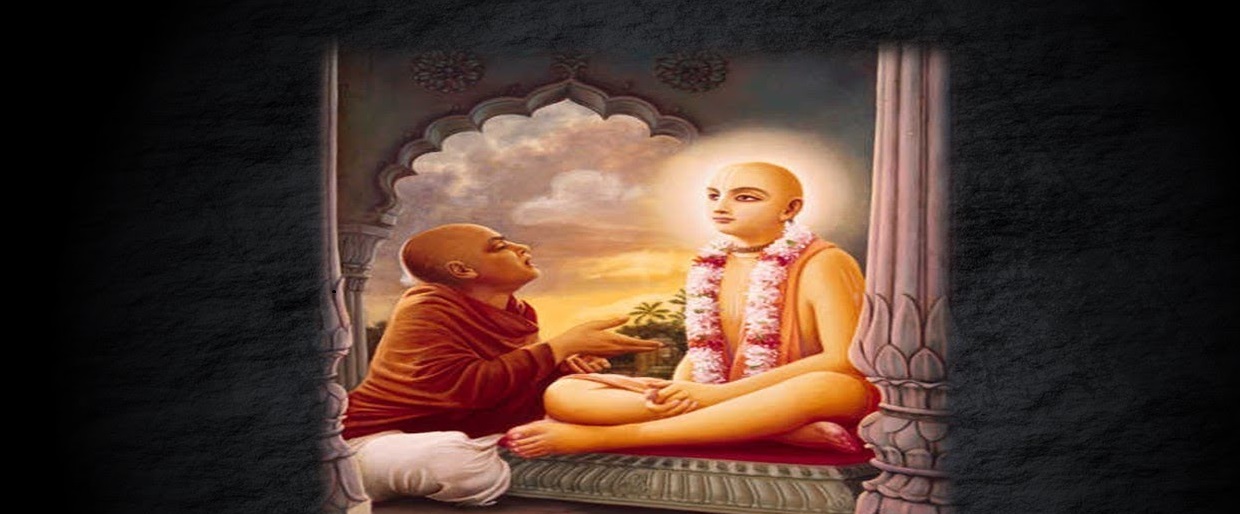
The Bhaṭṭācārya said, “Hearing Vedānta philosophy is a sannyāsī’s main business. Therefore without hesitation You should study Vedānta philosophy, hearing it without cessation from a superior person.” (121) Lord Caitanya replied, “You are very merciful to Me, and therefore I think it is My duty to obey your order.” (122) Thus for seven days continually, Śrī Caitanya Mahāprabhu listened to the Vedānta philosophy expounded by Sārvabhauma Bhaṭṭācārya. However, Caitanya Mahāprabhu did not say anything and did not indicate whether it was right or wrong. He simply sat there and listened to the Bhaṭṭācārya. (123) On the eighth day, Sārvabhauma Bhaṭṭācārya said to Caitanya Mahāprabhu, “You have been listening to Vedānta philosophy from me continually for seven days. (124)
“You have simply been listening, fixed in Your silence. Since You do not say whether You think it is right or wrong, I cannot know whether You are actually understanding Vedānta philosophy or not.” (125) Śrī Caitanya Mahāprabhu replied, “I am a fool, and consequently I do not study the Vedānta- sūtra. I am just trying to hear it from you because you have ordered Me. (126) “Only for the sake of executing the duties of the renounced order of sannyāsa do I listen. Unfortunately, I cannot in the least understand the meaning you are presenting.” (127) Sārvabhauma Bhaṭṭācārya replied, “I accept that You do not understand, yet even one who does not understand inquires about the subject matter. (128) “You are hearing again and again, yet You keep silent. I cannot understand what is actually within Your mind.” (129)
Śrī Caitanya Mahāprabhu then revealed His mind, saying, “I can understand the meaning of each sūtra very clearly, but your explanations have simply agitated My mind. (130) “The meaning of the aphorisms in the Vedānta- sūtra contain clear purports in themselves, but other purports you presented simply covered the meaning of the sūtras like a cloud. (131) “You do not explain the direct meaning of the Brahma- sūtras. Indeed, it appears that your business is to cover their real meaning.” (132) Caitanya Mahāprabhu continued, “The Vedānta- sūtra is the summary of all the Upaniṣads; therefore whatever direct meaning is there in the Upaniṣads is also recorded in the Vedānta- sūtra, or Vyāsa- sūtra. (133) “For each sūtra the direct meaning must be accepted without interpretation. However, you simply abandon the direct meaning and proceed with your imaginative interpretation. (134) “Although there is other evidence, the evidence given in the Vedic version must be taken as foremost. Vedic versions understood directly are first- class evidence.” (135)
Caitanya Mahāprabhu continued, “Conchshells and cow dung are nothing but the bones and the stool of some living entities, but according to the Vedic version they are both considered very pure. (136) “The Vedic statements are self- evident. Whatever is stated there must be accepted. If we interpret according to our own imagination, the authority of the Vedas is immediately lost.” (137) Śrī Caitanya Mahāprabhu continued, “The Brahma- sūtra, compiled by Śrīla Vyāsadeva, is as radiant as the sun. One who tries to interpret its meaning simply covers that sunshine with a cloud. (138) “All the Vedas and literature that strictly follows the Vedic principles explain that the Supreme Brahman is the Absolute Truth, the greatest of all, and a feature of the Supreme Lord. (139) “Actually, the Supreme Absolute Truth is a person, the Supreme Personality of Godhead, full with all opulences. You are trying to explain Him as impersonal and formless. (140)
“Wherever there is an impersonal description in the Vedas, the Vedas mean to establish that everything belonging to the Supreme Personality of Godhead is transcendental and free of mundane characteristics.” (141) Śrī Caitanya Mahāprabhu continued, “‘Whatever Vedic mantras describe the Absolute Truth impersonally only prove in the end that the Absolute Truth is a person. The Supreme Lord is understood in two features—impersonal and personal. If one considers the Supreme Personality of Godhead in both features, he can actually understand the Absolute Truth. He knows that the personal understanding is stronger because we see that everything is full of variety. No one can see anything that is not full of variety.’ (142) “Everything in the cosmic manifestation emanates from the Absolute Truth, remains in the Absolute Truth, and after annihilation again enters the Absolute Truth. (143) “The personal features of the Supreme Personality of Godhead are categorized in three cases— namely ablative, instrumental and locative.” (144)
Śrī Caitanya Mahāprabhu continued, “When the Supreme Personality of Godhead wished to become many, He glanced over the material energy. Before the creation there were no mundane eyes or mind; therefore the transcendental nature of the Absolute Truth’s mind and eyes is confirmed. (145-146) “The word ‘Brahman’ indicates the complete Supreme Personality of Godhead, who is Śrī Kṛṣṇa. That is the verdict of all Vedic literature. (147) “The confidential meaning of the Vedas is not easily understood by common men; therefore that meaning is supplemented by the words of the Purāṇas. (148) “‘How greatly fortunate are Nanda Mahārāja, the cowherd men and all the inhabitants of Vrajabhūmi! There is no limit to their fortune, because the Absolute Truth, the source of transcendental bliss, the eternal Supreme Brahman, has become their friend.’ (149) “The Vedic ‘apāṇi- pāda’ mantra rejects material hands and legs, yet it states that the Lord goes very fast and accepts everything offered to Him. (150) “All these mantras confirm that the Absolute Truth is personal, but the Māyāvādīs, throwing away the direct meaning, interpret the Absolute Truth as impersonal. (151)
“Are you describing as formless that Supreme Personality of Godhead whose transcendental form is complete with six transcendental opulences? (152) “The Supreme Personality of Godhead has three primary potencies. Are you trying to prove that He has no potencies? (153) “‘The internal potency of the Supreme Lord, Viṣṇu, is spiritual, as verified by the śāstras. There is another spiritual potency, known as kṣetra- jña, or the living entity. The third potency, which is known as nescience, makes the living entity godless and fills him with fruitive activity. (154) “‘O King, the kṣetra- jña- śakti is the living entity. Although he has the facility to live in either the material or spiritual world, he suffers the threefold miseries of material existence because he is influenced by the avidyā [nescience] potency, which covers his constitutional position. (155) “‘This living entity, covered by the influence of nescience, exists in different forms in the material condition. O King, he is thus proportionately freed from the influence of material energy, to a greater or lesser degree.’ (156)
“‘The Supreme Personality of Godhead is sac- cid- ānanda- vigraha. This means that He originally has three potencies—the pleasure potency, the potency of eternality and the potency of knowledge. Together these are called the cit potency, and they are present in full in the Supreme Lord. For the living entities, who are part and parcel of the Lord, the pleasure potency in the material world is sometimes displeasing and sometimes mixed. This is not the case with the Supreme Personality of Godhead, because He is not under the influence of the material energy or its modes.’ (157) “The Supreme Personality of Godhead in His original form is full of eternity, knowledge and bliss. The spiritual potency in these three portions [sat, cit and ānanda] assumes three different forms. (158) The three portions of the spiritual potency are called hlādinī [the bliss portion], sandhinī [the eternity portion] and samvit [the knowledge portion]. We accept knowledge of these as full knowledge of the Supreme Personality of Godhead. (159)
“The spiritual potency of the Supreme Personality of Godhead also appears in three phases— internal, marginal and external. These are all engaged in His devotional service in love. (160) “In His spiritual potency, the Supreme Lord enjoys six kinds of opulences. You do not accept this spiritual potency, and this is due to your great impudence. (161) “The Lord is the master of the potencies, and the living entity is the servant of them. That is the difference between the Lord and the living entity. However, you declare that the Lord and the living entities are one and the same. (162) “In the Bhagavad- gītā the living entity is established as the marginal potency of the Supreme Personality of Godhead. Yet you say that the living entity is completely different from the Lord. (163) “‘Earth, water, fire, air, ether, mind, intelligence and false ego are My eightfold separated energies. (164) “‘Besides these inferior energies, which are material, there is another energy, a spiritual energy, and this is the living being, O mighty- armed one. The entire material world is sustained by the living entities.’ (165)
“The transcendental form of the Supreme Personality of Godhead is complete in eternity, cognizance and bliss. However, you describe this transcendental form as a product of material goodness. (166) “One who does not accept the transcendental form of the Lord is certainly an agnostic. Such a person should be neither seen nor touched. Indeed, he is subject to be punished by Yamarāja. (167) “The Buddhists do not recognize the authority of the Vedas; therefore they are considered agnostics. However, those who have taken shelter of the Vedic scriptures yet preach agnosticism in accordance with the Māyāvāda philosophy are certainly more dangerous than the Buddhists. (168) “Śrīla Vyāsadeva presented the Vedānta philosophy for the deliverance of conditioned souls, but if one hears the commentary of Śaṅkarācārya, everything is spoiled. (169) “The Vedānta- sūtra aims at establishing that the cosmic manifestation has come into being by the transformation of the inconceivable potency of the Supreme Personality of Godhead. (170)
“The touchstone, after touching iron, produces volumes of gold without being changed. Similarly, the Supreme Personality of Godhead manifests Himself as the cosmic manifestation by His inconceivable potency, yet He remains unchanged in His eternal, transcendental form. (171) “Śaṅkarācārya’s theory states that the Absolute Truth is transformed. By accepting this theory, the Māyāvādī philosophers denigrate Śrīla Vyāsadeva by accusing him of error. They thus find fault in the Vedānta- sūtra and interpret it to try to establish the theory of illusion. (172) “The theory of illusion can be applied only when the living entity identifies himself with the body. As far as the cosmic manifestation is concerned, it cannot be called false, although it is certainly temporary. (173)
“The transcendental vibration oṁkāra is the sound form of the Supreme Personality of Godhead. All Vedic knowledge and this cosmic manifestation are produced from this sound representation of the Supreme Lord. (174) “The subsidiary vibration tat tvam asi [“you are the same”] is meant for the understanding of the living entity, but the principal vibration is oṁkāra. Not caring for oṁkāra, Śaṅkarācārya has stressed the vibration tat tvam asi.” (175) Thus Śrī Caitanya Mahāprabhu criticized Śaṅkarācārya’s Śārīraka- bhāṣya as imaginary, and He pointed out hundreds of faults in it. To defend Śaṅkarācārya, however, Sārvabhauma Bhaṭṭācārya presented unlimited opposition. (176) The Bhaṭṭācārya presented various types of false arguments with pseudo logic and tried to defeat his opponent in many ways. However, Śrī Caitanya Mahāprabhu refuted all these arguments and established His own conviction. (177)
Deepen your Bhakti-yoga practice, harmonize relationships, and receive guided coaching — all at Vedavarsity.com