When the elderly brāhmaṇa’s son heard this, he took the opportunity to juggle some words. Becoming very impudent, he stood before the assembly and spoke as follows. (58) “While touring various holy places of pilgrimage, my father carried much money. Seeing the money, this rogue decided to take it away. (59) “There was no one besides this man with my father. Giving him an intoxicant known as dhuturā to eat, this rogue made my father mad. (60) “Having taken all my father’s money, this rogue claimed that it was taken by some thief. Now he is claiming that my father has promised to give him his daughter in charity. (61) “All of you assembled here are gentlemen. Please judge whether it is befitting to offer this poor brāhmaṇa my father’s daughter.” (62)
Hearing all these statements, all the people gathered there became a little doubtful. They thought it quite possible that because of attraction for riches one might give up his religious principles. (63) At that time the young brāhmaṇa said, “My dear gentlemen, please hear. Just to gain victory in an argument, this man is lying. (64) “Being very satisfied with my service, this brāhmaṇa said to me of his own accord, ‘I promise to hand over my daughter to you.’ (65) “At that time I forbade him to do this, telling him, ‘O best of the brāhmaṇas, I am not a fit husband for your daughter. (66) “‘Whereas you are a learned scholar, a rich man belonging to an aristocratic family, I am a poor man, uneducated and with no claim to aristocracy.’ (67) “Still this brāhmaṇa insisted. Again and again he asked me to accept his proposal, saying, ‘I have given you my daughter. Please accept her.’ (68)
“I then said, ‘Please hear. You are a learned brāhmaṇa. Your wife, friends and relatives will never agree to this proposal. (69) “‘My dear sir, you will not be able to fulfill your promise. Your promise will be broken.’ Yet, again and again the brāhmaṇa emphasized his promise. (70) “‘I have offered you my daughter. Do not hesitate. She is my daughter, and I shall give her to you. Who can forbid me?’ (71) “At that time I concentrated my mind and requested the brāhmaṇa to make the promise before the Gopāla Deity. (72) “Then this gentleman said in front of the Gopāla Deity, ‘My dear Lord, please bear witness. I have offered my daughter to this brāhmaṇa in charity.’ (73) “Accepting the Gopāla Deity as my witness, I then submitted the following at His lotus feet. (74) “‘If this brāhmaṇa later hesitates to give me his daughter, my dear Lord, I shall call on You as a witness. Please note this with care and attention.’ (75)
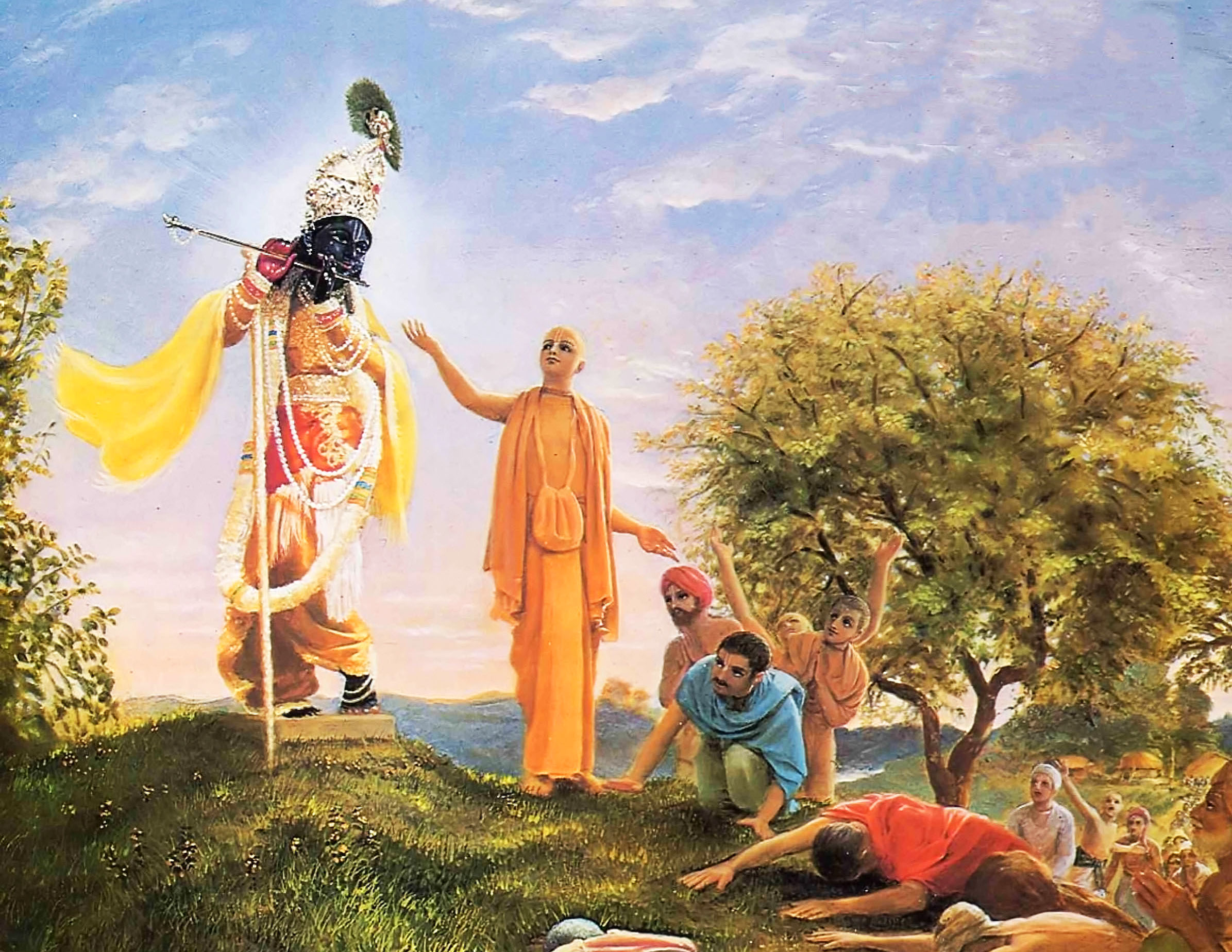
“Thus I have called upon a great personality in this transaction. I have asked the Supreme Godhead to be my witness. The entire world accepts the words of the Supreme Personality of Godhead.” (76) Taking this opportunity, the elderly brāhmaṇa immediately confirmed that this was really true. He said, “If Gopāla personally comes here to serve as a witness, I shall surely give my daughter to the young brāhmaṇa.” The elderly brāhmaṇa’s son immediately confirmed this, saying, “Yes, this is a very nice settlement.” (77-78) The elderly brāhmaṇa thought, “Since Lord Kṛṣṇa is very merciful, He will certainly come to prove my statement.” (79) The atheistic son thought, “It is not possible for Gopāla to come and bear witness.” Thinking thus, the father and son agreed. (80)
The young brāhmaṇa took this opportunity to speak: “Please write this down on paper in black and white so that you may not again change your word of honor.” (81) All the assembled people got this statement down in black and white and, taking the signatures of agreement from both of them, served as the mediators. (82) The young brāhmaṇa then said, “Will all you gentlemen present please hear me? This elderly brāhmaṇa is certainly truthful and is following religious principles. (83) “He had no desire to break his promise, but fearing that his kinsmen would commit suicide, he deviated from the truth. (84) “By the piety of the elderly brāhmaṇa, I shall call the Supreme Personality of Godhead as a witness. Thus I shall keep his truthful promise intact.” (85) Hearing the emphatic statement of the younger brāhmaṇa, some atheists in the meeting began to cut jokes. However, someone else said, “After all, the Lord is merciful, and if He likes, He can come.” (86) After the meeting, the young brāhmaṇa started for Vṛndāvana. Upon arriving there, he first offered his respectful obeisances to the Deity and then narrated everything in full detail. (87)
Deepen your Bhakti-yoga practice, harmonize relationships, and receive guided coaching — all at Vedavarsity.com