


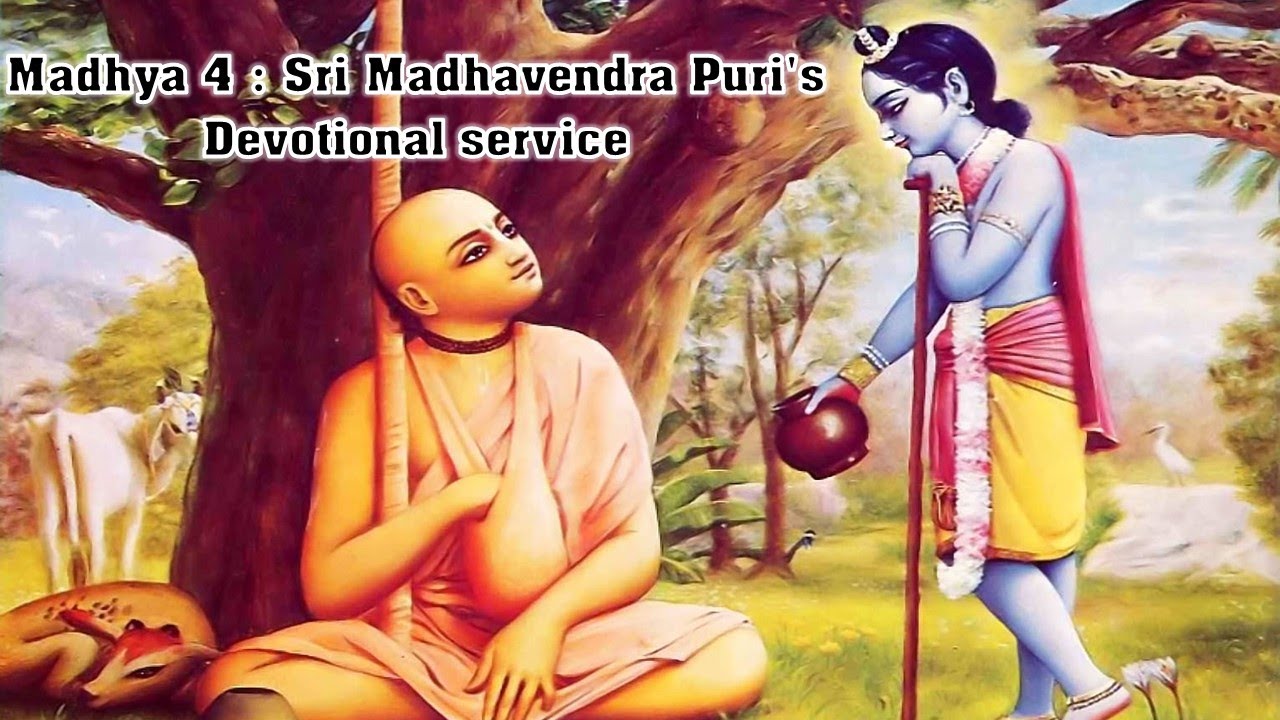
At the end of summer Mādhavendra Purī returned to Jagannātha Purī, where he remained with great pleasure during the whole period of Cāturmāsya. (169) Thus Śrī Caitanya Mahāprabhu personally praised the nectarean characteristics of Mādhavendra Purī, and while He related all this to the devotees, He personally relished it. (170) Lord Śrī Caitanya Mahāprabhu asked Nityānanda Prabhu to judge whether there was anyone within the world as fortunate as Mādhavendra Purī. (171) Śrī Caitanya Mahāprabhu said, “Mādhavendra Purī was so fortunate that Kṛṣṇa personally appeared before him on the plea of delivering milk. Three times the Lord gave orders to Mādhavendra Purī in dreams. (172) “Being obliged because of the loving affairs of Mādhavendra Purī, Lord Kṛṣṇa Himself appeared as the Gopāla Deity, and, accepting his service, He liberated the whole world. (173)
“On account of Mādhavendra Purī, Lord Gopīnātha stole the pot of sweet rice. Thus He became famous as Kṣīra- corā [the thief who stole the sweet rice]. (174) “Mādhavendra Purī smeared the sandalwood pulp over the body of Gopīnātha, and in this way he was overpowered with love of Godhead. (175) “In the provinces of India governed by the Muslims, there was much inconvenience in traveling with sandalwood and camphor. Because of this, Mādhavendra Purī might have gotten into trouble. This became known to the Gopāla Deity. (176) “The Lord is very merciful and attached to His devotees, so when Gopīnātha was covered with sandalwood pulp, Mādhavendra Purī’s labor became successful.” (177) Caitanya Mahāprabhu placed the standard of Mādhavendra Purī’s intense love before Nityānanda Prabhu for judgment. “All his loving activities are uncommon,” Caitanya Mahāprabhu said. “Indeed, one is struck with wonder to hear of his activities.” (178) Caitanya Mahāprabhu continued, “Śrī Mādhavendra Purī used to remain alone. He was completely renounced and always very silent. He was uninterested in everything material, and for fear of talking about mundane things, he always lived without a companion. (179)
“After receiving the transcendental orders of Gopāla, this great personality traveled thousands of miles just to collect sandalwood by begging. (180) “Although Mādhavendra Purī was hungry, he would not beg food to eat. This renounced person carried a load of sandalwood for the sake of Śrī Gopāla. (181) “Without considering his personal comforts, Mādhavendra Purī carried one maund [about eighty- two pounds] of sandalwood and twenty tolās [about eight ounces] of camphor to smear over the body of Gopāla. This transcendental pleasure was sufficient for him. (182) “Since there were restrictions against taking the sandalwood out of the Orissa province, the toll official confiscated the stock, but Mādhavendra Purī showed him the release papers given by the government and consequently escaped difficulties. (183) “Mādhavendra Purī was not at all anxious during the long journey to Vṛndāvana through the provinces governed by the Muslims and filled with unlimited numbers of watchmen. (184) “Although Mādhavendra Purī did not have a farthing with him, he was not afraid to pass by the toll officers. His only enjoyment was in carrying the load of sandalwood to Vṛndāvana for Gopāla. (185)
“This is the natural result of intense love of Godhead. The devotee does not consider personal inconveniences or impediments. In all circumstances he wants to serve the Supreme Personality of Godhead. (186) “Śrī Gopāla wanted to show how intensely Mādhavendra Purī loved Kṛṣṇa; therefore He asked him to go to Nīlācala to fetch sandalwood and camphor. (187) “With great trouble and after much labor, Mādhavendra Purī brought the load of sandalwood to Remuṇā. However, he was still very pleased; he discounted all the difficulties. (188) “To test the intense love of Mādhavendra Purī, Gopāla, the Supreme Personality of Godhead, ordered him to bring sandalwood from Nīlācala, and when Mādhavendra Purī passed this examination, the Lord became very merciful to him. (189) “Such behavior exhibited in loving service between the devotee and the devotee’s lovable object, Śrī Kṛṣṇa, is transcendental. It is not possible for a common man to understand. Common men do not even have the capacity.” (190) After saying this, Lord Caitanya Mahāprabhu read the famous verse of Mādhavendra Purī. That verse is just like the moon. It has spread illumination all over the world. (191)
Continuous rubbing increases the aroma of Malaya sandalwood. Similarly, consideration of this verse increases one’s understanding of its importance. (192) As the Kaustubha- maṇi is considered the most precious of valuable stones, this verse is similarly considered the best of poems dealing with the mellows of devotional service. (193) Actually this verse was spoken by Śrīmatī Rādhārāṇī Herself, and by Her mercy only was it manifest in the words of Mādhavendra Purī. (194) Only Śrī Caitanya Mahāprabhu has tasted the poetry of this verse. No fourth man is capable of understanding it. (195) Mādhavendra Purī recited this verse again and again at the end of his material existence. Thus uttering this verse, he attained the ultimate goal of life. (196) “O My Lord! O most merciful master! O master of Mathurā! When shall I see You again? Because of My not seeing You, My agitated heart has become unsteady. O most beloved one, what shall I do now?” (197)
When Śrī Caitanya Mahāprabhu recited this verse, He immediately fell to the ground unconscious. He was overwhelmed and had no control over Himself. (198) When Lord Śrī Caitanya Mahāprabhu fell to the ground in ecstatic love, Lord Nityānanda quickly took Him on His lap. Crying, Caitanya Mahāprabhu then got up again. (199) Exhibiting ecstatic emotions, the Lord began to run here and there, making resounding noises. Sometimes He laughed, and sometimes He cried, and sometimes He danced and sang. (200) Caitanya Mahāprabhu could not recite the whole verse. He simply said, “Ayi dīna! Ayi dīna!” repeatedly. Thus He could not speak, and profuse tears were in His eyes. (201) Trembling, perspiration, jubilant tears, shock, fading of the bodily luster, disappointment, moroseness, loss of memory, pride, joy and humility were all visible in Śrī Caitanya Mahāprabhu’s body. (202) This verse uncovered the door of ecstatic love, and when it was exhibited, all the servants of Gopīnātha saw Caitanya Mahāprabhu dance in ecstasy. (203)
When many people crowded around Śrī Caitanya Mahāprabhu, He regained His external senses. In the meantime, the offering to the Deity had been finished, and there was a resounding ārati performance. (204) When the Deities were laid down to rest, the priest came out of the temple and offered all twelve pots of sweet rice to Lord Caitanya Mahāprabhu. (205) When all the pots of sweet rice, remnants left by Gopīnātha, were placed before Śrī Caitanya Mahāprabhu, He became very pleased. In order to feed the devotees, He accepted five of them. (206) The seven remaining pots were pushed forward and delivered to the priest. Then the five pots of sweet rice the Lord had accepted were distributed among the five devotees, and they ate the prasādam. (207) Being identical with the Gopīnātha Deity, Śrī Caitanya Mahāprabhu had already tasted and eaten the pots of sweet rice. Yet just to manifest devotional service, He again ate the pots of sweet rice as a devotee. (208)
Śrī Caitanya Mahāprabhu passed that night at the temple engaged in congregational chanting. In the morning, after seeing the maṅgala- ārati performance, He departed. (209) In this way, Lord Śrī Caitanya Mahāprabhu personally tasted with His own mouth the transcendental qualities of Gopālajī, Gopīnātha and Śrī Mādhavendra Purī. (210) Thus I have described both the transcendental glories of Lord Caitanya Mahāprabhu’s affection for His devotees and the highest limit of ecstatic love of God. (211) One who hears this narration with faith and devotion attains the treasure of love of Godhead at the lotus feet of Śrī Kṛṣṇa. (212) Praying at the lotus feet of Śrī Rūpa and Śrī Raghunātha, always desiring their mercy, I, Kṛṣṇadāsa, narrate Śrī Caitanya- caritāmṛta, following in their footsteps. (213)
Deepen your Bhakti-yoga practice, harmonize relationships, and receive guided coaching — all at Vedavarsity.com