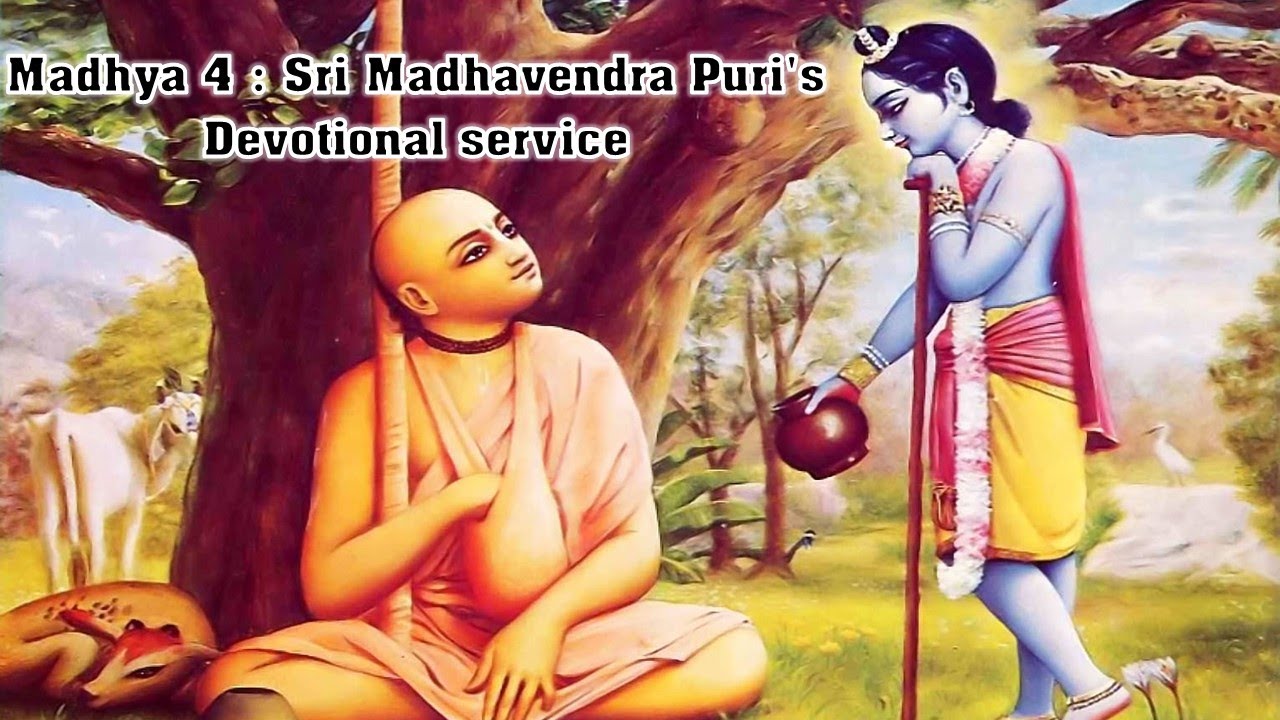
When the Deity was being installed, nine hundred pots of water were brought from Govinda- kuṇḍa. There were musical sounds of bugles and drums and the singing of women. (56) During the festival at the installation ceremony, some people sang and some danced. All the milk, yogurt and clarified butter in the village was brought to the festival. (57) Various foods and sweetmeats, as well as other kinds of presentations, were brought there. I am unable to describe all these. (58) The villagers brought a large quantity of tulasī leaves, flowers, and various kinds of garments. Then Śrī Mādhavendra Purī personally began the abhiṣeka [bathing ceremony]. (59) After all inauspicious things were driven away by the chanting of the mantra, the Deity’s bathing ceremony started. First the Deity was massaged with a large quantity of oil, so that His body became very glossy. (60)
After the first bathing, further bathings were conducted with pañca- gavya and then with pañcāmṛta. Then the mahā- snāna was performed with ghee and water, which had been brought in one hundred pots. (61) After the mahā- snāna was finished, the Deity was again massaged with scented oil and His body made glossy. Then the last bathing ceremony was performed with scented water kept within a conchshel. (62) After the body of the Deity was cleansed, He was dressed very nicely with new garments. Then sandalwood pulp, tulasī garlands and other fragrant flower garlands were placed upon the body of the Deity. (63) After the bathing ceremony was finished, incense and lamps were burned and all kinds of food offered before the Deity. These foods included yogurt, milk and as many sweetmeats as were received. (64)
The Deity was first offered many varieties of food, then scented drinking water in new pots, and then water for washing the mouth. Finally pan mixed with a variety of spices was offered. (65) After the last offering of tāmbūla and pan, bhoga- ārātrika was performed. Finally everyone offered various prayers and then obeisances, falling flat before the Deity in full surrender. (66) As soon as the people of the village had understood that the Deity was going to be installed, they had brought their entire stocks of rice, dhal and wheat flour. They brought such large quantities that the entire surface of the top of the hill was filled. (67) When the villagers brought their stock of rice, dhal and flour, the potters of the village brought all kinds of cooking pots, and in the morning the cooking began. (68) Ten brāhmaṇas cooked the food grains, and five brāhmaṇas cooked both dry and liquid vegetables. (69)
The vegetable preparations were made from various kinds of spinach, roots and fruits collected from the forest, and someone had made baḍā and baḍi by mashing dhal. In this way the brāhmaṇas prepared all kinds of food. (70) Five to seven men had prepared a huge quantity of chapatis, which were sufficiently covered with ghee [clarified butter], as were all the vegetables, rice and dhal. (71) All the cooked rice was stacked on palāśa leaves, which were on new cloths spread over the ground. (72) Around the stack of cooked rice were stacks of chapatis, and all the vegetables and liquid vegetable preparations were placed in different pots and put around them. (73) Pots of yogurt, milk, buttermilk and śikhariṇī, sweet rice, cream and solid cream were placed alongside the vegetables. (74) In this way the Annakūṭa ceremony was performed, and Mādhavendra Purī Gosvāmī personally offered everything to Gopāla. (75)
Many waterpots were filled with scented water for drinking, and Lord Śrī Gopāla, who had been hungry for many days, ate everything offered to Him. (76) Although Śrī Gopāla ate everything offered, still, by the touch of His transcendental hand, everything remained as before. (77) How Gopāla ate everything while the food remained the same was transcendentally perceived by Mādhavendra Purī Gosvāmī; nothing remains a secret to the devotees of the Lord. (78) The wonderful festival and installation of Śrī Gopālajī was arranged in one day. Certainly all this was accomplished by the potency of Gopāla. No one but a devotee can understand this. (79) Mādhavendra Purī offered water to Gopāla for washing His mouth, and he gave Him betel nuts to chew. Then, while ārati was performed, all the people chanted, “Jaya, Jaya!” [“All glories to Gopāla!”]. (80) Arranging for the Lord’s rest, Śrī Mādhavendra Purī brought a new cot, and over this he spread a new bedspread and thus made the bed ready. (81)
A temporary temple was constructed by covering the bed all around with a straw mattress. Thus there was a bed and a straw mattress to cover it. (82) After the Lord was laid down to rest on the bed, Mādhavendra Purī gathered all the brāhmaṇas who had prepared the prasādam and said to them, “Now feed everyone sumptuously, from the children on up to the aged!” (83) All the people gathered there sat down to honor the prasādam, and by and by they took food. All the brāhmaṇas and their wives were fed first. (84) Those who took prasādam included not only the people of Govardhana village but also those who came from other villages. They also saw the Deity of Gopāla and were offered prasādam to eat. (85) Seeing the influence of Mādhavendra Purī, all the people gathered there were struck with wonder. They saw that the Annakūṭa ceremony, which had been performed before during the time of Kṛṣṇa, was now taking place again by the mercy of Śrī Mādhavendra Purī. (86) All the brāhmaṇas present on that occasion were initiated by Mādhavendra Purī into the Vaiṣṇava cult, and Mādhavendra Purī engaged them in different types of service. (87)
After taking rest, the Deity must be awakened at the end of the day, and immediately some food and some water must be offered to Him. (88) When it was advertised throughout the country that Lord Gopāla had appeared atop Govardhana Hill, all the people from neighboring villages came to see the Deity. (89) One village after another was pleased to beg Mādhavendra Purī to allot them one day to perform the Annakūṭa ceremony. Thus, day after day, the Annakūṭa ceremony was performed for some time. (90) Śrī Mādhavendra Purī did not eat anything throughout the day, but at night, after laying the Deity down to rest, he took a milk preparation. (91) The next morning, the rendering of service to the Deity began again, and people from one village arrived with all kinds of food grains. (92) The inhabitants of the village brought to the Deity of Gopāla as much food grains, ghee, yogurt and milk as they had in their village. (93) The next day, almost as before, there was an Annakūṭa ceremony. All the brāhmaṇas prepared foods and Gopāla accepted them. (94)
The ideal place to execute Kṛṣṇa consciousness is Vrajabhūmi, or Vṛndāvana, where the people are naturally inclined to love Kṛṣṇa and Kṛṣṇa is naturally inclined to love them. (95) Throngs of people came from different villages to see the Deity of Gopāla, and they took mahā- prasādam sumptuously. When they saw the superexcellent form of Lord Gopāla, all their lamentation and unhappiness disappeared. (96) All the villages in neighboring Vrajabhūmi [Vṛndāvana] became aware of the appearance of Gopāla, and all the people from these villages came to see Him. Day after day they all performed the Annakūṭa ceremony. (97) In this way not only the neighboring villages but all the other provinces came to know of Gopāla’s appearance. Thus people came from all over, bringing a variety of presentations. (98)
The people of Mathurā, who are very big capitalists, also brought various presentations and offered them before the Deity in devotional service. (99) Thus countless presentations of gold, silver, garments, scented articles and eatables arrived. The store of Gopāla increased daily. (100) One very rich kṣatriya of the royal order constructed a temple, someone made cooking utensils, and someone constructed boundary walls. (101) Each and every family residing in the land of Vrajabhūmi contributed one cow. In this way, thousands of cows became the property of Gopāla. (102) Eventually two brāhmaṇas in the renounced order arrived from Bengal, and Mādhavendra Purī, who liked them very much, kept them in Vṛndāvana and gave them all kinds of comforts. (103)
These two were then initiated by Mādhavendra Purī, and he entrusted them with the daily service of the Lord. This service was performed continuously, and the worship of the Deity became very gorgeous. Thus Mādhavendra Purī was very pleased. (104) In this way the Deity worship in the temple was very gorgeously performed for two years. Then one day Mādhavendra Purī had a dream. (105) In his dream, Mādhavendra Purī saw Gopāla, who said, “My bodily temperature still has not decreased. Please bring sandalwood from the Malaya province and smear the pulp over My body to cool Me. (106) “Bring sandalwood pulp from Jagannātha Purī. Kindly go quickly. Since no one else can do it, you must.” (107) After having this dream, Mādhavendra Purī Gosvāmī became very glad due to ecstasy of love of Godhead, and in order to execute the command of the Lord, he started east toward Bengal. (108)
Before leaving, Mādhavendra Purī made all arrangements for regular Deity worship, and he engaged different people in various duties. Then, taking up the order of Gopāla, he started for Bengal. (109) When Mādhavendra Purī arrived at the house of Advaita Ācārya in Śāntipura, the Ācārya became very pleased upon seeing the ecstatic love of Godhead manifest in Mādhavendra Purī. (110) Advaita Ācārya begged to be initiated by Mādhavendra Purī. After initiating Him, Mādhavendra Purī started for South India. (111) Going into South India, Śrī Mādhavendra Purī visited Remuṇā, where Gopīnātha is situated. Upon seeing the beauty of the Deity, Mādhavendra Purī was overwhelmed. (112) In the corridor of the temple, from which people generally viewed the Deity, Mādhavendra Purī chanted and danced. Then he sat down there and asked a brāhmaṇa what kinds of foods they offered to the Deity. (113) From the excellence of the arrangements, Mādhavendra Purī understood by deduction that only the best food was offered. (114)
Mādhavendra Purī thought, “I shall inquire from the priest what foods are offered to Gopīnātha so that by making arrangements in our kitchen, we can offer similar foods to Śrī Gopāla.” (115) When the brāhmaṇa priest was questioned about this matter, he explained in detail what kinds of foods were offered to the Deity of Gopīnātha. (116) The brāhmaṇa priest said, “In the evening the Deity is offered sweet rice in twelve earthen pots. Because the taste is as good as nectar [amṛta], it is named amṛta- keli. (117) “This sweet rice is celebrated throughout the world as gopīnātha- kṣīra. It is not offered anywhere else in the world.” (118) While Mādhavendra Purī was talking with the brāhmaṇa priest, the sweet rice was placed before the Deity as an offering. Hearing this, Mādhavendra Purī thought as follows. (119) “If, without my asking, a little sweet rice is given to me, I can then taste it and make a similar preparation to offer my Lord Gopāla.” (120) Mādhavendra Purī became greatly ashamed when he desired to taste the sweet rice, and he immediately began to think of Lord Viṣṇu. While he was thus thinking of Lord Viṣṇu, the offering was completed, and the ārati ceremony began. (121) After the ārati was finished, Mādhavendra Purī offered his obeisances to the Deity and then left the temple. He did not say anything more to anyone. (122)
Deepen your Bhakti-yoga practice, harmonize relationships, and receive guided coaching — all at Vedavarsity.com