


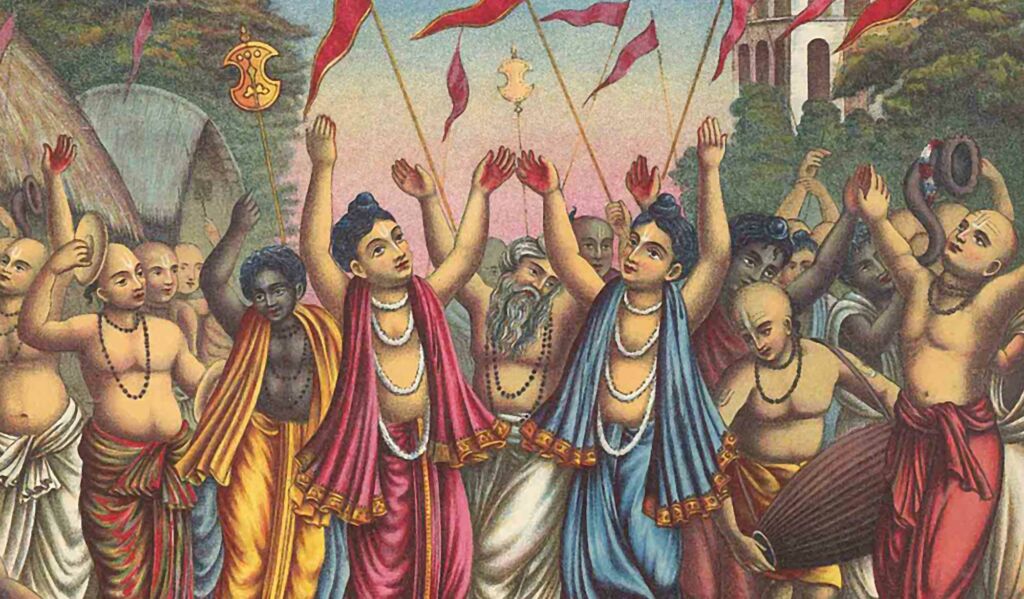
The same Supreme Personality of Godhead who appeared as the son of mother Yaśodā has now appeared as the son of mother Śacī, relishing four kinds of devotional activities. (275) To taste the mellows of Śrīmatī Rādhārāṇī’s loving affairs in Her relationship with Kṛṣṇa, and to understand the reservoir of pleasure in Kṛṣṇa, Kṛṣṇa Himself, as Śrī Caitanya Mahāprabhu, accepted the mood of Rādhārāṇī.(276) Lord Caitanya Mahāprabhu accepted the mood of the gopīs, who accept Vrajendranandana, Śrī Kṛṣṇa, as their lover. (277) It is firmly concluded that the ecstatic mood of the gopīs is possible only before Kṛṣṇa, and no one else. (278)
He has a bluish complexion, a peacock feather on His head, a guṣjā garland and the decorations of a cowherd boy. His body is curved in three places, and He holds a flute to His mouth. (279) If Lord Kṛṣṇa gives up this original form and assumes another Viṣṇu form, nearness to Him cannot invoke the ecstatic mood of the gopīs.(280) “Once Lord Śrī Kṛṣṇa playfully manifested Himself as Nārāyaṇa, with four victorious hands and a very beautiful form. When the gopīs saw this exalted form, however, their ecstatic feelings were crippled. Even a learned scholar, therefore, cannot understand the gopīs’ ecstatic feelings, which are firmly f ixed upon the original form of Lord Kṛṣṇa as the son of Nanda Mahārāja. The wonderful feelings of the gopīs in ecstatic parama-rasa with Kṛṣṇa constitute the greatest mystery in spiritual life.”(281) During the season of springtime, when the rāsa dance was going on, suddenly Kṛṣṇa disappeared from the scene, indicating that He wanted to be alone with Śrīmatī Rādhārāṇī. (282)
Kṛṣṇa was sitting in a solitary bush, waiting for Śrīmatī Rādhārāṇī to pass by. But while He was searching, the gopīs arrived there, like a phalanx of soldiers. (283) “Just see!” the gopīs said, seeing Kṛṣṇa from a distant place. “Here within a bush is Kṛṣṇa, the son of Nanda Mahārāja.” (284) As soon as Kṛṣṇa saw all the gopīs, He was struck with emotion. Thus He could not hide Himself, and out of fear He became motionless. (285) Kṛṣṇa assumed His four armed Nārāyaṇa form and sat there. When all the gopīs came, they looked at Him and spoke as follows. (286) “He is not Kṛṣṇa! He is the Supreme Personality of Godhead, Nārāyaṇa.” After saying this, they offered obeisances and the following respectful prayers. (287)
“O Lord Nārāyaṇa, we offer our respectful obeisances unto You. Kindly be merciful to us. Give us the association of Kṛṣṇa and thus vanquish our lamentation.” (288) After saying this and offering obeisances, all the gopīs dispersed. Then Śrīmatī Rādhārāṇī came and appeared before Lord Kṛṣṇa.(289) When Lord Kṛṣṇa saw Rādhārāṇī, He wanted to maintain the four-armed form to joke with Her.(290) In front of Śrīmatī Rādhārāṇī, Śrī Kṛṣṇa had to hide the two extra arms. He tried His best to keep four arms before Her, but He was completely unable to do so.(291) The influence of Rādhārāṇī’s pure ecstasy is so inconceivably great that it forced Kṛṣṇa to come to His original two-armed form.(292) “Prior to the rāsa dance, Lord Kṛṣṇa hid Himself in a grove just to have fun. When the gopīs came, their eyes resembling those of deer, by His sharp intelligence He exhibited His beautiful four-armed form to hide Himself. But when Śrīmatī Rādhārāṇī came there, Kṛṣṇa could not maintain His four arms in Her presence. This is the wonderful glory of Her love.” (293)
Father Nanda, the King of Vrajabhūmi, is now Jagannātha Miśra, the father of Caitanya Mahāprabhu. And mother Yaśodā, the Queen of Vrajabhūmi, is now Śacīdevī, Lord Caitanya’s mother. (294) The former son of Nanda Mahārāja is now Śrī Caitanya Mahāprabhu, and the former Baladeva, Kṛṣṇa’s brother, is now Nityānanda Prabhu, the brother of Lord Caitanya. (295) Śrī Nityānanda Prabhu always feels the ecstatic emotions of paternity, servitude and friendship. He always assists Śrī Caitanya Mahāprabhu in that way. (296) Śrī Nityānanda Prabhu overflooded the entire world by distributing transcendental loving service. No one can understand His character and activities. (297) Śrīla Advaita Ācārya Prabhu appeared as an incarnation of a devotee. He is in the category of Kṛṣṇa, but He descended to this earth to propagate devotional service. (298)
His natural emotions were always on the platform of fraternity and servitude, but the Lord sometimes treated Him as His spiritual master.(299) All the devotees of Śrī Caitanya Mahāprabhu, headed by Śrīvāsa Ṭhākura, have their own emotional humors in which they render service unto Him.(300) Personal associates like Gadādhara, Svarūpa Dāmodara, Rāmānanda Rāya, and the six Gosvāmīs (headed by Rūpa Gosvāmī) are all situated in their respective transcendental humors. Thus the Lord submits to various positions in various transcendental mellows. (301) In kṛṣṇa-līlā the Lord’s complexion is blackish. Holding a flute to His mouth, He enjoys as a cowherd boy. Now the selfsame person has appeared with a fair complexion, sometimes acting as a brāhmaṇa and sometimes accepting the renounced order of life. (302) Therefore the Lord Himself, accepting the emotional ecstasy of the gopīs, now addresses the son of Nanda Mahārāja, “O master of My life! O My dear husband!”(303)
He is Kṛṣṇa, yet He has accepted the mood of the gopīs. How is it so? It is the inconceivable character of the Lord, which is very difficult to understand. (304) One cannot understand the contradictions in Lord Caitanya’s character by putting forward mundane logic and arguments. Consequently one should not maintain doubts in this connection. One should simply try to understand the inconceivable energy of Kṛṣṇa; otherwise one cannot understand how such contradictions are possible. (305) The pastimes of Śrī Kṛṣṇa Caitanya Mahāprabhu are inconceivable and wonderful. His ecstasy is wonderful, His qualities are wonderful, and His behavior is wonderful. (306) If one simply adheres to mundane arguments and therefore does not accept this, he will boil in the hell of Kumbhīpāka. For him there is no deliverance.(307) “Anything transcendental to material nature is called inconceivable, whereas arguments are all mundane. Since mundane arguments cannot touch transcendental subject matters, one should not try to understand transcendental subjects through mundane arguments.” (308)
Only a person who has firm faith in the wonderful pastimes of Lord Caitanya Mahāprabhu can approach His lotus feet.(309) In this discourse I have explained the essence of the devotional conclusion. Anyone who hears this develops unalloyed devotional service to the Lord. (310) If I repeat what is already written, I may thus relish the purport of this scripture. (311) We can see in the scripture Śrīmad Bhāgavatam the conduct of its author, Śrī Vyāsadeva. After speaking the narration, he repeats it again and again.(312) Therefore I shall enumerate the chapters of the Ādi-līlā. In the first chapter I offer obeisances to the spiritual master, for this is the beginning of auspicious writing.(313) The second chapter explains the truth of Śrī Caitanya Mahāprabhu. He is the Supreme Personality of Godhead, Lord Kṛṣṇa, the son of Mahārāja Nanda.(314)
Śrī Kṛṣṇa Caitanya Mahāprabhu, who is Kṛṣṇa Himself, has now appeared as the son of mother Śacī. The third chapter describes the general cause of His appearance. (315) The third chapter specifically describes the distribution of love of Godhead. It also describes the religion of the age, which is simply to distribute the holy name of Lord Kṛṣṇa and propagate the process of loving Him.(316) The fourth chapter describes the main reason for His appearance, which is to taste the mellows of His own transcendental loving service and His own sweetness. (317) The fifth chapter describes the truth of Lord Nityānanda Prabhu, who is none other than Balarāma, the son of Rohiṇī. (318) The sixth chapter considers the truth of Advaita Ācārya. He is an incarnation of Mahā-Viṣṇu.(319) The seventh chapter describes the Panca-tattva — Śrī Caitanya, Prabhu Nityānanda, Śrī Advaita, Gadādhara and Śrīvāsa. They all combined together to distribute love of Godhead everywhere. (320)
The eighth chapter gives the reason for describing Lord Caitanya’s pastimes. It also describes the greatness of Lord Kṛṣṇa’s holy name.(321) The ninth chapter describes the desire tree of devotional service. Śrī Caitanya Mahāprabhu Himself is the gardener who planted it.(322) The tenth chapter describes the branches and subbranches of the main trunk and the distribution of their fruits.(323) The eleventh chapter describes the branch called Śrī Nityānanda Prabhu. The twelfth chapter describes the branch called Śrī Advaita Prabhu. (324) The thirteenth chapter describes the birth of Śrī Caitanya Mahāprabhu, which took place with the chanting of the holy name of Kṛṣṇa. (325) The fourteenth chapter gives some description of the Lord’s childhood pastimes. The fifteenth briefly describes the Lord’s boyhood pastimes.(326) In the sixteenth chapter I have indicated the pastimes of the kaiśora age [the age prior to youth]. In the seventeenth chapter I have specifically described His youthful pastimes. (327)
Thus there are seventeen varieties of subjects in the first canto, which is known as the Ādi līlā. Twelve of these constitute the preface of this scripture.(328) After the chapters of the preface, I have described five transcendental mellows in five chapters. I have described them very briefly rather than expansively.(329) By the order and strength of Śrī Nityānanda Prabhu, Śrīla Vṛndāvana dāsa Ṭhākura has elaborately described in his Caitanya-maṅgala all that I have not. (330) The pastimes of Lord Śrī Caitanya Mahāprabhu are wonderful and unlimited. Even personalities like Lord Brahmā, Lord Śiva and Śeṣa Nāga cannot f ind their end. (331) Anyone who describes or hears any part of this elaborate subject will very soon receive the causeless mercy of Śrī Kṛṣṇa Caitanya Mahāprabhu. (332)
[Herein the author again describes the Paṣca-tattva.] Śrī Kṛṣṇa Caitanya, Prabhu Nityānanda, Śrī Advaita, Gadādhara, Śrīvāsa and all the devotees of Lord Caitanya.(333) I offer my respectful obeisances to all the residents of Vṛndāvana. I wish to place their lotus feet on my head in great humbleness.(334) I wish to place the lotus feet of the Gosvāmīs on my head. Their names are Śrī Svarūpa Dāmodara, Śrī Rūpa Gosvāmī, Śrī Sanātana Gosvāmī, Śrī Raghunātha dāsa Gosvāmī and Śrī Jīva Gosvāmī. Placing their lotus feet on my head, always hoping to serve them, I, Kṛṣṇadāsa, narrate Śrī Caitanya-caritāmṛta, following in their footsteps.(335-336)
Deepen your Bhakti-yoga practice, harmonize relationships, and receive guided coaching — all at Vedavarsity.com