


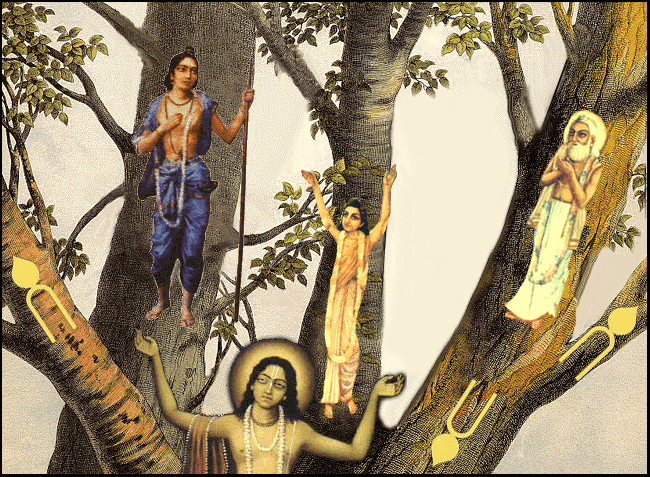
Lord Śrī Caitanya Mahāprabhu bestows His causeless mercy upon His devotees in three features: His own direct appearance [sākṣāt], His prowess within someone He empowers [āveśa], and His manifestation [āvirbhāva]. (56) The appearance of Lord Śrī Caitanya Mahāprabhu in every devotee’s presence is called sākṣāt. His appearance in Nakula Brahmacārī as a symptom of special prowess is an example of āveśa. (57) The former Pradyumna Brahmacārī was given the name Nṛsiṁhānanda Brahmacārī by Śrī Caitanya Mahāprabhu. (58)
In his body there were symptoms of āvirbhāva. Such appearances are uncommon, but Lord Caitanya Mahāprabhu displayed many such pastimes through His different features. (59) Śrīla Śivānanda Sena experienced the three features of sākṣāt, āveśa and āvirbhāva. Later I shall vividly describe this transcendentally blissful subject.(60) The sons, servants and family members of Śivānanda Sena constituted a subbranch. They were all sincere servants of Lord Śrī Caitanya Mahāprabhu. (61) The three sons of Śivānanda Sena, named Caitanya dāsa, Rāmadāsa and Karṇapūra, were all heroic devotees of Lord Caitanya. (62)
Śrīvallabha Sena and Śrīkānta Sena were also subbranches of Śivānanda Sena, for they were not only his nephews but also unalloyed devotees of Śrī Caitanya Mahāprabhu. (63) Govindānanda and Govinda Datta, the twenty- fifth and twenty- sixth branches of the tree, were performers of kīrtana in the company of Śrī Caitanya Mahāprabhu. Govinda Datta was the principal singer in Lord Caitanya’s kīrtana party. (64) Śrī Vijaya dāsa, the twenty- seventh branch, another of the Lord’s chief singers, gave the Lord many books written by hand. (65)
Śrī Caitanya Mahāprabhu gave Vijaya dāsa the name Ratnabāhu [“jewel- handed”] because he copied many manuscripts for Him. The twenty- eighth branch was Kṛṣṇadāsa, who was very dear to the Lord. He was known as Akiñcana Kṛṣṇadāsa. (66) The twenty- ninth branch was Śrīdhara, a trader in banana- tree bark. He was a very dear servant of the Lord. On many occasions, the Lord played jokes on him. (67) Every day Lord Caitanya Mahāprabhu jokingly snatched fruits, flowers and pulp from Śrīdhara and drank from his broken iron pot. (68) The thirtieth branch was Bhagavān Paṇḍita. He was an extremely dear servant of the Lord, but even previously he was a great devotee of Lord Kṛṣṇa who always kept the Lord within his heart. (69)
The thirty- first branch was Jagadīśa Paṇḍita, and the thirty- second was Hiraṇya Mahāśaya, unto whom Lord Caitanya in His childhood showed His causeless mercy. (70) In their two houses Lord Caitanya Mahāprabhu begged food on the Ekādaśī day and personally ate it. (71) The thirty- third and thirty- fourth branches were the two students of Caitanya Mahāprabhu named Puruṣottama and Sañjaya, who were stalwart students in grammar. They were very great personalities. (72) Vanamālī Paṇḍita, the thirty- fifth branch of the tree, was very much celebrated in this world. He saw a golden club and plow in the hands of the Lord. (73) The thirty- sixth branch, Buddhimanta Khān, was extremely dear to Lord Caitanya Mahāprabhu. He was always prepared to carry out the Lord’s orders, and therefore he was considered to be a chief servant of the Lord. (74)
Garuḍa Paṇḍita, the thirty- seventh branch of the tree, always engaged in chanting the auspicious name of the Lord. Because of the strength of this chanting, even the effects of poison could not touch him. (75) Gopīnātha Siṁha, the thirty- eighth branch of the tree, was a faithful servant of Lord Caitanya Mahāprabhu. The Lord jokingly addressed him as Akrūra. (76) Devānanda Paṇḍita was a professional reciter of Śrīmad- Bhāgavatam, but by the mercy of Vakreśvara Paṇḍita and the grace of the Lord he understood the devotional interpretation of the Bhāgavatam. (77)
Śrī Khaṇḍavāsī Mukunda and his son Raghunandana were the thirty- ninth branch of the tree, Narahari was the fortieth, Cirañjīva the forty- first and Sulocana the forty- second. They were all big branches of the all- merciful tree of Caitanya Mahāprabhu. They distributed the fruits and flowers of love of Godhead anywhere and everywhere. (78-79) Satyarāja, Rāmānanda, Yadunātha, Puruṣottama, Śaṅkara and Vidyānanda all belonged to the twentieth branch. They were inhabitants of the village known as Kulīna- grāma. (80) All the inhabitants of Kulīna- grāma village, headed by Vāṇīnātha Vasu, were servants of Lord Caitanya, who was their only life and wealth. (81) The Lord said, “What to speak of others, even a dog in the village of Kulīna- grāma is My dear friend. (82)
“No one can describe the fortunate position of Kulīna- grāma. It is so sublime that even sweepers who tend their hogs there also chant the Hare Kṛṣṇa mahā- mantra.” (83) On the western side were the forty- third, forty- fourth and forty- fifth branches-Śrī Sanātana, Śrī Rūpa and Anupama. They were the best of all. (84) Among these branches, Rūpa and Sanātana were principal. Anupama, Jīva Gosvāmī and others, headed by Rājendra, were their subbranches. (85) By the will of the supreme gardener, the branches of Śrīla Rūpa Gosvāmī and Sanātana Gosvāmī grew many times over, expanding throughout the western countries and covering the entire region. (86) Extending to the borders of the river Sindhu and the Himalayan Mountain valleys, these two branches expanded throughout India, including all the places of pilgrimage, such as Vṛndāvana, Mathurā and Haridvāra. (87)
The fruits of love of Godhead which fructified on these two branches were distributed in abundance. Tasting these fruits, everyone became mad after them. (88) The people in general on the western side of India were neither intelligent nor well behaved, but by the influence of Śrīla Rūpa Gosvāmī and Sanātana Gosvāmī they were trained in devotional service and good behavior. (89) In accordance with the directions of the revealed scriptures, both Gosvāmīs excavated the lost places of pilgrimage and inaugurated the worship of Deities in Vṛndāvana. (90)
Deepen your Bhakti-yoga practice, harmonize relationships, and receive guided coaching — all at Vedavarsity.com