


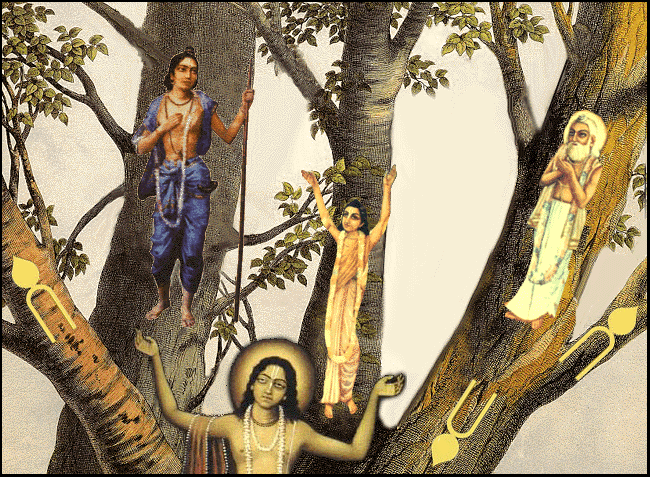
Let me repeatedly offer my respectful obeisances unto the beelike devotees who always taste the honey of the lotus feet of Lord Caitanya Mahāprabhu. If even a doggish nondevotee somehow takes shelter of such devotees, he enjoys the aroma of the lotus flower. (1) All glories to Lord Caitanya Mahāprabhu and Lord Nityānanda! All glories to Advaita Prabhu, and all glories to the devotees of Lord Caitanya, headed by Śrīvāsa! (2) The description of Lord Caitanya as the gardener and the tree is inconceivable. Now hear with attention about the branches of this tree. (3)
The associates of Śrī Caitanya Mahāprabhu were many, but none of them should be considered lower or higher. This cannot be ascertained. (4) All the great personalities in the line of Lord Caitanya enumerated these devotees, but they could not distinguish between the greater and the lesser. (5) I offer my obeisances unto them as a token of respect. I request them not to consider my offenses. (6) I offer my obeisances to all the dear devotees of Śrī Caitanya Mahāprabhu, the eternal tree of love of Godhead. I offer my respects to all the branches of the tree, the devotees of the Lord who distribute the fruit of love of Kṛṣṇa. (7) The two brothers Śrīvāsa Paṇḍita and Śrī Rāma Paṇḍita started two branches that are well known in the world. (8)
Their two brothers were named Śrīpati and Śrīnidhi. These four brothers and their servants and maidservants are considered one big branch. (9) There is no counting the subbranches of these two branches. Śrī Caitanya Mahāprabhu held congregational chanting daily at the house of Śrīvāsa Paṇḍita. (10) These four brothers and their family members fully engaged in the service of Lord Caitanya. They knew no other god or goddess. (11) Another big branch was Ācāryaratna, and his associates were subbranches. (12) Ācāryaratna was also named Śrī Candraśekhara Ācārya. In a drama in his house, Lord Caitanya played the goddess of fortune. (13)
Puṇḍarīka Vidyānidhi, the third big branch, was so dear to Lord Caitanya Mahāprabhu that in his absence Lord Caitanya Himself would sometimes cry. (14) Gadādhara Paṇḍita, the fourth branch, is described as an incarnation of the pleasure potency of Śrī Kṛṣṇa. No one, therefore, can equal him. (15) His disciples and granddisciples are his subbranches. To describe them all would be difficult. (16) Vakreśvara Paṇḍita, the fifth branch of the tree, was a very dear servant of Lord Caitanya’s. He could dance with constant ecstasy for seventy- two hours. (17)
Śrī Caitanya Mahāprabhu personally sang while Vakreśvara Paṇḍita danced, and thus Vakreśvara Paṇḍita fell at the lotus feet of the Lord and spoke as follows. (18) “O Candramukha! Please give me ten thousand Gandharvas. Let them sing as I dance, and then I will be greatly happy.” (19) Lord Caitanya replied, “I have only one wing like you, but if I had another, certainly I would fly in the sky!” (20) Paṇḍita Jagadānanda, the sixth branch of the Caitanya tree, was celebrated as the life and soul of the Lord. He is known to have been an incarnation of Satyabhāmā [one of the chief queens of Lord Kṛṣṇa]. (21)
Jagadānanda Paṇḍita [as an incarnation of Satyabhāmā] always wanted to see to the comfort of Lord Caitanya, but since the Lord was a sannyāsī He did not accept the luxuries that Jagadānanda Paṇḍita offered. (22) They sometimes appeared to fight over trifles, but these quarrels were based on their affection, of which I shall speak later. (23) Rāghava Paṇḍita, Lord Śrī Caitanya Mahāprabhu’s original follower, is understood to have been the seventh branch. From him proceeded another subbranch, headed by Makaradhvaja Kara. (24)
Rāghava Paṇḍita’s sister Damayantī was the dear maidservant of the Lord. She always collected various ingredients with which to cook for Lord Caitanya. (25) The foods Damayantī cooked for Lord Caitanya when He was at Purī were carried in bags by her brother Rāghava without the knowledge of others. (26) The Lord accepted these foods throughout the entire year. Those bags are still celebrated as rāghavera jhāli [“the bags of Rāghava Paṇḍita”]. (27) I shall describe the contents of the bags of Rāghava Paṇḍita later in this book. Hearing this narration, devotees generally cry, and tears glide down from their eyes. (28) Paṇḍita Gaṅgādāsa was the eighth dear branch of the tree of Śrī Caitanya Mahāprabhu. One who remembers his activities attains freedom from all bondage. (29)
Śrī Ācārya Purandara, the ninth branch, was a constant associate of Lord Caitanya’s. The Lord accepted him as His father.(30) Dāmodara Paṇḍita, the tenth branch of the Caitanya tree, was so elevated in love of Lord Caitanya that he once unhesitatingly chastised the Lord with strong words. (31) Later in the Caitanya- caritāmṛta I shall describe this incident of chastisement in detail. The Lord, being very much satisfied by this chastisement, sent Dāmodara Paṇḍita to Navadvīpa. (32) The eleventh branch, the younger brother of Dāmodara Paṇḍita, was known as Śaṅkara Paṇḍita. He was celebrated as the shoes of the Lord. (33)
Sadāśiva Paṇḍita, the twelfth branch, was always eager to serve the lotus feet of the Lord. It was his good fortune that when Lord Nityānanda came to Navadvīpa He resided at his house. (34) The thirteenth branch was Pradyumna Brahmacārī. Since he was a worshiper of Lord Nṛsiṁhadeva, Śrī Caitanya Mahāprabhu changed his name to Nṛsiṁhānanda Brahmacārī. (35) Nārāyaṇa Paṇḍita, the fourteenth branch, a great and liberal devotee, did not know any shelter but Lord Caitanya’s lotus feet. (36) The fifteenth branch was Śrīmān Paṇḍita, who was a constant servitor of Lord Caitanya Mahāprabhu. He used to carry a torch while the Lord danced. (37) The sixteenth branch, Śuklāmbara Brahmacārī, was very fortunate because Lord Caitanya Mahāprabhu jokingly or seriously begged food from him or sometimes snatched it from him forcibly and ate it. (38)
Nandana Ācārya, the seventeenth branch of the Caitanya tree, is celebrated within the world because the two Prabhus [Lord Caitanya and Nityānanda] sometimes hid in his house. (39) Mukunda Datta, a class friend of Lord Caitanya’s, was another branch of the Caitanya tree. Lord Caitanya danced while he sang. (40) Vāsudeva Datta, the nineteenth branch of the Śrī Caitanya tree, was a great personality and a most confidential devotee of the Lord. One could not describe his qualities even with thousands of mouths. (41) Śrīla Vāsudeva Datta Ṭhākura wanted to suffer for the sinful activities of all the people of the world so that Lord Caitanya Mahāprabhu might deliver them. (42)
The twentieth branch of the Caitanya tree was Haridāsa Ṭhākura. His character was wonderful. He used to chant the holy name of Kṛṣṇa 300,000 times a day without fail. (43) There was no end to the transcendental qualities of Haridāsa Ṭhākura. Here I mention but a fraction of his qualities. He was so exalted that Advaita Gosvāmī, when performing the śrāddha ceremony of his father, offered him the first plate. (44) The waves of his good qualities were like those of Prahlāda Mahārāja. He did not even slightly raise an eyebrow when persecuted by the Muslim ruler. (45)
After the passing away of Haridāsa Ṭhākura, the Lord Himself took his body on His lap and danced with it in great ecstasy. (46) Śrīla Vṛndāvana dāsa Ṭhākura has vividly described the pastimes of Haridāsa Ṭhākura in his Caitanya- bhāgavata. Whatever has remained undescribed I shall try to explain later in this book. (47) One subbranch of Haridāsa Ṭhākura consisted of the residents of Kulīna- grāma. The most important among them was Satyarāja Khān, or Satyarāja Vasu, who was a recipient of all the mercy of Haridāsa Ṭhākura. (48)
Murāri Gupta, the twenty- first branch of the tree of Śrī Caitanya Mahāprabhu, was a storehouse of love of Godhead. His great humility and meekness melted the heart of Lord Caitanya. (49) Śrīla Murāri Gupta never accepted charity from friends, nor did he accept money from anyone. He practiced as a physician and maintained his family with his earnings. (50) As Murāri Gupta treated his patients, by his mercy both their bodily and spiritual diseases subsided. (51) Śrīmān Sena, the twenty- second branch of the Caitanya tree, was a very faithful servant of Lord Caitanya. He knew nothing else but the lotus feet of Śrī Caitanya Mahāprabhu. (52)
Śrī Gadādhara dāsa, the twenty- third branch, was understood to be the topmost, for he induced all the Muslim Kazis to chant the holy name of Lord Hari. (53) Śivānanda Sena, the twenty- fourth branch of the tree, was an extremely confidential servant of Lord Caitanya Mahāprabhu. Everyone who went to Jagannātha Purī to visit Lord Caitanya took shelter and guidance from Śrī Śivānanda Sena. (54) Every year he took a party of devotees from Bengal to Jagannātha Purī to visit Lord Caitanya. He maintained the entire party as they journeyed on the road. (55)
Deepen your Bhakti-yoga practice, harmonize relationships, and receive guided coaching — all at Vedavarsity.com