In Vṛndāvana, in a great place of pilgrimage underneath the desire trees, is a golden throne bedecked with jewels. (50) On that throne sits the son of Nanda Mahārāja, Śrī Govindadeva, the transcendental Cupid. (51) Varieties of majestic service are rendered to Govinda there. His garments, ornaments and paraphernalia are all transcendental. (52)
In that temple of Govindajī, thousands of servitors always render service to the Lord in devotion. Even with thousands of mouths, one could not describe this service. (53) In that temple the chief servitor was Śrī Haridāsa Paṇḍita. His qualities and fame are known all over the world. (54) He was gentle, tolerant, peaceful, magnanimous, grave, sweet in his words and very sober in his endeavors. (55) He was respectful to everyone and worked for the benefit of all. Diplomacy, envy and jealousy were unknown to his heart. (56) The fifty qualities of Lord Kṛṣṇa were all present in his body. (57)
“In one who has unflinching devotional faith in Kṛṣṇa, all the good qualities of Kṛṣṇa and the demigods are consistently manifested. However, one who has no devotion to the Supreme Personality of Godhead has no good qualifications because he is engaged by mental concoction in material existence, which is the external feature of the Lord.” (58) Ananta Ācārya was a disciple of Gadādhara Paṇḍita. His body was always absorbed in love of Godhead. He was magnanimous and advanced in all respects. (59) Ananta Ācārya was a reservoir of all good qualities. No one can estimate how great he was. Paṇḍita Haridāsa was his beloved disciple. (60)
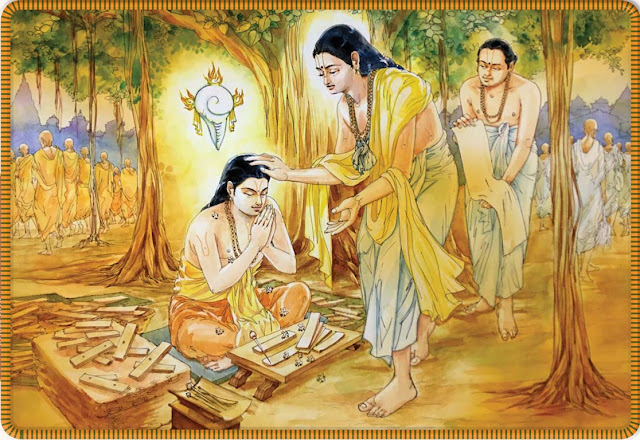
Paṇḍita Haridāsa had great faith in Lord Caitanya and Nityānanda. Therefore he took great satisfaction in knowing about Their pastimes and qualities. (61) He always accepted the good qualities of Vaiṣṇavas and never found fault in them. He engaged his heart and soul only to satisfy the Vaiṣṇavas. (62) He always heard the reading of Śrī Caitanya- maṅgala, and all the other Vaiṣṇavas used to hear it by his grace. (63) Like the full moon, he illuminated the entire assembly of Vaiṣṇavas by speaking Śrī Caitanya- maṅgala, and by the nectar of his qualities he increased their transcendental bliss. (64) By his causeless mercy he ordered me to write about the last pastimes of Śrī Caitanya Mahāprabhu. (65)
Govinda Gosāñi, the priest engaged in the service of Lord Govinda in Vṛndāvana, was a disciple of Kāśīśvara Gosāñi. There was no servant more dear to the Govinda Deity. (66) Śrī Yādavācārya Gosāñi, a constant associate of Śrīla Rūpa Gosvāmī, was also very enthusiastic in hearing and chanting about Lord Caitanya’s pastimes. (67) Bhugarbha Gosāñi, a disciple of Paṇḍita Gosāñi, was always engaged in topics regarding Lord Caitanya, knowing nothing else. (68) Among his disciples were Caitanya dāsa, who was a priest of the Govinda Deity, as well as Mukundānanda Cakravartī and the great devotee Kṛṣṇadāsa. (69) Among the disciples of Ananta Ācārya was Śivānanda Cakravartī, in whose heart Lord Caitanya and Nityānanda constantly dwelled. (70)
In Vṛndāvana there were also many other great devotees, all of whom desired to hear the last pastimes of Lord Caitanya. (71) By their mercy, all these devotees ordered me to write of the last pastimes of Śrī Caitanya Mahāprabhu. Because of their order only, although I am shameless, I have attempted to write this Caitanya- caritāmṛta. (72) Having received the order of the Vaiṣṇavas but being anxious within my heart, I went to the temple of Madana- mohana in Vṛndāvana to ask His permission also. (73) When I visited the temple of Madana- mohana, the priest Gosāñi dāsa was serving the feet of the Lord, and I also prayed at the Lord’s lotus feet. (74)
When I prayed to the Lord for permission, a garland from His neck immediately slipped down. (75) As soon as this happened, the Vaisnavas standing there all loudly chanted, “Haribol!” and the priest, Gosañi dasa, brought me the garland and put it around my neck. (76) I was greatly pleased to have the garland signifying the order of the Lord, and then and there I comme nced to write this book. (77) Actually Śrī Caitanya- caritāmṛta is not my writing but the dictation of Śrī Madana- mohana. My writing is like the repetition of a parrot. (78) As a wooden doll is made to dance by a magician, I write as Madana- gopāla orders me to do so. (79)
I accept as my family Deity Madana- mohana, whose worshipers are Raghunātha dāsa Gosvāmī, Śrī Rūpa Gosvāmī and Sanātana Gosvāmī. (80) I took permission from Śrīla Vṛndāvana dāsa Ṭhākura by praying at his lotus feet, and upon receiving his order I have attempted to write this auspicious literature. (81) Śrīla Vṛndāvana dāsa Ṭhākura is the authorized writer on the pastimes of Lord Caitanya. Without his mercy, therefore, one cannot describe these pastimes. (82)
I am foolish, lowborn and insignificant, and I always desire material enjoyment; yet by the order of the Vaiṣṇavas I am greatly enthusiastic to write this transcendental literature. (83) The lotus feet of Śrī Rūpa Gosvāmī and Raghunātha dāsa Gosvāmī are my source of strength. Remembering their lotus feet can fulfill all one’s desires. (84) Praying at the lotus feet of Śrī Rūpa and Śrī Raghunātha, always desiring their mercy, I, Kṛṣṇadāsa, narrate Śrī Caitanya- caritāmṛta, following in their footsteps. (85)
Deepen your Bhakti-yoga practice, harmonize relationships, and receive guided coaching — all at Vedavarsity.com