Lord Nityānanda Svarūpa formerly appeared as Lakṣmaṇa and served Lord Rāmacandra as His younger brother. (149) The activities of Lord Rāma were full of suffering, but Lakṣmaṇa, of His own accord, tolerated that suffering. (150) As a younger brother He could not stop Lord Rāma from His resolution, and so He remained silent, although unhappy in His mind. (151) When Lord Kṛṣṇa appeared, He [Balarāma] became His elder brother to serve Him to His heart’s content and make Him enjoy all sorts of happiness. (152)
Śrī Rāma and Śrī Lakṣmaṇa, who are plenary portions of Lord Kṛṣṇa and Lord Balarāma respectively, entered into Them at the time of Kṛṣṇa’s and Balarāma’s appearance. (153) Kṛṣṇa and Balarāma present Themselves as younger brother and elder brother, but in the scriptures They are described as the original Supreme Personality of Godhead and His expansion. (154) “I worship Govinda, the primeval Lord, who by His various plenary portions appears in the world in different forms and incarnations such as Lord Rāma, but who personally appears in His supreme original form as Lord Kṛṣṇa.” (155) Lord Caitanya is the same Lord Kṛṣṇa, and Lord Nityānanda is Lord Balarāma. Lord Nityānanda fulfills all of Lord Caitanya’s desires. (156)
The ocean of Lord Nityānanda’s glories is infinite and unfathomable. Only by His mercy can I touch even a drop of it. (157) Please listen to another glory of His mercy. He made a fallen living entity climb to the highest limit. (158) To disclose it is not proper, for it should be kept as confidential as the Vedas, yet I shall speak of it to make His mercy known to all. (159) O Lord Nityānanda, I write of Your mercy out of great exultation. Please forgive me for my offenses. (160) Lord Nityānanda Prabhu had a servant named Śrī Mīnaketana Rāmadāsa, who was a reservoir of love. (161) At my house there was saṅkīrtana day and night, and therefore he visited there, having been invited. (162)
Absorbed in emotional love, he sat in my courtyard, and all the Vaiṣṇavas bowed down at his feet. (163) In a joyful mood of love of God he sometimes climbed upon the shoulder of someone offering obeisances, and sometimes he struck others with his flute or mildly slapped them. (164) When someone saw the eyes of Mīnaketana Rāmadāsa, tears would automatically flow from his own eyes, for a constant shower of tears flowed from the eyes of Mīnaketana Rāmadāsa. (165) Sometimes there were eruptions of ecstasy like kadamba flowers on some parts of his body, and sometimes one limb would be stunned while another would be trembling. (166) Whenever he shouted aloud the name Nityānanda, the people around him were filled with great wonder and astonishment. (167)
One respectable brāhmaṇa named Śrī Guṇārṇava Miśra was serving the Deity. (168) When Mīnaketana was seated in the yard, this brāhmaṇa did not offer him respect. Seeing this, Śrī Rāmadāsa became angry and spoke. (169) “Here I find the second Romaharṣaṇa- sūta, who did not stand to show honor when he saw Lord Balarāma.” (170) After saying this, he danced and sang to his heart’s content, but the brāhmaṇa did not become angry, for he was then serving Lord Kṛṣṇa. (171) At the end of the festival Mīnaketana Rāmadāsa went away, offering his blessings to everyone. At that time he had some controversy with my brother. (172) My brother had firm faith in Lord Caitanya but only a dim glimmer of faith in Lord Nityānanda. (173)
Knowing this, Śrī Rāmadāsa felt unhappy in his mind. I then rebuked my brother. (174)”These two brothers,” I told him, “are like one body; They are identical manifestations. If you do not believe in Lord Nityānanda, you will fall down. (175) “If you have faith in one but disrespect the other, your logic is like the logic of accepting half a 1ardha- kukkuṭī- nyāya, literally “half- hen logic”. (176) “It would be better to be an atheist by slighting both brothers than a hypocrite by believing in one and slighting the other.” (177) Thus Śrī Rāmadāsa broke his flute in anger and went away, and at that time my brother fell down. (178) I have thus described the power of the servants of Lord Nityānanda. Now I shall describe another characteristic of His mercy. (179)
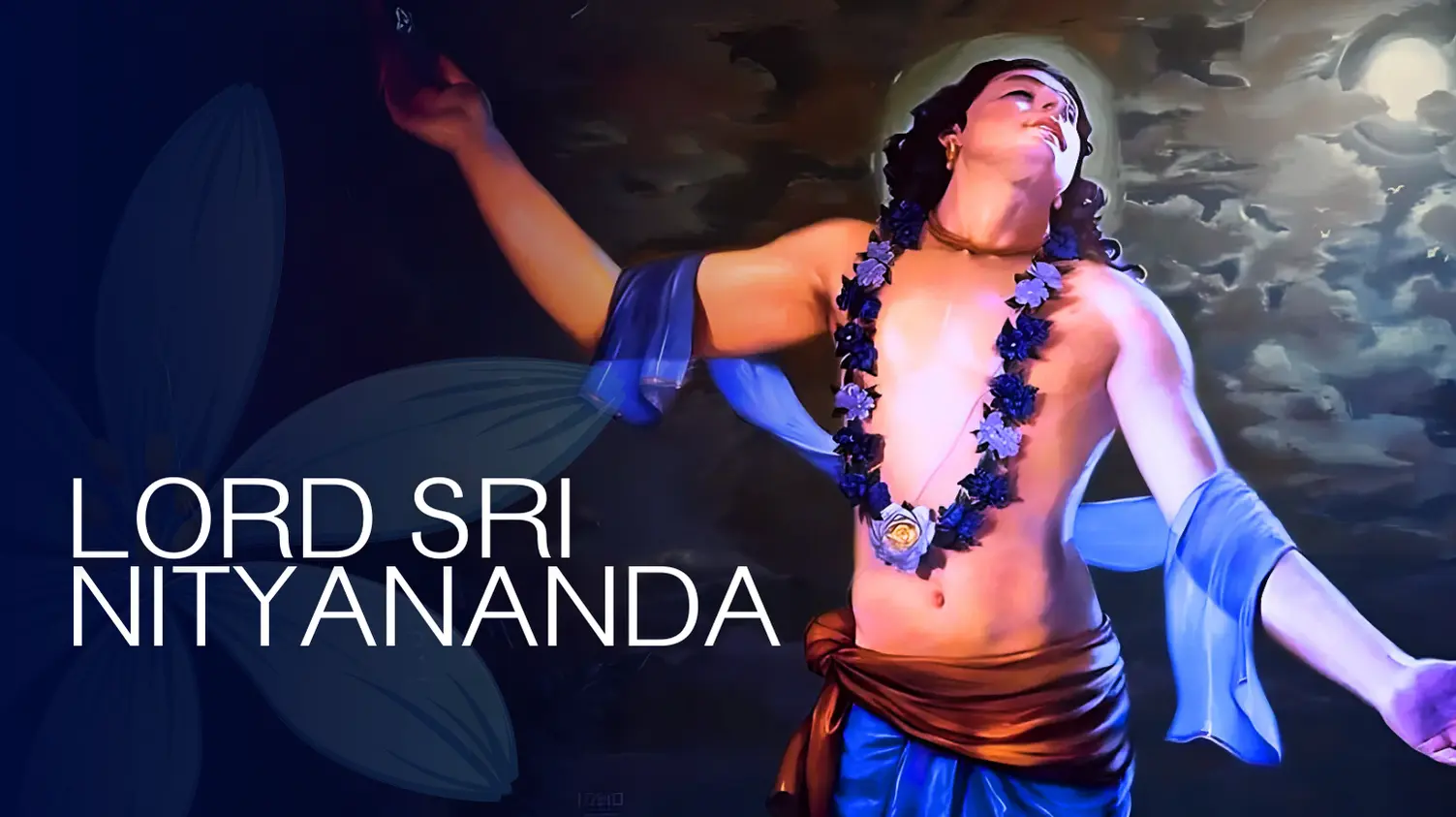
That night Lord Nityānanda appeared to me in a dream because of my good quality in chastising my brother. (180) In the village of Jhāmaṭapura, which is near Naihāṭi, Lord Nityānanda appeared to me in a dream. (181) I fell at His feet, offering my obeisances, and He then placed His own lotus feet upon my head. (182) “Arise! Get up!” He told me again and again. Upon rising, I was greatly astonished to see His beauty. (183) He had a glossy blackish complexion, and His tall, strong, heroic stature made Him seem like Cupid himself. (184) He had beautifully formed hands, arms and legs, and eyes like lotus flowers. He wore a silk cloth, with a silk turban on His head. (185)
He wore golden earrings on His ears, and golden armlets and bangles. He wore tinkling anklets on His feet and a garland of flowers around His neck. (186) His body was anointed with sandalwood pulp, and He was nicely decorated with tilaka. His movements surpassed those of a maddened elephant. (187) His face was more beautiful than millions upon millions of moons, and His teeth were like pomegranate seeds because of His chewing betel. (188) His body moved to and fro, right and left, for He was absorbed in ecstasy. He chanted “Kṛṣṇa, Kṛṣṇa” in a deep voice. (189) His red stick moving in His hand, He seemed like a maddened lion. All around the four sides of His feet were bumblebees. (190)
His devotees, dressed like cowherd boys, surrounded His feet like so many bees and also chanted “Kṛṣṇa, Kṛṣṇa,” absorbed in ecstatic love. (191) Some of them played horns and flutes, and others danced and sang. Some of them offered betel nuts, and others waved cāmara fans about Him. (192) Thus I saw such opulence in Lord Nityānanda Svarūpa. His wonderful form, qualities and pastimes are all transcendental. (193) I was overwhelmed with transcendental ecstasy, not knowing anything else. Then Lord Nityānanda smiled and spoke to me as follows. (194)
“O my dear Kṛṣṇadāsa, do not be afraid. Go to Vṛndāvana, for there you will attain all things.” (195) After saying this, He directed me toward Vṛndāvana by waving His hand. Then He disappeared with His associates. (196) I fainted and fell to the ground, my dream broke, and when I regained consciousness I saw that morning had come. (197) I thought about what I had seen and heard and concluded that the Lord had ordered me to proceed to Vṛndāvana at once. (198) That very second I started for Vṛndāvana, and by His mercy I reached there in great happiness. (199)
Deepen your Bhakti-yoga practice, harmonize relationships, and receive guided coaching — all at Vedavarsity.com