


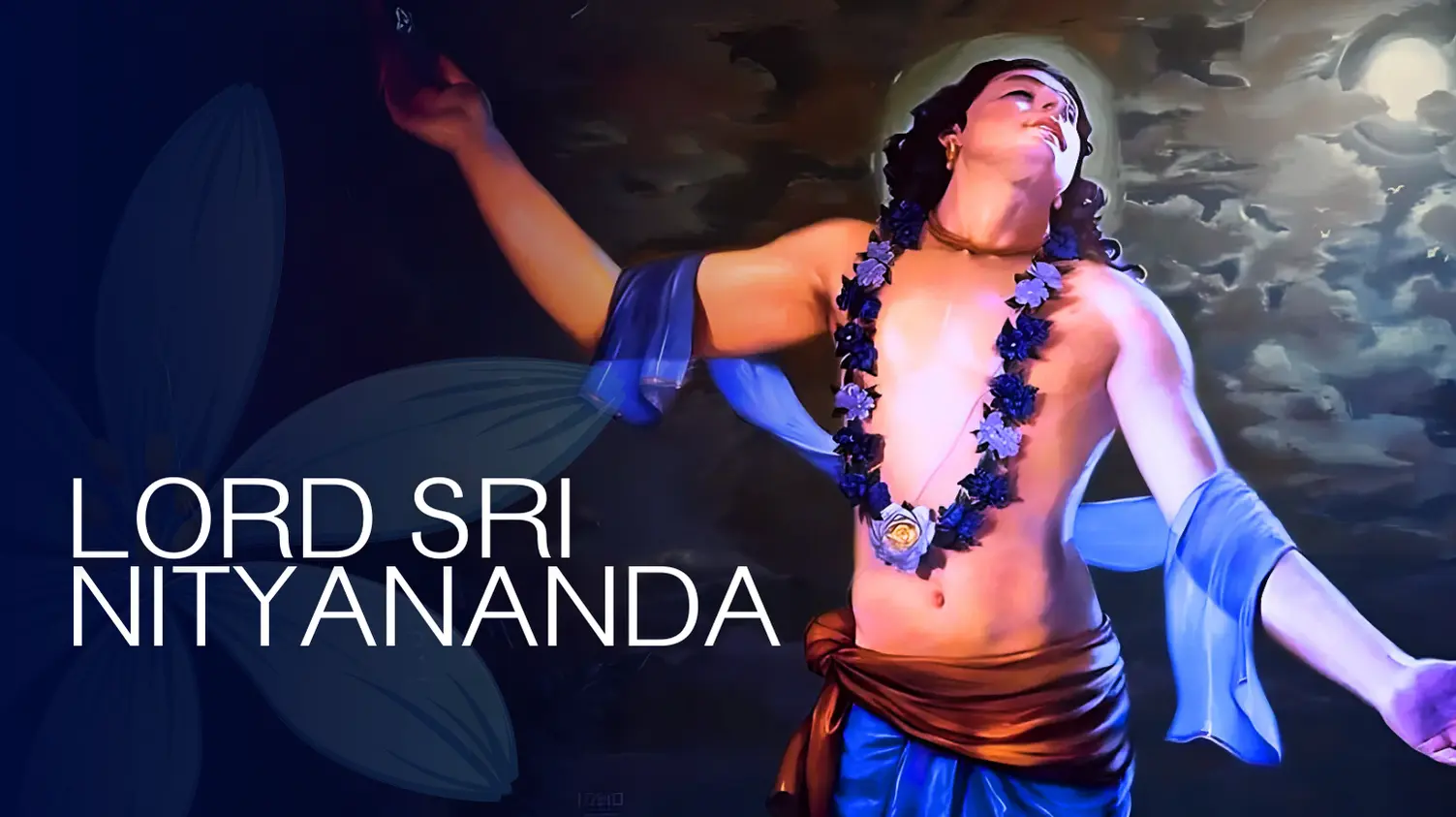
I have thus explained the ninth verse, and now I shall explain the tenth. Please listen with rapt attention. (92) I offer my full obeisances unto the feet of Śrī Nityānanda Rāma, a partial part of whom is Garbhodakaśāyī Viṣṇu. From the navel of Garbhodakaśāyī Viṣṇu sprouts the lotus that is the birthplace of Brahmā, the engineer of the universe. The stem of that lotus is the resting place of the multitude of planets. (93) After creating millions of universes, the first puruṣa entered into each of them in a separate form, as Śrī Garbhodakaśāyī. (94) Entering the universe, He found only darkness, with no place in which to reside. Thus He began to consider. (95)
Then He created water from the perspiration of His own body and with that water filled half the universe. (96) The universe measures five hundred million yojanas. Its length and breadth are one and the same. (97) After filling half the universe with water, He made His own residence therein and manifested the fourteen worlds in the other half. (98) There He manifested Vaikuṇṭha as His own abode and rested in the waters on the bed of Lord Śeṣa. (99) He lay there with Ananta as His bed. Lord Ananta is a divine serpent having thousands of heads, thousands of faces, thousands of eyes and thousands of hands and feet. He is the seed of all incarnations and is the cause of the material world. (100-101)
From His navel grew a lotus flower, which became the birthplace of Lord Brahmā. (102) Within the stem of that lotus were the fourteen worlds. Thus the Supreme Lord, as Brahmā, created the entire creation. (103) And as Lord Viṣṇu He maintains the entire world. Lord Viṣṇu, being beyond all material attributes, has no touch with the material qualities. Assuming the form of Rudra, He destroys the creation. Thus creation, maintenance and dissolution are created by His will. (105) He is the Supersoul, Hiraṇyagarbha, the cause of the material world. The universal form is conceived as His expansion. (106) That Lord Nārāyaṇa is a part of a plenary part of Lord Nityānanda Balarāma, who is the source of all incarnations. (107)
I have thus explained the tenth verse. Now please listen to the meaning of the eleventh verse with all your mind. (108) I offer my respectful obeisances unto the feet of Śrī Nityānanda Rāma, whose secondary part is the Viṣṇu lying in the ocean of milk. That Kṣīrodakaśāyī Viṣṇu is the Supersoul of all living entities and the maintainer of all the universes. Śeṣa Nāga is His further subpart. (109) The material planets rest within the stem that grows from the lotus navel of Lord Nārāyaṇa. Among these planets are seven oceans. (110) There, in part of the ocean of milk, lies Śvetadvīpa, the abode of the sustainer, Lord Viṣṇu. (111) He is the Supersoul of all living entities. He maintains this material world, and He is its Lord. (112)
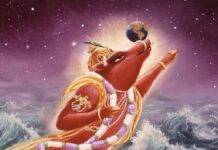
In the ages and millenniums of Manu, He appears as different incarnations to establish the principles of real religion and vanquish the principles of irreligion. (113) Unable to see Him, the demigods go to the shore of the ocean of milk and offer prayers to Him. (114) He then descends to maintain the material world. His unlimited opulences cannot be counted. (115) That Lord Viṣṇu is but a part of a part of a plenary portion of Lord Nityānanda, who is the source of all incarnations. (116) That same Lord Viṣṇu, in the form of Lord Śeṣa, holds the planets upon His heads, although He does not know where they are, for He cannot feel their existence upon His heads. (117) His thousands of extended hoods are adorned with dazzling jewels surpassing the sun. (118)
The universe, which measures five hundred million yojanas in diameter, rests on one of His hoods like a mustard seed. (119) That Ananta Śeṣa is the devotee incarnation of Godhead. He knows nothing but service to Lord Kṛṣṇa. (120) With His thousands of mouths He sings the glories of Lord Kṛṣṇa, but although He always sings in that way, He does not find an end to the qualities of the Lord. (121) The four Kumāras hear Śrīmad- Bhāgavatam from His lips, and they in turn repeat it in the transcendental bliss of love of Godhead. (122) He serves Lord Kṛṣṇa, assuming all the following forms: umbrella, slippers, bedding, pillow, garments, resting chair, residence, sacred thread and throne. (123) He is thus called Lord Śeṣa, for He has attained the ultimate end of servitude to Kṛṣṇa. He takes many forms for the service of Kṛṣṇa, and thus He serves the Lord. (124)
That person of whom Lord Ananta is a kalā, or part of a plenary part, is Lord Nityānanda Prabhu. Who, therefore, can know the pastimes of Lord Nityānanda? (125) From these conclusions we can know the limit of the truth of Lord Nityānanda. But what glory is there in calling Him Ananta? (126) But I accept it as the truth because it has been said by devotees. Since He is the source of all incarnations, everything is possible in Him. (127) They know that there is no difference between the incarnation and the source of all incarnations. Previously Lord Kṛṣṇa was regarded in the light of different principles by different people. (128) Some said that Kṛṣṇa was directly Lord Nara- Nārāyaṇa, and some called Him Lord Vāmanadeva incarnate. (129) Some called Lord Kṛṣṇa an incarnation of Lord Kṣīrodakaśāyī. All these names are true; nothing is impossible. (130)
When the Supreme Personality of Godhead Kṛṣṇa appears, He is the shelter of all plenary parts. Thus at that time all His plenary portions join in Him. (131) In whatever form one knows the Lord, one speaks of Him in that way. In this there is no falsity, since everything is possible in Kṛṣṇa. (132) Therefore Lord Caitanya Mahāprabhu has exhibited to everyone all the pastimes of all the various incarnations. (133) Thus Lord Nityānanda has unlimited incarnations. In transcendental emotion He calls Himself a servant of Lord Caitanya. (134) Sometimes He serves Lord Caitanya as His guru, sometimes as His friend and sometimes as His servant, just as Lord Balarāma played with Lord Kṛṣṇa in these three different moods in Vraja. (135) Playing like a bull, Lord Balarāma fights with Kṛṣṇa head to head. And sometimes Lord Kṛṣṇa massages the feet of Lord Balarāma. (136)
He considers Himself a servant and knows Kṛṣṇa to be His master. Thus He regards Himself as a fragment of His plenary portion. (137) “Acting just like ordinary boys, They played like roaring bulls as They fought each other, and They imitated the calls of various animals.” (138) “Sometimes when Lord Kṛṣṇa’s elder brother, Lord Balarāma, felt tired after playing and lay His head on the lap of a cowherd boy, Lord Kṛṣṇa Himself served Him by massaging His feet.” (139)”Who is this mystic power, and where has she come from? Is she a demigod or a demoness? She must be the illusory energy of My master, Lord Kṛṣṇa, for who else can bewilder Me?” (140) “What is the value of a throne to Lord Kṛṣṇa? The masters of the various planetary systems accept the dust of His lotus feet on their crowned heads. That dust makes the holy places sacred, and even Lord Brahmā, Lord Śiva, Lakṣmī and I Myself, who are all portions of His plenary portion, eternally carry that dust on our heads.” (141)
Lord Kṛṣṇa alone is the supreme controller, and all others are His servants. They dance as He makes them do so. (142) Thus Lord Caitanya is also the only controller. All others are His associates or servants. (143) His elders such as Lord Nityānanda, Advaita Ācārya and Śrīvāsa Ṭhākura, as well as His other devotees whether His juniors, equals or superiors are all His associates who help Him in His pastimes. Lord Gaurāṅga fulfills His aims with their help. (144-145) Śrī Advaita Ācārya and Śrīla Nityānanda Prabhu, who are plenary parts of the Lord, are His principal associates. With these two the Lord performs His pastimes in various ways. (146) Lord Advaita Ācārya is directly the Supreme Personality of Godhead. Although Lord Caitanya accepts Him as His preceptor, Advaita Ācārya is a servant of the Lord. (147) I cannot describe the truth of Advaita Ācārya. He has delivered the entire world by making Lord Kṛṣṇa descend. (148)
Deepen your Bhakti-yoga practice, harmonize relationships, and receive guided coaching — all at Vedavarsity.com