



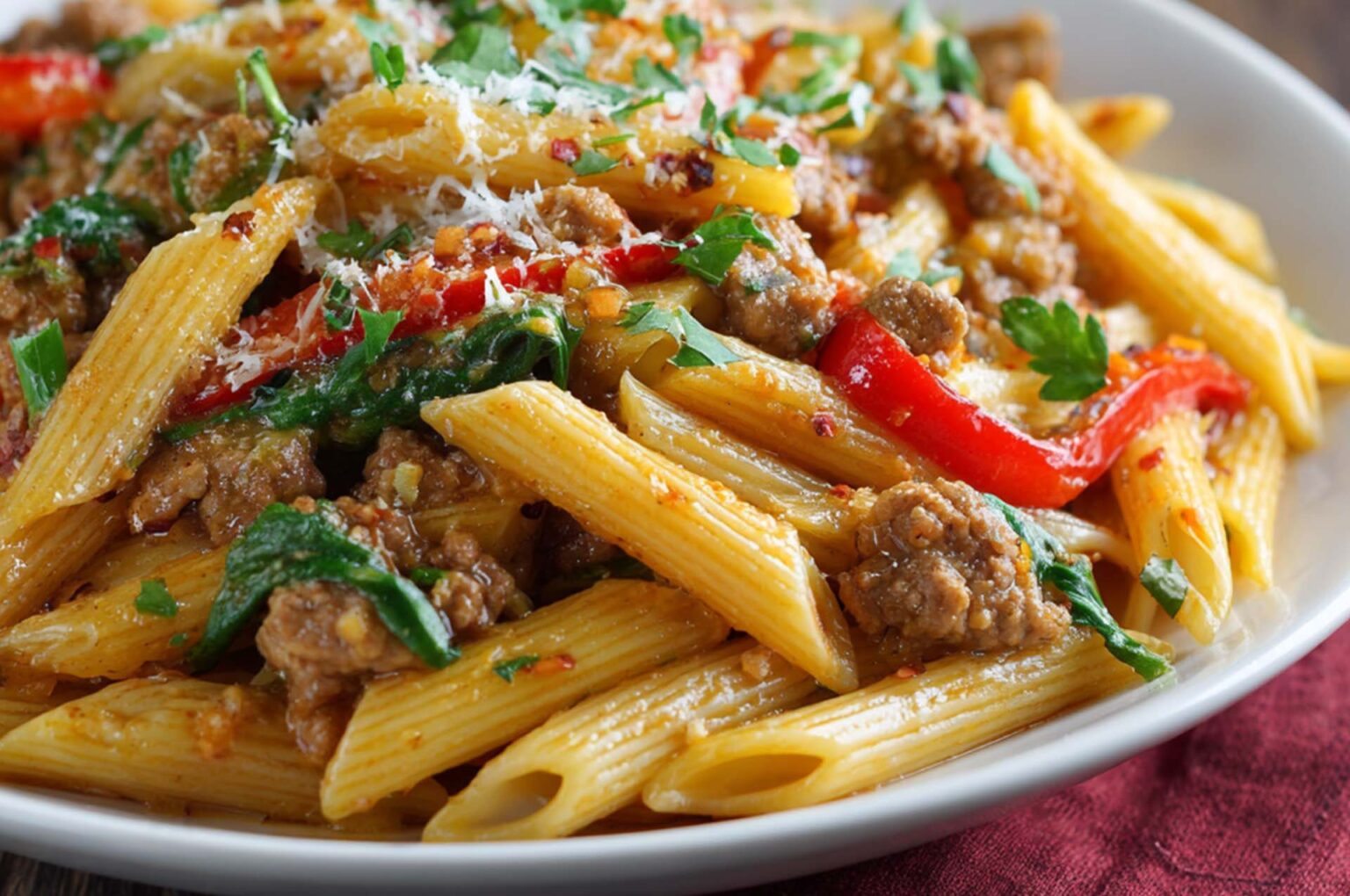
Here’s a wholesome collection of vegetarian pasta, noodle, and grain dishes from Greece, Japan, Italy, Morocco, India, and Malaysia.
By Kurma Dasa
Vegetarian Lasagna
Tender pasta sandwiched between layers of tasty bechamel sauce, cheese, spinach, and herbed tomato sauce, topped with more cheese and baked until firm whenever we serve Vegetarian Lasagna at Gopal’s Restaurant our clientele become practically ecstatic. “Could you possibly give us the recipe? ” they ask. So here it is. This recipe calls for good quality imported Italian instant lasagna noodles. I like to use “Verde Ondine” instant lasagna. Otherwise, if you choose to use the non-instant variety, precook it according to the directions on the packet.
• PREPARATION & COOKING TIME: 1 1/2 hours
• BAKING TIME: 45 minutes
• YIELD: 1 tray of lasagna, 30 x 20 x 8 cm (12 x 8 x 3 inches)
This lasagna has five distinct ingredients: pasta, tomato sauce, bechamel sauce, spinach, and cheese.
Pasta
• About fifteen 17 cm x 17 cm (7-inch x 7-inch) sheets of instant lasagna (400 g, or about 14 ounces)
Tomato Sauce
• 1/2 cup (125 ml) olive oil
• 1/2 teaspoon (2 ml) yellow asafoetida powder
• 1 cup (250 ml) chopped fresh basil
• 1 teaspoon (5 ml) dried oregano
• 1 teaspoon (5 ml) dried marjoram
• 2 bay leaves
• 1 teaspoon (5 ml) freshly ground black pepper
• 1 medium eggplant, diced into 0.5 cm (1/4-inch) cubes
• 3 medium peppers diced into 1.25 cm (1/2-inch) squares
• 24 medium tomatoes, blanched, peeled, and chopped,
or six 250 g (9-ounce) tins Italian tomatoes,
cut into 2.5 cm (1-inch) cubes (keep the juice)
• 1/2 cup (125 ml) black olives, chopped
• 2 tablespoons (40 ml) tomato paste
• 1 teaspoon (5 ml) salt
• 1 teaspoon (5 ml) brown sugar
• 2 tablespoons (40 ml) chopped fresh parsley
Bechamel sauce
• 1/2 cup (125 ml) melted butter
• 1/4 teaspoon (1 ml) ground nutmeg
• 1/2 teaspoon freshly ground black pepper
• 1/2 cup (125 ml) sifted plain flour
• 4 cups (1 litre) warm milk
Spinach
• 1 large bunch of spinach leaves, separated, stalks removed, washed, blanched in boiling water, and drained
Cheese
• 375 g (13 ounces) grated cheddar cheese
• 250 g (9 ounces) grated mozzarella cheese
• 60 g (2 ounces) grated parmesan cheese
• 1 tablespoon (20 ml) grated parmesan cheese, reserved for garnish.
To cook the tomato sauce
1. Heat the olive oil over moderate heat in a large, heavy-based saucepan. When hot, add the asafoetida. Saute momentarily; then add the fresh basil, oregano, marjoram, bay leaves, and black pepper and saute for another few seconds.
2. Add the eggplant cubes and stir-fry for 2 minutes. Add the peppers and, stirring occasionally, cook them along with the eggplant pieces until both are softened (about 3 or 4 minutes).
3. Add the tomatoes and olives and stir well. Bring to the boil, reduce the heat slightly, and cook uncovered, stirring often, for about 1/2 hour or until it reduces and thickens. Add tomato paste, salt, sugar, and parsley, mix well, and remove from the heat.
To cook the bechamel sauce
1. Place the melted butter in a heavy saucepan over low heat and stir in the nutmeg, black pepper, and flour and saute until the mixture darkens slightly (about 1/2 minute). Remove from the heat.
2. Gradually pour in the warm milk, stirring with a whisk until the sauce is smooth. Return to moderate heat and stir until it boils. Reduce the heat and simmer, stirring constantly until the sauce thickens to a thick-custard consistency (about 5 minutes).
To assemble the lasagna
1. Combine all 3 cheeses (except the reserved parmesan) in a bowl. Divide the tomato sauce and bechamel sauce into 3. Divide the cheese and spinach into 2. Divide the pasta into 5.
2. Spread one-third of the tomato sauce in the bottom of the baking tray. Place one-fifth of the pasta sheets on top. Spread on one-third of the bechamel sauce then another one-fifth of the pasta. Spread one-half of the spinach leaves; then sprinkle half the grated cheese on top.
3. Repeat this process twice more and you should end up with the bechamel sauce on top. Sprinkle with parmesan cheese. Place the lasagna in the top of a pre-heated 200°C/390°F oven and cook for 30 – 45 minutes or until the top is slightly golden and the pasta “gives” when you stick a knife in it. It’s best to let the lasagna set for at least another hour before serving, as this “plumps” the pasta. Cut into squares and serve.
Potato Dumplings with Tomato Sauce (Gnocchi)
Although not a true pasta, homemade gnocchi can replace pasta in a meal. These tasty and substantial dumplings originate in the style of the Molise region of Central Italy and are thus known as Gnocchi alla Molisana.
• PREPARATION TIME: 10 minutes
• COOKING TIME: 40 minutes
• YIELD: Enough for 6 persons
Sauce
• 3 tablespoons (60 ml) olive oil
• 1/4 teaspoon (1 ml) yellow asafoetida powder
• 3 1/2 cups (875 ml) tomatoes, blanched, peeled, and pureed
• 1 teaspoon ( 5 ml) salt
• 1/4 teaspoon ( 1 ml) freshly ground black pepper
• 2 tablespoons (40 ml) chopped fresh basil
• grated parmesan cheese
• 2 tablespoons (40 ml) chopped fresh parsley
Dumplings
• 500 g (17 1/2 ounces) old potatoes
• 1 1/2 cups (375 ml) self-raising flour
• 1/2 teaspoon (2 ml) salt
• 1/4 teaspoon (1 ml) nutmeg
• 1 tablespoon (20 ml) milk
1. Heat the olive oil in a heavy 4-litre/quart saucepan over moderate heat until hot but not smoking. Saute the asafoetida in the hot oil. Add the tomatoes, salt, pepper, and basil; stirring occasionally, simmer the sauce for about 30 minutes or until reduced somewhat. Remove from the heat, cover, and keep warm.
2. Meanwhile, peel and quarter the potatoes and boil them in a saucepan of slightly salted water until very tender. Drain well and push the potatoes through a fine sieve into a bowl. Add the sifted flour, salt, nutmeg, and milk. Mix well. Turn the mixture out onto a lightly floured surface. Knead for 2 minutes.
3. Take one-quarter of the mixture and form it into a roll on a floured surface. The roll should be 2.5 cm (1-inch) in diameter. Repeat with the remaining dough. Cut the rolls into 1.25 cm (1/2-inch) gnocchi lengths.
4. With two fingers, press each gnocchi against a cheese grater (medium holes) to roughen the surface on one side, at the same time making a dent in the other side where the fingers press. This gives the traditional gnocchi shape. Repeat with the remaining gnocchi.
5. Place one-quarter of the gnocchi into a large saucepan of boiling salted water over full heat. The gnocchi will go straight to the bottom of the pan and then start to float to the top. When the last dumpling rises to the top, boil for 1 minute; then remove them from the pan with a slotted spoon. Repeat with the remaining gnocchi in batches. Add the gnocchi to the prepared tomato sauce and simmer uncovered for 5 minutes over low heat. Place the gnocchi in a serving bowl and spoon over half the sauce. Serve the remaining sauce and grated parmesan cheese separately. Garnish with chopped parsley.
Baked Rigatoni with Vegetables (Rigatoni al Forno)
This is a vegetarian version of the famous Calabrian “Rigatoni al Forno”.
• PREPARATION & COOKING TIME: 45 minutes
• YIELD: Enough for 4 to 6 persons
• 1/4 cup (60 ml) grated parmesan cheese
• 1/2 teaspoon (2 ml) grated nutmeg
• 2/3 cup (165 ml) ricotta or cottage cheese
• 1/2 cup (125 ml) bread crumbs
• 300 g (10 ounces) rigatoni pasta
• 1 cup (250 ml) grated mozzarella cheese
• 1 cup (250 ml) heavy sour cream
• 1/4 cup (60 ml) olive oil
• 1/2 teaspoon (2 ml) yellow asafoetida powder
• 1/4 cup (60 ml) red peppers, diced
• 3 cups (750 ml) tomato puree
• 1 cup (250 ml) tiny broccoli flowerets
• 1 cup (250 ml) tiny cauliflower flowerets
• 1/4 cup (60 ml) cooked green peas
• 2 teaspoons (10 ml) salt
• 1/4 teaspoon (1 ml) freshly ground black pepper
• 2 tablespoons (40 ml) chopped fresh basil
• 1 tablespoon (20 ml) fresh chopped parsley
1. Heat the olive oil in a heavy 4-litre/quart saucepan over moderately high heat. Saute the asafoetida and diced red peppers for two minutes. Add the tomato puree, broccoli, cauliflower, green peas, salt, pepper, basil, and nutmeg. Simmer covered for 15 – 20 minutes or until all the vegetables are soft. Add the sour cream, parmesan cheese, ricotta cheese, and bread crumbs. Remove from the heat and cover.
2. Cook the pasta in boiling salted
water until cooked but still firm (aldente). Drain thoroughly.
3. Combine the pasta and the vegetable sauce. Empty the mixture into a large casserole dish, smooth over, sprinkle with the mozzarella cheese, and bake in a preheated oven 200°C/390°F for 10 minutes. Serve hot, garnished with fresh chopped parsley.
Couscous with Vegetable Sauce
Couscous is the most common and well-known of all north African Arab dishes. Couscous is a grain product made from semolina, and it is also the name of the famous dish of which couscous is the main ingredient. Imported couscous can be obtained in some specialty supermarkets, although it can sometimes be a little costly. I have found it is much more economical to purchase a kilo or two from a well-stocked Middle Eastern grocer who has couscous in bulk, usually in huge sacks.
Traditionally, couscous is cooked in a couscousier a special pot where the grains are steamed on top, the steam being generated from the sauce simultaneously cooking underneath. But if you don’t have a couscousier, you will find this recipe from Morocco quick and easy. The couscous is cooked the “quick” method.
Couscous is always served in a mound with the sauce poured on top, the extra juice from the vegetables sometimes being served separately in little bowls on the side. Serve couscous as a filling main course with a spoonful of North African Hot Pepper Sauce (Harissa) added to the bowl of extra juice.
• PREPARATION & COOKING TIME: 1 hour
• YIELD: Enough for 8 to 10 persons
Sauce
• 3 tablespoons (60 ml) butter
• 1/2 teaspoon (2 ml) yellow asafoetida powder
• 6 small zucchinis, cut into 2.5 cm (1-inch) sections
• 2 medium green peppers, seeded, cored, and cut into thick strips
• 2 cups (500 ml) pumpkin, cubed
• 1 large potato, peeled and coarsely chopped
• 2 small turnips, cut in half and sliced lengthwise
• at least 4 cups (1 litre) water
• 2 cups (500 ml) chickpeas, cooked and drained
• 8 medium tomatoes, diced
• 1 1/2 teaspoons (7 ml) ground coriander
• 1 1/2 teaspoons (7 ml) ground cumin
• 2 teaspoons (10 ml) turmeric
• 1/2 teaspoon (2 ml) cayenne pepper
• 2 small hot green chilies, chopped
• 1 1/2 teaspoons (7 ml) salt
• 1/2 teaspoon (2 ml) freshly ground black pepper
Coucous
• 2 cups (500 ml) water
• 1 tablespoon (20 ml) oil
• 1 teaspoon (5 ml) salt
• 500 g (17 1/2 ounces) couscous
• 2 tablespoons (40 ml) butter
To make the sauce
1. Melt the 3 tablespoons (60 ml) of butter over moderate heat in a heavy saucepan or in the bottom of a couscousier. Add the asafoetida, zucchinis, peppers, pumpkin, potato, and turnips and saute for 10 minutes. Add half the water and bring to a boil. Reduce the heat and simmer for 30 minutes.
2. Add the chickpeas, tomatoes, ground coriander, cumin, turmeric, cayenne, chilies, salt, pepper, and the rest of the water, (adding more if needed). Stir well and reduce the heat to a simmer. Cook for another 15 minutes. Towards the end of the cooking time for the sauce, prepare the couscous.
To prepare the coucous
1. Pour 2 cups (500 ml) water into a large saucepan. Add 1 tablespoon (20 ml) oil and 1 teaspoon (5 ml) salt and bring to the boil. Remove from the heat.
2. Stirring constantly, add the couscous. Allow the grains to swell for 2 minutes. Add 2 – 3 tablespoons (40 – 60 ml) butter and heat the grains over low heat for 3 minutes whilst stirring with a fork.
To assemble the dish
• Pile the couscous on a large prewarmed serving dish. Drain some of the liquid from the vegetables (reserving it in little bowls to serve as an accompaniment), pour the vegetable sauce over the couscous, and serve immediately.
Spaghetti alla Napoletana
The famous city of Naples in Campania, Italy, produces the majority of commercially made pasta. Here is my version of the simple but famous Napolese spaghetti. Serve with a generous sprinkle of your favourite cheese.
• PREPARATION & COOKING TIME: 40 minutes
• YIELD: Enough for 4 persons
• 2 tablespoons (40 ml) chopped fresh basil leaves
• 1/2 cup (125 ml) olive oil
• 1/2 teaspoon (2 ml) yellow asafoetida powder
• 1.2 kg (3 pounds) ripe tomatoes, blanched, peeled, and chopped; or
three 400 g (14-ounce) tins Italian peeled tomatoes, chopped (save liquid)
• 1 teaspoon (5 ml) salt
• 1/4 teaspoon (1 ml) freshly ground black pepper
• 400 g (14 ounces) spaghetti cheese for serving
• Heat the olive oil in a heavy pan over moderate heat until hot but not smoking. Saute the asafoetida in the hot oil. Add the tomatoes, basil, salt, and pepper and cook gently for 30 minutes. Meanwhile, cook the spaghetti in plenty of boiling salted water until cooked but still a little firm (al dense). Drain thoroughly and pile into a warmed serving dish. Pour the sauce over the top, sprinkle with cheese and serve immediately.
Pasta Pesto
Genoa, Northern Italy, is the home of the famous “Pasta Pesto alla Genovese” pasta with a pungent sauce called “pesto”, made primarily of fresh basil leaves, parmesan cheese, and toasted pine nuts. Traditionally, ribbon-shaped pasta such as trenette or linguine are used.
• PREPARATION & COOKING TIME: 20 minutes
• YIELD: Enough for 6 persons
• 1 1/2 cups (375 ml) chopped fresh basil leaves
• 1 teaspoon (5 ml) salt
• 1/2 cup (125 ml) olive oil (reserve 1 tablespoon, 20 ml)
• 3 tablespoons (60 ml) pinenuts lightly toasted and chopped
• 3/4 teaspoon (3 ml) yellow asafoetida powder
• 125 g (4 ounces) grated parmesan cheese
• 575 g (1 1/4 pounds) pasta trenette or pasta linguine
1. Crush the basil with the salt and half the olive oil in a large pestle and mortar, or in a food processor. Add the rest of the oil and the pine nuts and three-quarters of the cheese. Blend until smooth. Add a little water if too thick.
2. Place one tablespoon (20 ml) olive oil in a small pan and place over moderate heat. Saute the asafoetida powder in the hot oil. Add this mixture to the mortar or food processor.
3. Cook the pasta in plenty of salted boiling water until cooked but still a little firm (al dente). Drain thoroughly. Serve the pasta with the pesto sauce. Serve immediately.
Note: Be sure to choose fresh pine nuts. Old ones become rancid and taste bitter.
Stuffed Vine Leaves (Dolmades)
There are many versions of this stuffed appetizer, found in Armenia, Turkey, Greece, and the Middle East. A dolma is actually any dish prepared by stuffing a vine, fig, cabbage, or other edible leaf with a savoury filling. Here is a Greek version of vine leaves stuffed with rice, pine nuts, and currants and flavoured with dill and oregano. They can be served cold as an appetizer with salad, bread, and dips or heated in the oven with tomato sauce.
• PREPARATION TIME: 45 minutes
• COOKING TIME: 1 – 1 1/2 hours
• YIELD: 30 or 40 dolmades
• 2 cups (500 ml) boiling water
• 2 tablespoons (40 ml) olive oil
• 1/3 cup (85 ml) pine nuts
• 3/4 teaspoon (3 ml) yellow asafoetida powder
• 1 cup (250 nl) long-grain rice
• 1/3 cup (85 ml) currants
• 1 1/2 teaspoons (7 ml) dried oregano
• 1 teaspoon (5 ml) dried dill
• 1 teaspoon (5 nl) salt
• 1/4 teaspoon (1 ml) freshly ground black pepper
• 1 tablespoon (20 ml) tomato paste
• two 250 g (9-ounce) packets of vine leaves
• juice of 2 lemons
1. Boil the water in a small pan over moderate heat.
2. Heat the olive oil in a non-stick 2-litre/quart pot over moderate heat. Stir-fry the pine nuts in the hot oil until they turn golden. Saute the asafoetida; then add the rice and stir-fry for 2 minutes. Add the boiling water, the currants, oregano, dill, salt, and pepper. Boil, stir, reduce the heat to low, and simmer the rice covered without stirring for 20 minutes. Stir in the tomato paste. Empty the rice into a bowl and allow to cool.
3. Place the vine leaves in a bowl and scald them with boiling water. Leave them to soak for 10 minutes; then drain and rinse under cold water.
4. Open up each leaf, placing between 1 teaspoon and 1 tablespoon of the filling (depending on the size of the leaf), rolled into a short tubular shape, into the centre of each leaf. Roll up the leaf, tucking in the sides as you go.
5. Place some damaged or unused leaves on the bottom of a large, heavy pot and layer the stuffed leaves on top. If you have more than one layer, place some leaves in between.
6. Place an inverted plate or saucer on top of the stuffed leaves, add enough hot water just to cover them, add the lemon juice, and cover the pot. Simmer for one hour over low heat. After they are cooked, allow them to cool in the pot and carefully remove them.
Malaysian Hot Noodles with Tofu (Mie Goreng)
The basis of this chili-hot noodle dish is dried Chinese-style wheat noodles. They can be obtained in any Asian grocery or most good supermarkets. The soft, moist varieties of noodle found in the refrigerated display of Asian grocer shops are unsuitable for strict vegetarians since, like most fresh pasta in Italian shops, they contain eggs.
The chili-hot taste of this wellknown Malaysian Chinese dish comes from sambal oelek, an Indonesian condiment made from minced fresh red chilies and salt. Be sure to obtain plain sambal oelek, as other varieties are loaded with garlic and onions. Alternatively make your own. The dried tofu that I use comes in the form of thick sheets about 5 cm x 10 cm (2 inches x 4 inches) and is called “Dry Sliced Bean Curd”. Choy sum is a delicate Chinese green vegetable available at Chinese grocers. Select young, thin-stalked choysum, cut off 2.5 cm (1-inch) from the base and use the rest.
• PREPARATION & COOKING TIME: 20 – 30 minutes
• YIELD: Enough for 10 to 12 persons
• 375 g (13 ounces) “Dry Sliced Bean Curd”
• 250 g (9 ounces) Chinese dried wheat noodles
• oil for deep frying
• 400 g (14 ounces) firm tofu cut into 1.25 cm (1/2-inch) cubes
• 3 tablespoons (60 ml) Chinese sesame oil
• 3 tablespoons (60 ml) minced fresh ginger
• 1/2 teaspoon (2 ml) yellow asafoetida powder
• 1 bunch choy sum, chopped into 2.5 cm (1-inch) sections (leaves and stalk)
• 3 tablespoons (60 ml) soy sauce
• 2 tablespoons (40 ml) plain sambal oelek (or more if you want hotter noodles)
• 3 tablespoons (60 ml) fresh lemon juice
• 2 cups (500 ml) mung bean shoots
1. Soak the dried tofu slices in hot water for 15 minutes. When softened, cut into 2.5 cm (1-inch) squares, drain, and pat dry.
2. Cook the wheat noodles in a 5-litre/quart saucepan of boiling water until they are still a little firm (al dense). Drain, rinse under cold water, and drain again.
3. Heat the oil in a wok or pan over high heat. Deep-fry the tofu cubes until they turn golden brown, remove, and drain. Repeat for all the tofu. Next, deep-fry the squares of dried tofu until golden and slightly blistered. Remove and drain. Put aside.
4. Heat the sesame oil in another wok over full heat. Saute the minced ginger for 1 minute. Add the asafoetida and choysum and stir-fry until the vegetables become soft.
5. Add the soy sauce, sambal oelek, lemon juice, fried dry tofu, fried fresh tofu, and bean shoots and stir well. Increase the heat and add the drained wheat noodles. Stir-fry for another 2 minutes or until the noodles are hot. Serve immediately.
Japanese Rice-Balls (Onigiri)
These traditional stuffed rice-balls, or onigiri, are quick and easy to prepare. They are served, as with all Japanese dishes, with great attention to colour and presentation. They are, in fact, not balls, but rather flattened triangular shapes. You will require two special ingredients to make onigiri, both available from Japanese or Asian specialty grocers: Japanese pickled plums (umeboshi) and yellow pickled daikon radish (takuwan).
Serve onigiri as a snack, or as part of a special picnic lunch, accompanied by yellow pickled radish, on a plate decorated with fresh green leaves. Allow 2 balls per person.
• PREPARATION TIME: 10 minutes
• YIELD: 8 balls
• 1 teaspoon (5 ml) salt
• 5 cups (1.25 litres) unsalted short grain white rice, cooked to sticky consistency, and cooled
• 8 Japanese pickled plums (umeboshi)
• 2 tablespoons (40 ml) dry-roasted sesame seeds
• yellow pickled daikon radish (takuwan) as accompaniment
1. Mix the salt thoroughly with the sticky rice. Roll into 8 even-sized balls and flatten each ball into a wheel shape with a flattened perimeter.
2. Make a slight indent in the side of each wheel with the thumb. Press one umeboshi into each hollow, allowing the plum to be visible on one face. Form the wheel of rice into a triangle with two flattened paralled faces. The plum should be visible on one of the faces. Press toasted sesame seeds around the plum on the flat face where the plum is visible and stand the savouries up on one of their three sides. Serve with yellow daikon radish pickles, allowing 2 or 3 small pieces of pickle per person. Onigiri with pickled plum will last 2 – 3 days without refrigeration.
Vegetable and Semolina Pudding (Upma)
Upma is a traditional grain dish much loved all over India. It consists of roasted semolina and sauteed spices, with added vegetables and nuts combined with water to form a moist, savoury pudding. Though upma’s texture resembles Italian polenta or North African couscous, its flavour is unique. Served with fresh lemon juice and a little yogurt, it makes a delicious breakfast.
• PREPARATION & COOKING TIME: About 30 minutes
• YIELD: Enough for 6 to 8 persons
• 1 1/2 cups (375 ml) coarse-grain semolina
• 1/4 cup (60 ml) ghee or oil
• 1 1/2 teaspoons (7 ml) black mustard seeds
• 2 teaspoons (10 ml) split urad dal
• 1 1/2 teaspoons (7 ml) cumin seeds
• 2 hot green chilies, seeded and minced
• 2 cups (500 ml) cabbage, finely shredded
• 1 red pepper, seeded and diced
• 1 cup (250 ml) diced zucchini
• 1 cup (250 ml) peeled potatoes, cubed
• 1/2 teaspoon (2 ml) turmeric
• 3 cups (750 ml) hot water
• 1 cup (250 ml) green peas, cooked if fresh, thawed if frozen
• 1 1/2 teaspoons (7 ml) salt
• 1 cup (250 ml) roasted cashew pieces
• 2 tablespoons (40 ml) chopped fresh coriander leaves
• 2 tablespoons (40 ml) fresh lemon juice
1. Stir-fry the semolina in a large, heavy frying pan over moderate heat for 6 – 8 minutes or until the grains darken a few shades. Transfer to a bowl and set aside.
2. Heat the ghee or oil in a heavy 4 or 5-litre/quart saucepan over moderately high heat. Saute the black mustard seeds in the hot oil until they crackle. Add the urad dal and cumin seeds and saute them until they darken; add the chilies and, stirring, add the cabbage, peppers, zucchini, potatoes, and turmeric. Stir-fry for 2 or 3 minutes. Reduce the heat to moderate and continue to cook for another 4 or 5 minutes or until the vegetables are limp and partly cooked.
3. Carefully add the hot water and bring to the boil. Add the cooked fresh peas or thawed frozen peas. Add the semolina, stirring continuously. Add the salt, reduce the heat to very low, and half-cover with a lid, stirring often until the upma becomes a light, fluffy pudding (about 10 minutes). If the upma appears too dry, add a little warm water.
4. Remove the upma from the heat, stir in the cashew nuts and fresh coriander leaves, and serve hot with a sprinkle of lemon juice.
Deepen your Bhakti-yoga practice, harmonize relationships, and receive guided coaching — all at Vedavarsity.com