In the Śrīmad-Bhāgavatam there are many references to the mystic powers of demigods, yogīs, and ṛṣis. These living beings are clearly endowed with more highly developed sensory powers than ordinary human beings, and they also are able to operate within a more extensive realm of activity than the space-time continuum of our ordinary experience. (Note that in accordance with Vedic usage, we are using the term “sensory” to refer both to senses of perception and to senses of action.)
A typical inhabitant of the higher planets has a life span of 10,000 celestial years, where each day and each night equals six earthly months (SB 4.9.63p). However, many demigods live for a much longer period. Thus demigods such as Indra hold official positions in the universal administration for the span of one manvantara, or 71 X 12,000 celestial years, and their total life span is much longer.
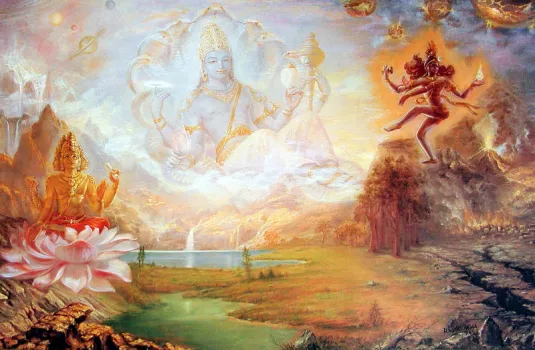
The demigods have the power to assume any desired form (SB 8.15.32p) and to appear and disappear at will before ordinary human beings. Thus SB 9.21.15 says that demigods such as Lord Brahmā and Lord Śiva appeared in human form before Mahārāja Rantideva, and SB 1.12.20p says that that Indra and Agni appeared before Mahārāja Śibi in the form of an eagle and a pigeon. There are also many passages in the Bhāgavatam that describe how demigods possessing higher levels of karmic merit can appear and disappear at will before lesser demigods. For example, Indra’s guru, Bṛhaspati, made himself inaccessible to Indra after Indra offended him (SB 6.7.16).
Our thesis is that this ability to appear and disappear is not “just a matter of mystical power.”
Rather, it demonstrates an important feature of the physical world in which we live. This world contains many manifestations that are not accessible to us with our ordinary senses, but that are accessible to more highly developed beings, such as the demigods. There is a hierarchy of dimensional levels within the universe, and beings on one particular level can operate within a larger continuum than beings on lower levels. The spiritual realm of Vaikuṇṭha and Goloka Vṛndāvana is on a still higher level. Thus Brahmā, the topmost demigod within the material universe, became completely bewildered when Kṛṣṇa revealed the spiritual world to him.
In SB 1.16.3 it is said that during Mahārāja Parīkṣit’s horse sacrifices, even a common man could see demigods. It appears that in Vedic times demigods often visited the earth and engaged in various dealings with human beings. Generally, however, only qualified persons were able to see them. Even recently, after the birth of Lord Caitanya, to glorify the Lord demigods used to visit the home of Jagannātha Miśra while remaining invisible (CC AL 14.76-81).
The Bhāgavatam often alludes to the idea that by acquiring higher spiritual qualifications one can enhance one’s sensory powers and automatically experience phenomena within a broader realm of existence. (It is also emphasized, of course, that such powers should not be exploited for sense gratification, since this would divert one from the actual goal of spiritual life.) One example of such powers is indicated by Nārada Muni’s instructing Dhruva Mahārāja that by chanting a certain mantra-oṁ namo bhagavate vāsudevāya-Dhruva would soon be able to see “the perfect human beings [khe-carān] flying in the sky” (SB 4.8.53).
One method that was sometimes used to travel between the higher planets and the earth is mentioned in SB 3.8.5p, where we read that great sages can travel from Satyaloka to the earth via the Ganges River, which flows all over the universe. Śrīla Prabhupāda points out that this form of travel is possible in any river by mystic power. It hardly seems plausible that this method of travel involves swimming up- or downstream over vast distances, and, of course, the connection between the earthly Ganges and its celestial counterpart is not visible to us. We suggest that this process of travel involves higher-dimensional connections between locations, and that the river serves as a kind of guiding beacon to direct such higher-dimensional transport. In the case of the Ganges, the course of the river from higher planets down to the earth must also be higher-dimensional.
In KB p. 534 there is a description of the mystic yoginī Citralekhā traveling in outer space from Śoṇitapura to Dvārakā and taking the sleeping Aniruddha back to Śoṇitapura. This is another example of a form of travel that seems to require higher-dimensional connections for its operation.
The Vedic śāstras mention many remarkable events that are said to have taken place on the earth in the remote past. Many of these events involve phenomena that we do not experience today, and one might ask why this should be so, if these events actually did occur at one time. One reason for this given in the Bhāgavatam is that prior to the beginning of Kali-yuga, natural processes on the earth operated in a different mode than they do today (see SB 1.4.17p). The sensory powers of all living beings were on a higher average level than they are at present, and advanced beings such as demigods and great sages regularly visited the earth. Thus the earthly realm of ordinary human life was more intimately linked up with higher realms of material and spiritual reality than it has been since the start of the Kali-yuga.
This idea leads naturally to the following tentative scenario for the history of the last few thousand years: Once the Kali-yuga began, demigods and other higher beings greatly curtailed communications with people on the earth, and the general sensory level of human beings also declined. For some time, people continued to believe in stories about the earlier state of affairs on the earth due to the authority of tradition. However, due to the lack of feedback from higher sources and the natural cheating propensity of human beings, the traditions in various parts of the world gradually became more and more garbled, and people began to lose faith in them. Finally the present stage of civilization was reached, in which old traditions are widely viewed as useless mythology, and people seek knowledge entirely through the use of their current, limited senses.
Deepen your Bhakti-yoga practice, harmonize relationships, and receive guided coaching — all at Vedavarsity.com