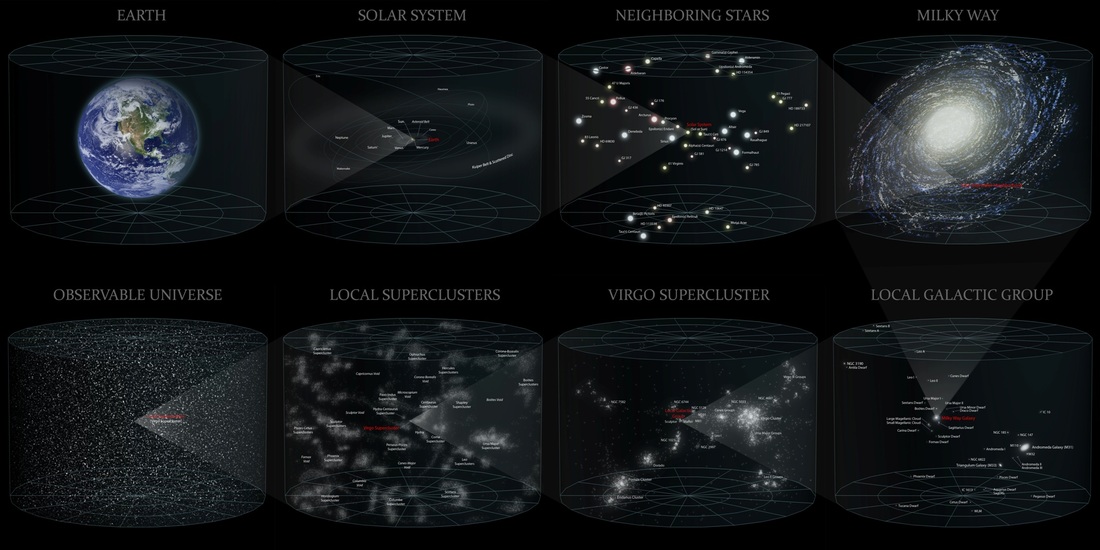
In the Śrīmad-Bhāgavatam a figure of 500 million yojanas is given for the diameter of the universe. On the basis of 8 miles per yojana, this comes to 4 billion miles, a distance that can accommodate the orbit of Saturn (according to modern distance figures), but that is smaller than the orbital diameters of Uranus, Neptune, and Pluto. Since this figure for the diameter of the universe seems to be quite small, it is interesting to note the purport given by Śrīla Prabhupāda to CC ML 21.84:
[Text:] Kṛṣṇa said, “Your particular universe extends four billion miles; therefore it is the smallest of all the universes. Consequently you have only four heads.”
[Purport:] Śrīla Bhaktisiddhānta Sarasvatī Ṭhākura, one of the greatest astrologers of his time, gives information from Siddhānta-śiromaṇi that this universe measures 18,712,069,200,000,000 X 8 miles. This is the circumference of this universe. According to some, this is only half the circumference.
In his Anubhāṣya commentary on this verse of Caitanya-caritāmṛta, Śrīla Bhaktisiddhānta Sarasvatī quotes from Sūrya-siddhānta 12.90, “The circumference of the sphere of the Brahmāndee in which the sun’s rays spread is 18,712,080,864,000,000 yojanas” (SS, p. 87). Then he quotes Siddhānta-śiromaṇi, Golādhyāya Bhuvana-kośa: “Some astronomers have asserted the circumference of the circle of heaven to be 18,712,069,200,000,000 yojanas in length. Some say that this is the length of the zone binding the two hemispheres of the Brahmāṇḍa. Some Paurāṇikas say that this is the length of the circumference of the Lokāloka Parvata [adṛśya-dṛśyaka-girim] (SSB1, p. 126).
Here the circumference of 18,712,069,200,000,000 yojanas corresponds to a diameter of 5,956,200,000,000,000 yojanas. This number is much larger than the 500,000,000-yojana diameter given in the Bhāgavatam, and we might ask how it relates to it. According to the Bhāgavatam (5.20.37),
By the supreme will of Kṛṣṇa, the mountain known as Lokāloka has been installed as the outer border of the three worlds-Bhūrloka, Bhuvarloka and Svarloka-to control the rays of the sun throughout the universe. All the luminaries, from the sun up to Dhruvaloka, distribute their rays throughout the three worlds, but only within the boundary formed by this mountain.
This verse reconciles the statement that the 18-quadrillion-yojana circumference is the limit of distribution of the sun’s rays with the statement that it is the circumference of Lokāloka Mountain. We also note that in SB 5.20.38 the diameter of Lokāloka Mountain is stated to be half the diameter of the universe. This is consistent with the statement in Śrīla Prabhupāda’s purport that “according to some, this is only half the circumference.” We are thus left with a picture of the universe in which the rays of the sun and other luminaries spread to a radial distance of 2,978,100,000,000,000 yojanas, and are there blocked in all directions by an enormous mountain. This mountain lies halfway between the sun and the beginning of the outer coverings of the universe. This means that the distance from the sun to the coverings of the universe is some 5,077 light-years, where a light-year is the distance traveled in one year by a beam of light moving at 186,000 miles per second and we use the Sūrya-siddhānta’s 5-mile yojanas.
In Chapters 3 and 4 we will say more about the possible relation between this very large universal radius and the much smaller figure given in the Bhāgavatam. At present we will consider what the jyotiṣa śāstras have to say about the radius of the universe. It turns out that the Siddhānta-śiromaṇi, the Sūrya-siddhānta, and many other jyotiṣa śāstras give a simple rule for computing this number.
The Sūrya-siddhānta gives the following rule: “Multiply the number of … revolutions of the moon in a kalpa by the moon’s orbit…: the product is equal to the orbit of heaven (or the circumference of the middle of the brahmāṇḍa): to this orbit the sun’s rays reach” (SS, p. 86). If we perform this calculation, we find that the circumference of the brahmāṇḍa, or universe, is:
57,753,336 X 1,000 X 324,000 = 18,712,080,864,000,000 yojanas
In The Aryabhatiya of Aryabhata we find the statement that the circumference of the sky (ākāśa-kakṣa) in yojanas is equal to 10 times the number of minutes of arc covered by the moon during one divya-yuga (AA, p. 13). This comes to:
57,753,336 x 360 x 60 x 10 = 12,474,720,576,000 yojanas
When interpreting this figure, we should keep in mind that Āryabhaṭa used a yojana of about 7.55 miles rather than 5 miles. If we convert Āryabhaṭa’s figure to 5-mile yojanas, we obtain a universal circumference that is almost exactly one thousandth of the figure cited in Sūrya-siddhānta and Siddhānta-śiromaṇi. The reason for this is that Āryabhaṭa used the number of revolutions of the moon in a divya-yuga rather than the number of revolutions in a kalpa. (There are 1,000 divya-yugas per kalpa.)
We mention Āryabhaṭa’s calculation for the sake of completeness. There are a number of ways in which Āryabhaṭa differs from other Indian astronomers (AA). For example, he is unique in making the four yugas equal in length, and he also suggests that the earth rotates daily on its axis. (All other Indian astronomers speak of the kāla-cakra rotating around a fixed earth.) Our main point here is that very large figures for the size of the universe were commonly presented in the jyotiṣa śāstras, and such figures have been accepted by Śrīla Bhaktisiddhānta Sarasvatī Ṭhākura and Śrīla Prabhupāda.
Deepen your Bhakti-yoga practice, harmonize relationships, and receive guided coaching — all at Vedavarsity.com