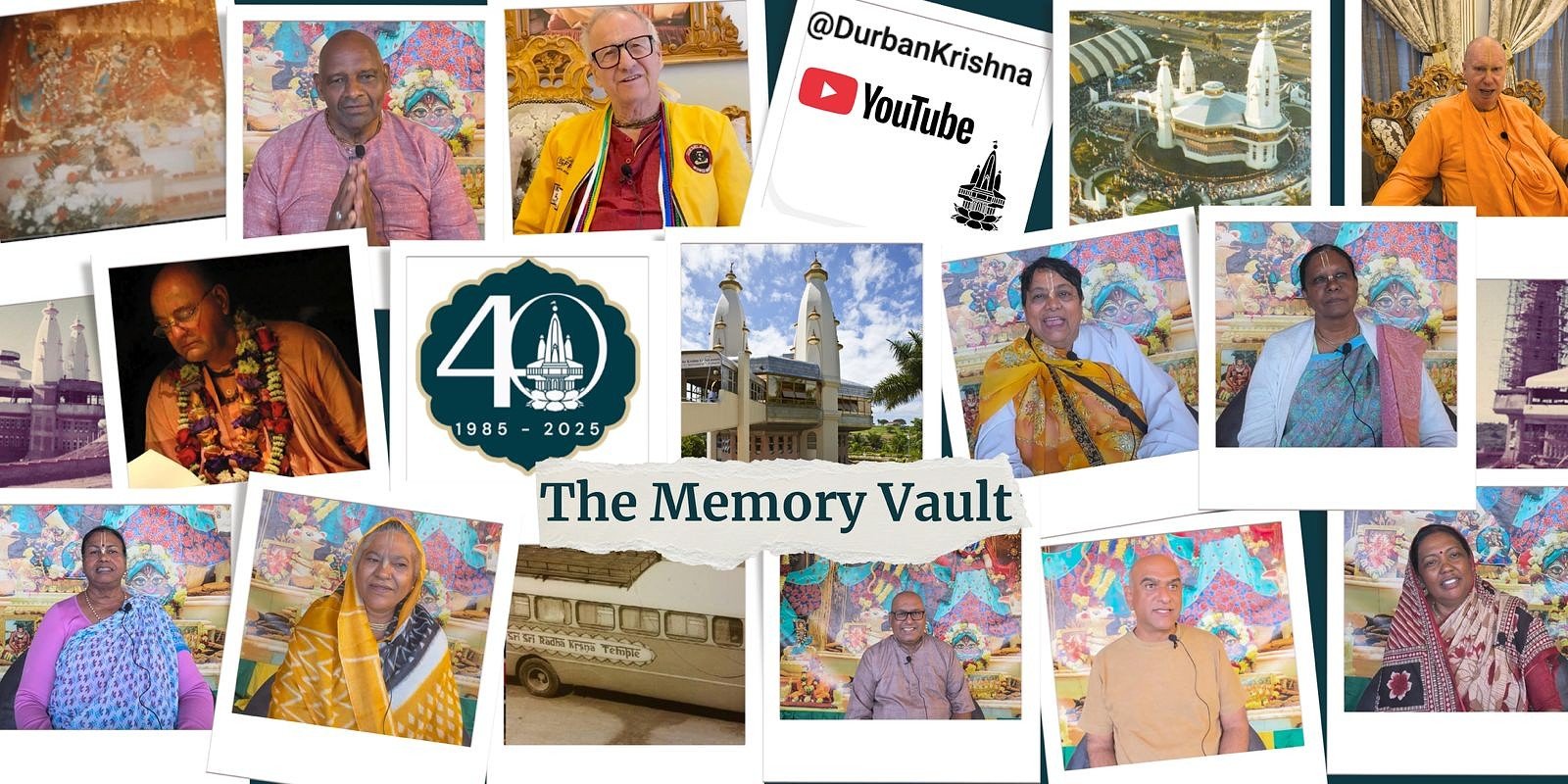
When the Sri Sri Radha Radhanath Temple (SSRRT) community marked its 40th anniversary in October 2025, one of the most meaningful offerings wasn’t a ceremony or performance, but a living archive. The Memory Vault, compiled by Priya Kishori Devi Dasi, gathered decades of service and shared devotion through interviews with devotees who helped shape ISKCON Durban from its earliest years.
What began as a small idea to collect written memories grew into a multimedia project that preserved the voices of those who built and sustained the community over four decades.
An Offering of Gratitude
The idea for The Memory Vault came from Rasa-sthali Dasi, who encouraged devotees to share written reflections as part of the temple’s anniversary campaign. When the response proved enthusiastic, the initiative was expanded to include recorded interviews. “Rasa-sthali originally put out a message for devotees to share their written memories,” Priya Kishori recalled. “My service came through the 40th anniversary preparations when Devadeva Das – Temple President at SSRRT, asked me to record devotees’ memories of SSRRT.” For Priya Kishori, who joined the ISKCON movement around 2015, it was a new kind of service. “I had no experience,” she admitted. “My experience of recording was maybe a Facebook Live.”
With the help of her father, she set up a small recording tent on the temple grounds during the anniversary festival. Devotees came throughout the weekend to share their memories against a backdrop of Sri Sri Radha Radhanath. “We had the lights, tripod, and the full setup,” she said. “Some came by appointment, but many were walk-ins.
A few devotees who had left Krishna consciousness years ago returned just to record their memories. It was amazing.” Alongside the recording booth, Champakalata Devi Dasi also provided a facility for devotees to write their memories on a card, ensuring these cherished remembrances are preserved.
Capturing Four Decades of Devotion
Over the course of the celebration, the team recorded about 30 interviews, 20 of which had been edited and shared by the time of reporting. “It’s been a really good project,” Priya Kishori said. “But I feel like it’s an ongoing one.”
The stories revealed a consistent thread of sacrifice and determination. “It really highlighted the spirit of sacrifice,” she reflected. “Some of these devotees gave their youth to building the temple. The architect, the engineers, the painters, most were devotees themselves.”
The recordings include vivid recollections of those early days. Devotees spoke of living on buses without running water, sometimes eating only “an apple or a carrot a day,” while continuing construction work with unwavering faith. One described painting the dome from the scaffolding and feeling dizzy as a cloud passed, then regaining balance “by Krishna’s mercy.”
Another remembered being asked, at age seventeen, to cook one hundred kilograms of rice for the temple’s opening. “Hearing these memories really showed how much devotees had to endure,” Priya Kishori reflected. “It was their life’s offering.”
A Mirror of South African History
The interviews also revealed the social climate surrounding the temple’s construction during apartheid. “It’s important to highlight those dynamics,” she pointed out. “We had white-bodied and Indian-bodied devotees fundraising together, and in some areas, one Indian lady would have to hide under a blanket when driving through specific areas. Despite that, they still built this temple for Srila Prabhupada.”
These stories reminded her how ISKCON’s message of spiritual equality, seeing everyone as a spirit soul, played out in practice. The temple itself became a symbol of unity, transcending barriers of race and background through shared devotion and service.
Challenges and Future Directions
Recording The Memory Vault came with its share of obstacles. Priya Kishori has little formal training in filming or editing, so she relies on intuition and practicality. Initially, she planned to use professional equipment, but ended up filming most of the footage on her phone. “We had to just be practical,” she said.
Festival noise and limited equipment added to the challenge. “In the middle of a recording, the Harinam started, and as wonderful as that was, I was in a lot of anxiety that it would pick up in the background,” she recalled. An external lapel microphone helped, but managing battery life, file sizes, and back-to-back interviews tested the team’s patience. “My dad would say, ‘Why are we so quiet?’ and I’d say, ‘We need to charge the phone!’” Editing was just as demanding. “A five-minute clip could take an hour to edit,” she explained. “I wanted each video to feel personal and polished.”
Despite these challenges, 20 interviews were completed and shared with the community on the Durban Krishna YouTube channel, under the The Memory Vault playlist. The series was promoted across ISKCON Durban’s social media pages and newsletters, allowing devotees, both locally and abroad, to revisit the temple’s history.
Looking ahead, Priya Kishori hopes to expand the project to include new voices, young devotees, visiting pilgrims, and senior disciples who haven’t yet been interviewed. “Each generation has something sacred to offer,” she said. “Passing that on helps future devotees understand the sacredness of service.”
She also envisions documenting temple departments, festival preparations, and traditional recipes from senior cooks and pujaris. Together, these elements could form a complete devotional archive, a cultural record of Sri Sri Radha Radhanath’s community in both spirit and practice.
Celebrating Forty Years of Service
During the October celebrations, The Memory Vault became a highlight of the anniversary program. The temple, recognized among Durban’s leading cultural landmarks on TripAdvisor, hosted a weekend of exhibitions, lectures, and cultural performances honoring four decades of service. “The anniversary festival gave us a chronological understanding of how everything unfolded,” Priya Kishori shared. “It helped me place each devotee’s story within that larger narrative.”
Reflecting on the experience, she emphasized the importance of appreciation. “As the current generation of SSRRT’s congregation, we don’t really know what went into building this temple,” she observed. “We’re enjoying the fruits of their sacrifice. If we don’t understand our roots, it’s easy to take it for granted.”
Preserving the Heartbeat of a Community
Today, the SSRT continues to welcome visitors from around the world, from Brazil, Argentina, Spain, and across Africa. Through The Memory Vault, their stories join those of the devotees who built and served before them, forming a living history of faith and community.
In recording the past, Priya Kishori and her team are helping to ensure that ISKCON Durban’s future will always remember where it began, rooted in service, sacrifice, and devotion.
Deepen your Bhakti-yoga practice, harmonize relationships, and receive guided coaching — all at Vedavarsity.com