


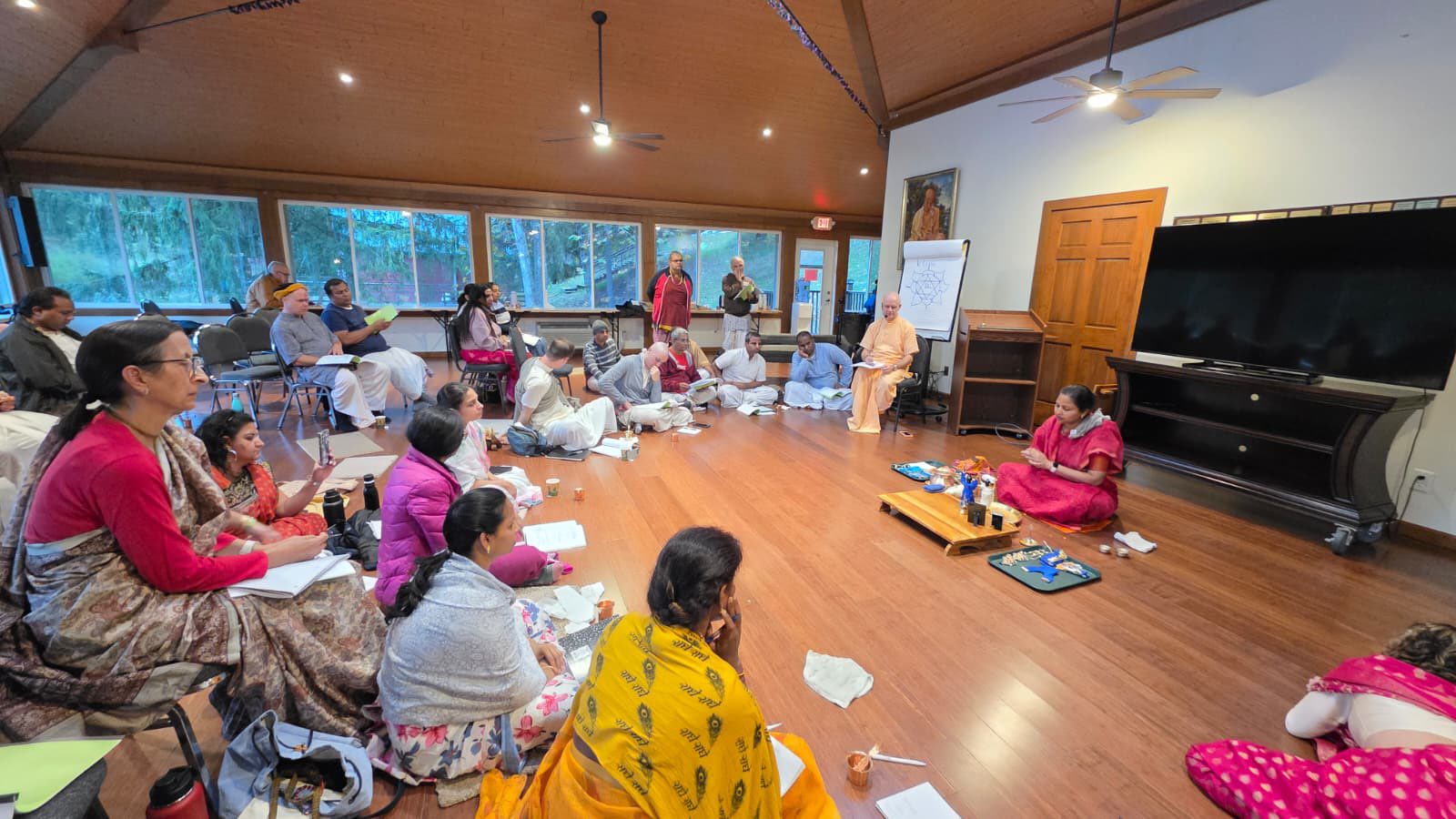
ISKCON New Vrindaban recently hosted a 10-day Deity Worship Course facilitated by Nṛsiṁha Kavaca Dāsa of the ISKCON Deity Worship Ministry (IDWM). He was joined by a skilled teaching team consisting of Murali Manohar from England, Vraj Mohan Das, Rasa Devī Dāsī, and Nāmaruci Das. This year’s participation exceeded expectations, with 37 students registering—nearly double the ministry’s preferred class size. The IDWM typically aims for 26–30 participants, with a minimum of 20, to allow for personal attention and to meet basic financial needs for teachers and administrative support. Students are charged a flat fee to help sustain the ministry, while all other costs are handled separately.
With a desire to support the ministry and enhance Deity worship across North America, ISKCON New Vrindaban offered free accommodation and prasadam to all attendees. Students only covered their transportation and the standard course fee designated for the IDWM. Due to an unusual and unexpected registration glitch, the class size swelled to 37 participants. Rather than causing difficulty, the larger group generated heightened enthusiasm and energy throughout the training.
A Beautiful Setting for Sacred Learning
The course took place in the Yogashala, overlooking Kusum Sarovara, the chattras, and the swans gliding peacefully across the water. Mild autumn weather enriched the experience, although Nṛsiṁha Kavaca, visiting from New Govardhan in Australia, joked that he would have preferred slightly warmer temperatures. Participants represented a wide range of backgrounds, including those not yet initiated, devotees preparing for initiation, newly first-initiated participants, and many second-initiated devotees who had never previously received formal Deity worship training. The teachers created an accessible and enlivening introduction to the sacred art and discipline of Deity worship.


“What Would You Do if Krishna Knocked at Your Door?”
A theme that deeply resonated with students centered on the question: “What would you do if Krishna Himself knocked at your door?” From this inquiry, the course opened into a profound exploration of Vaiṣṇava hospitality and the traditional culture of receiving sacred guests. Scriptures detail the etiquette involved in receiving the Lord, such as offering a seat, washing the feet, providing scented water, offering prayers, giving a refreshing bath, massaging with fragrant oils, and creating a peaceful, worshipful environment with incense, āratis, mantras, and yagyas. These time-honored principles shape the foundation of Deity worship in all ISKCON temples.
The Structure of Worship
Nṛsiṁha Kavaca explained that every act of worship—whether offered to Guru, Śrīla Prabhupāda, or the Deities—follows three essential components: meditation, pūjā, and prayers. The meditation aspect includes contemplating the sacred space and the personality being worshiped. Pūjā involves both mānasa-pūjā, performed within the mind, and bāhya-pūjā, the physical offering. The final section includes prayers, stutis, and pranāmas offered specifically to each deity. Together, these elements create a “sandwich” of worship that is personal, intimate, and spiritually transformative.
Intensity, Discipline, and a Culture of Study
For the full 10 days, students immersed themselves with remarkable intensity. There was no social downtime or distraction. Instead, participants spent every spare moment studying handouts, walking while reciting mantras, practicing Sanskrit terms such as āsanam, svāgatam, and pādyam, forming study circles, and repeatedly reviewing procedures and mantras. Family members remarked on the noticeable changes they saw in their spouses, observing increased discipline, early rising, and constant dedication to study.


Assessments: Thorough and Transformative
Students participated in several assessments throughout the course. Their ācāmana cups were inspected daily, and the challenge was heightened by the use of copper cups, which required extra effort to clean. They completed purification mantra tests and demonstrated their understanding of ingredients used in the Sixteen Upacāras. The final worship exam required each participant to perform a complete pūjā from memory, without using a book, a process that took some devotees up to 1.5 hours. Alongside these practical assessments, the course also prompted deeper reflection on values, ethics, lifestyle purity, and how Deity worship purifies the practitioner internally.
A Lasting Impact
Participants concluded the course with a heightened sense of responsibility, an increased appreciation for Deity worship, and renewed enthusiasm for maintaining devotional integrity. Many felt a stronger personal connection with the Lord. The IDWM team expressed great satisfaction with the experience and announced plans to return in two years for the next training, an opportunity ISKCON New Vrindaban looks forward to hosting again.
Encouragement for All Students
The broader community is encouraged to support and uplift the devotees who completed this rigorous and inspiring course as they deepen their practice of Deity worship and carry these teachings forward.
Deepen your Bhakti-yoga practice, harmonize relationships, and receive guided coaching — all at Vedavarsity.com